
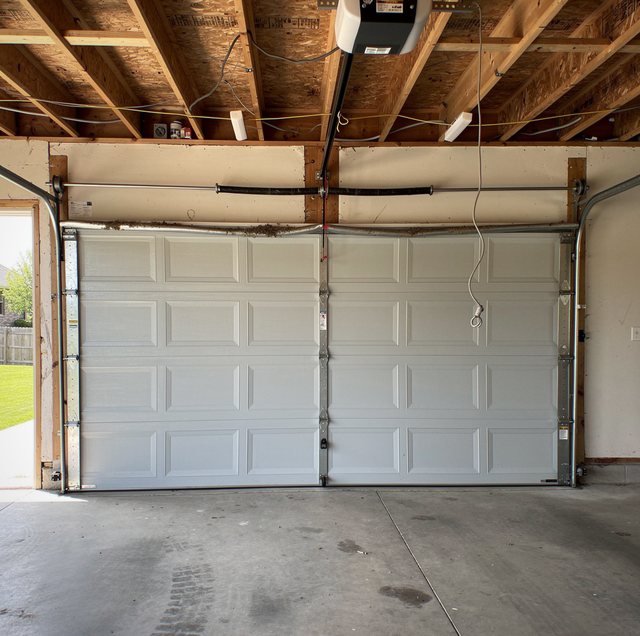
The rail is the straight track running from the motor unit back to the header bracket above the door, and its job is narrow: it guides the trolley and carries whatever push or pull the opener sends down the line. A rail that bows or visibly flexes as the door tries to move indicates that the opener is pushing or pulling against something that will not move freely, and the rail is part of that chain that flexes enough to show it before something else gives.
Where in the door's travel the bow shows up narrows down what is driving it:
| When the Rail Bows | Likely Cause |
|---|---|
| On the first pull up from a closed door | The door is heavier than the springs can carry, so the opener is doing the springs' job from the first inch |
| On the first push down from a fully open door | A door that resists closing because the springs over-carry it, or a sagging hanger or loose header bracket letting the rail move |
| At the same single spot in the travel on each cycle | A roller or a track section catching at one spot |
| Every cycle since a repair or a new opener was installed | Something at the mounting or the connection changed during that work |
| The door feels heavy when a technician lifts it by hand, opener disconnected | A spring that has stopped carrying the door's weight |
A Door Out of Balance and What the Opener Is Asked to Carry
A garage door is supposed to be carried by its springs, with the opener only guiding it and providing the final push. When a spring has lost tension, that balance shifts, and the opener starts doing part of the lifting job for which the springs were sized. Every pound the springs no longer carry has to travel somewhere, and it travels through the trolley into the rail on its way to the motor housing. A rail bowing hardest right at the start of an opening cycle, when a healthy door would still feel light in the hand, is carrying load that belongs to a spring. The opposite imbalance shows up on the way down: springs that over-carry the door hold it up during the closing stroke, so the opener has to drive it down on the first push.
Whether the door itself is too heavy for its springs is settled by the balance check, a separate question from what the rail shows.
An opener working against an unbalanced door does not fail cleanly. It strains on every cycle, and the rail bowing can be the first visible sign of that strain, showing before a motor burns out or a gear strips.
Binding in the Tracks and Rollers
A track or roller that binds at one spot creates the same kind of resistance as a weak spring, concentrated at a single point of the lift. A roller riding rough through a section, or a track pulled slightly out of line, catches the door right there, and the rail downstream of that catch takes the load the opener throws at it as it tries to push through. That is why a bow showing up at the same point in the travel, cycle after cycle, reads as the hardware the door rides on rather than the springs. Confirming and correcting a misaligned track is a controlled, sequenced job that starts with the door secured and never with a wrench on a moving section.
The Top Section and the Opener Arm
The connection between the opener and the door itself sits at a single bracket on the top section, where an arm ties the trolley to the panel. If that top section is flexing under the pull, whether from a reinforcement issue on a wide door or a joint that has started to give, the rail sees resistance the same way it would with a binding track, since the door is still not moving the way the opener expects. Whether a wide top section needs a reinforcing strut is a separate judgment from the rail bow itself, made on its own signs.
The Rail's Own Mounting at the Header and the Ceiling Hangers
A rail can also bow because its own mounting has begun to give way. The rail bolts to a header bracket on the wall above the opening and hangs from a run of ceiling brackets between there and the motor unit. A hanger that has worked loose, or a header bracket sitting on fasteners that no longer bite the way they did when the door was installed, lets the whole rail shift sideways off its line under load, and that shift is what a bow at the mounting end can be. Hanger spacing and how the rail's own weight rides at the ceiling affect noise and vibration, as a separate question from an active bow under load. A rail bowing at its mount can be an earlier stage of the failure that tears a mount out of the ceiling or a top fixture off the door.
Why the Opener Keeps Pushing, and When Reversal Settings Are a Technician's Call
An opener cannot tell a door that is simply heavy from a door that is stuck fast. It reads resistance against the threshold it was set to expect, and until that threshold is crossed, it keeps applying force; that steady force is what a bowing rail shows. Whether that threshold itself needs resetting once the real mechanical cause is fixed is a decision made alongside a simple floor test designed to confirm the door reverses as it should. A rail that visibly strains during that test is one of the things it is built to catch.
A rail bowing on every cycle is absorbing a load it was not designed to carry, and pulling the emergency release with a spring or cable that is already damaged can cause the door to drop onto anyone beneath it. A technician isolates the cause first.
Once a rail is bowing regularly, running the opener again puts the same load on the same weak point. Stop cycling the door and leave it as it is until a technician has seen it. Leave the emergency release cord alone while the door is open or while a spring or cable shows signs of damage, since a door held up only by a compromised spring can drop the moment it is disconnected. Do not adjust springs, cables, or the opener's own force and travel settings, and do not unbolt the rail from the header bracket to inspect it yourself. All of that sits under spring tension, opener wiring, or both.
Frequently Asked Questions
Steel that has visibly bowed under load can take a permanent set, meaning it does not reliably spring back straight even once whatever was loading it is corrected. Once the underlying cause is fixed, a rail left with that set is replaced, since a straightened section may not hold its shape under the next hard pull.
Not automatically, but it gets checked. A trolley riding along a bowed section of rail can bind or drag along that stretch even when the trolley itself is undamaged, since the channel it rides in is no longer perfectly straight. A trolley that drags only through the bent stretch and runs freely on straight rail is reading the rail's shape; one that drags along the whole run has wear of its own.
Yes. Some rails are a single continuous piece, and a bow in that style appears as a single smooth curve along the run. Others are several steel sections joined end to end, and under the same resistance, a step or a small gap can open at one of the joints.
Yes, and this is easy to miss because each cycle looks harmless. A header bracket or a hanger takes a small jolt of extra torque every time the opener pushes against resistance before stopping. That repeated stress can loosen its mounting screws over a series of cycles, even though nothing broke on any single attempt. A mount that has loosened this way is checked and re-secured as part of the same repair.
It can show which stroke is loading it. Pushing the door closed squeezes the rail along its length, and a squeezed rail can buckle upward or sideways across its least-supported span. Pulling the door open draws on the arm, which angles down to the top section, so a heavy start can drag the door end of the rail downward.
No. A support wedged under a bowing rail hides how far it has bent by the time anyone measures it. If the prop touches the trolley's path or the door starts moving against it, the support itself becomes one more thing the opener has to strain against. Leave the rail as it is, stop running the door, and let it be measured before anything is fixed in place.
Secure garage door opener repair with a door balance check — rail alignment, trolley condition, and header mounting. Squared Away Garage Door Service serves Cedar Park and Central Texas. Call (512) 456-3781.