
Emergency Garage Door Repair: What Travels, What Waits
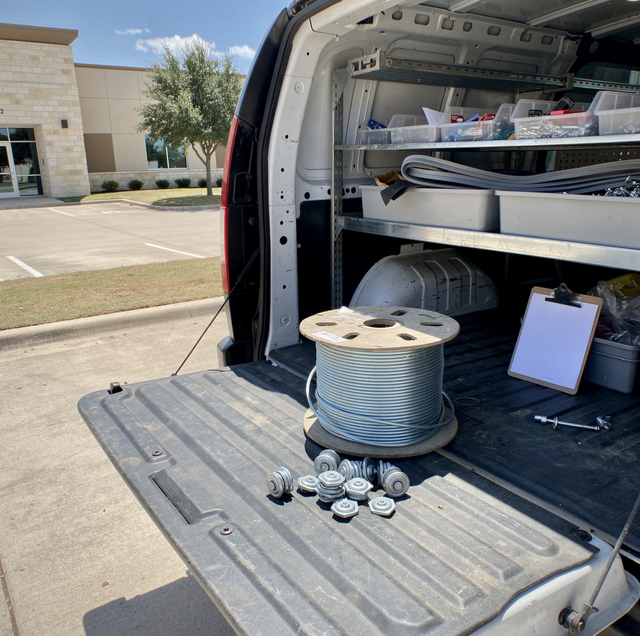
The first question on an after-hours call is what broke, and the answer starts sorting the repair before anyone leaves the shop, because it decides whether the part is already aboard. Racked along the inside wall of a properly stocked service van: a spool of galvanized lift cable, a couple dozen steel rollers with sealed bearings, hinges in a few common gauges, a rack of torsion springs sorted by wire diameter, a box of bottom brackets and end-stile hardware, remotes and keypads still in their static bags, a folded run of vinyl weather seal, and a coil of red release-cord line. Some of that fits almost any door in the service area. Some of what a broken door actually needs isn't on that shelf at all and won't be until it's ordered.
Parts With One Version Almost Always Travel
A roller is a roller. Steel or nylon, the stem length and bearing type are standardized across nearly every residential door built in the last few decades, so a van carrying a working range of both covers the overwhelming majority of calls. Hinges are the same story: a handful of gauges cover light, medium, and heavy sectional doors regardless of manufacturer. Lift cable is sold by diameter and comes in a short list of common lengths that cover most door heights, so a technician trims to fit instead of special-ordering.
Torsion springs look like an exception, because a broken spring feels like the emergency. They behave much more like rollers than a custom part. Springs are specified by wire diameter, coil length, and inside diameter, and manufacturers converge on a limited set of combinations that cover most residential door weights. A technician measures the failed spring's wire with a caliper and counts its coils, matches it against that common range, and exchanges the spring assembly whole, since the stationary cone and the winding cone arrive already fitted to the replacement.
Bottom brackets, standard opener carriage assemblies for a common rail width, weather seal, and remotes and keypads round out the shelf. None of that hardware is tied to one door's paint code or one opener's discontinued firmware.
One caution applies to the release cord no matter how simple it looks: The release cord is safe to use only with the door fully closed and the counterbalance intact, and it is never a way to hold a door open.
Parts With Many Versions Usually Wait
A section is a different kind of part. It's a color, a panel design, a width, a height, and a manufacturer, and all five have to match at once for a replacement to sit flush against the sections on either side of it. A van can't carry every combination of those five variables, so a damaged section on a specific door is usually measured and photographed during the emergency visit, then ordered.
Opener logic boards hit the same wall from a different angle. A board is built for one control platform, and an older one may be paired to a remote-code protocol the manufacturer no longer stocks, so the board and the remotes that talk to it sometimes have to be sourced together. A spring outside the common range, wide-door struts sized for openings the standard stock doesn't cover, and glass inserts cut to one panel's window pattern all share the same shape of problem: each is correct for exactly one door, not a working range of doors.
How Many Variables Have to Match
The line between those two lists is a count. A roller has to match on one variable, its stem length. A hinge has to match on two things: its gauge and its position number, since hinges are numbered by where they sit in the stack of joints, and a #1 will not do a #4's job. A section has to match on five at once, and getting four of the five right still leaves a panel that sits proud of its neighbors or refuses the hinge pattern already on the door. Every variable added multiplies the number of versions that would have to be sitting on a shelf for the right one to be there at eleven at night, which is why the count, more than the bulk or the weight of a part, decides what rides along.
Why Standard Sizing Exists at All
None of this is accidental. Door manufacturers build to a shared set of expectations, roughly the same range of section weights, the same few rail widths, the same stem lengths for rollers, because a supply chain serving thousands of installers works better with fewer variables. That convergence is what makes a stocked van possible at all: it is a bet that most doors calling at eleven at night sit inside the common range. The doors outside it- custom colors, discontinued opener lines, oversized openings- are where the bet stops paying off and a part has to be ordered instead of pulled off a shelf.
What Secured Tonight, Finished When the Part Lands Actually Means
When the part a door needs is not the kind that travels, the visit still does physical work. A section that's cracked or torn loose can often be reinforced with stock hardware so the door stops carrying its load through a split panel. A door that can't be run safely can be brought down, secured in the closed position, and taken out of service until the ordered part arrives, so the opening isn't standing open overnight with the house behind it. Where a door can't be brought down at all, securing the opening itself is its own piece of work, done with materials that ride on the van precisely because they fit any opening.
A spring outside the common range is the plainest example of a part that waits rather than gets improvised. The counterbalance is sized for one specific door, and there is no partial version, so the honest outcome on that call is a door left closed and out of service until the right spring is in hand.
What This Means When You Call
A few details, given up front, sort a repair toward one list or the other: whether the door's color is one the manufacturer still makes or a shade that has been retired, whether any panel carries glass inserts, and whether the opening is wider than standard. Each of those is a variable no van can stock every version of, so each one shifts the odds on its own. If the door still carries its manufacturer label, usually a foil sticker or a stamped plate on the inside of an end stile or the back face of a section, the series and color code printed there settle two of those three at once, and reading them off takes less effort than describing a panel design over the phone.
Frequently Asked Questions
Mostly, but not blindly. Stem length is the variable that matters: residential rollers commonly come in 4-inch and 7-inch stems, and using the wrong one changes how the roller sits in the track's throat, so a technician still checks stem length and bearing type before swapping, even though both are stocked.
It happens on doors that have been through an earlier spring job, and matching the new spring to the failed one would only reproduce the error. The specification for a counterbalance is actually the door's weight, not its width or panel count, and two doors of the same opening size can differ by a hundred pounds or more depending on whether they are single-layer steel, insulated, or carry a solid wood overlay. A door that has run heavy or light since its last spring replacement is the tell, and the correct match is made to the door itself rather than to the part that failed.
Manufacturers periodically retire colors from production, sometimes within a few years of a door's installation, which is separate from a color simply being older. Once a shade is retired, remaining supply comes from existing distributor stock rather than a fresh production run, so the window to get an exact match narrows over time even on a door that isn't old.
Yes. Doors around 16 feet wide commonly use two torsion springs instead of one and a heavier-gauge reinforcing strut across the panel's stiles, which reduces the range of pre-matched combinations a standard van carries for that width compared with a single-car door.
Sometimes. Inserts are held in place by a stop molding that snaps or screws into the panel's window opening, and if that molding profile is common, the insert alone can be swapped. If the molding is specific to a discontinued panel design, the insert and the molding usually have to be ordered as a set.
Whether the opener's receiver still supports the remote's code protocol. Rolling-code receivers built in the last couple of decades can usually be reprogrammed to a new remote in minutes; a receiver tied to an older fixed-code protocol sometimes can't accept a current remote at all, which turns a simple reprogramming task into a parts question.
Schedule an inspection — find out which repairs can be completed in one visit and which require a specially matched part. Squared Away Garage Door Service serves Cedar Park and Central Texas, with stocked vans behind emergency repairs in Pflugerville and a full line of garage door parts and upgrades for everything that has to be matched to your door. Call (512) 456-3781.
