
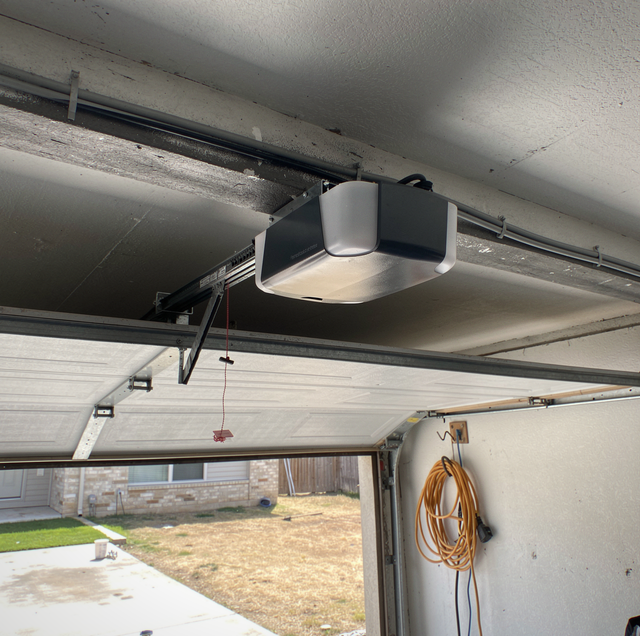
A garage door opener's logic board sits inside the motor housing and works as the switchboard for the whole system. It watches the wall control, listens for whatever comes in over the wireless receiver, keeps an eye on both safety sensors, and combines all of it to decide when the motor runs and where the door's programmed limits sit. Because the wall control, the receiver, and both sensors all route through that one board before anything moves, a fault on the board can show up as something else entirely: a dead remote, a stuck sensor, or a tired motor.
What the Logic Board Controls and Why Its Faults Look Like Something Else
The board has one input wired directly to the wall control, a separate receiver circuit that listens for the remote and keypad, and its own input pins for the two sensor eyes. It tracks the motor's position via revolution counts or an encoder, keeping the door within its travel at every point, and switches power to the motor windings via a relay only after it has determined the door is clear to move. A voltage spike is one way the board can fail outright, and the faults below can also appear without a surge at all.
Because every one of those functions sits on the same board, a failure in one small section can read like a failure in the part on the other end of its wire. Each symptom pairs with the part it gets mistaken for and the board-side cause that produces the same result:
| Symptom | Look-Alike Part | Board-Side Cause |
|---|---|---|
| Door reverses for no clear reason | The safety sensors | A mis-set force or travel-limit setting, or a failed sensor-input pin on the board itself |
| Remotes stop working, wall button still runs the door | Dead batteries or a lost pairing | The board's stored remote-code memory wiped or corrupted |
| Opener runs, then stops partway through the cycle | An obstruction or a bound track | The board's force or current-limit setting cutting power before the door reaches its programmed stop |
| Lights flash, but the door never moves | The safety sensors, or a dead motor | A failed sensor-input on the board, or a relay that never closes to the motor |
| Opener is dead with power confirmed at the outlet | A failed motor | The board's own internal fuse or step-down power supply, which sits ahead of the motor |
Symptoms That Look Like a Sensor Problem
A door that reverses partway through closing is the symptom homeowners send straight to the sensor eyes, and the sensors can be the cause. But the wire from each eye lands on its own input pin on the logic board, and if that pin or the trace feeding it has failed, the door reverses the same way it would with a broken beam, even with both eyes clean, aligned, and reporting a good signal on their own terminals. A steady, aligned pair of sensor eyes rules out alignment and the eyes themselves; it does not rule out the input on the board they report to.
The other board-side cause is a stored setting rather than a failed part. The board's force and travel settings judge the door against the resistance it had when they were set; a travel limit set past the floor, or a force setting left too low for a door whose resistance has since changed, reverses the door at the same point every cycle, not wherever an object happens to be sitting, which is what tells the setting problem apart from a beam problem, even though the two can look identical from the driveway.
Symptoms That Look Like a Remote or Keypad Problem
A remote that quits while the wall button still opens the door is the textbook case for a dead battery, and checking that battery first is always worth the thirty seconds. If a fresh battery changes nothing, and the keypad has also gone silent at the same time, the fault sits on the shared wireless side: the board's stored codes, the receiver itself, or interference at the receiver, rather than two coincidental battery failures.
The wall button is wired directly into its own terminal on the board, entirely separate from the wireless receiver circuit that handles remotes and keypads. That separation is why the wall button keeps working normally even when every wireless code on the board has been wiped: the fault sits in one section of the board's memory, not in the board's ability to run the motor at all.
Symptoms That Look Like a Motor or Gear Problem
An opener that gives you nothing at all, no light and no sound, with power confirmed at the outlet, looks like a dead motor. Some logic boards carry an internal fuse or a small onboard stage that steps household current down to the low voltage the board's electronics run on, and either one failing cuts power before it ever reaches the motor, leaving a motor, gears, and drive line that are all completely fine sitting behind a board that never lets them see a volt.
Flashing lights with a still door can be the sensor signal or a relay on the board that never closes; which one it is belongs to a check at the opener. An opener that runs partway and stops can trace to the same family of causes: the board's force or current-limit setting cutting power mid-cycle to protect the motor, which halts the door at the same point a physically jammed track would, without anything blocking it. A motor that hums steadily without moving the door at all rules out the board and points to a mechanical block or a weak capacitor, since a humming motor is proof the board is already sending it power successfully.
How a Technician Rules Out the Others First
The safe first step is always the same: unplug the opener before opening its cover, since the board carries line voltage on one side even when the motor itself is off. With the cover off, the technician restores power only for the live checks, and power at the board comes first: a board showing no power at all narrows it to the fuse or the power supply and skips every other check. The wall button and the wireless side are tested separately, because a fault that follows only the wireless path narrows the search to the receiver's memory rather than the board as a whole. And a reversing door is tracked over a few cycles to see whether it stops in the same spot each time or somewhere different depending on what's in the way, since a fixed point implies a stored setting or a fixed bind or balance problem, and a moving one implies the sensors.
When the door lifts easily under its own springs, but nothing happens at the button, the fault sits in the opener path, not the counterbalance, and the board is only one of several parts along that path worth checking.
A logic board fault can disable the door's automatic reversal without any visible warning sign. Never bypass or tape over the safety sensors, and leave a door that won't reverse against resistance out of use until a technician checks the board.
Once the board is confirmed as the part that failed, whether it makes more sense to replace just that board or the whole opener is a decision in its own right, one that depends on more than the diagnosis alone.
Frequently Asked Questions
Yes. A thermal cutout, in the motor on some openers and on the board's output on others, opens after heavy cycling and makes a sound motor look dead from the button; it resets once it cools, which a failed motor does not.
No. On an opener that stores its limits electronically, the travel limits, force setting, and every stored remote and keypad code live in the old board's memory, so a new board starts blank: the travel and force need to be set again, and each remote and keypad has to be re-paired before they will work, even though nothing else about the opener changed.
Not on its own. A keypad carries its own battery, its own key contacts, and its own pairing, and it is the one control mounted outdoors, so a keypad that fails while every remote keeps working has a fault confined to that one device. A fresh battery comes first, then a re-pair from the opener's learn button.
Yes. A board with a marginal solder joint or a hairline crack in a circuit trace can test fine with the trolley disconnected and the motor running free, but then fault once the motor draws full current while lifting the door, which is why some board faults show up only after the door is reconnected and the board is run under load.
Yes. The board stores separate limit points for fully open and fully closed, so a single corrupted or mis-set limit can affect only one direction: the door might close normally every time but stop short on the way up, or the reverse, while the working direction continues to behave normally. That split is a sign of a stored limit rather than a fault that would affect the motor or sensors equally in both directions.
A relay welded closed keeps the motor powered after the board has told it to stop, so the door runs past its limit or starts with no command, while a switch or connection stuck open gives no response at the button. Unwanted motor running is the relay's signature; total silence belongs to a different fault on the board.
Arrange a garage door opener repair — the board is tested against the motor, sensors, and remote memory to identify the faulty part. Squared Away Garage Door Service serves Cedar Park and Central Texas. Call (512) 456-3781.