
A sectional garage door moves as a run of stiff panels connected by hinges that let each section pivot on its own as the door swings from a floor-to-ceiling path into an overhead one. Every hinge on the door does the same basic job, joining two sections and letting them articulate, but not every hinge does that job at the same angle or under the same load. That difference is why a hinge pulled from mid-door and one pulled from a joint near the top do not look alike, and why swapping them without checking the stamped number undoes the design that keeps the door tracking smoothly.
| Hinge Position | What It Does |
|---|---|
| Center hinges | Join sections across the middle of a wide door; carry no roller, and are stamped #1 at every joint |
| End / graduated hinges | Carry the roller stem at the edge of each joint; the stamped number sets how far that roller sits from the panel face |
| Top fixture | The adjustable bracket holding the top roller; not part of the numbered hinge set |
| Double-end hinges | A second roller-carrying hinge added at one joint on a wide or heavy door, splitting the load a single end hinge would otherwise carry alone |
What the Stamped Number Means
End hinges on a sectional door are stamped with a number, and the numbering starts at the bottom joint and climbs toward the top, so the #1 hinge sits nearest the floor and the highest number sits nearest the header. That number sets the roller offset, meaning how far the roller stem projects from the hinge leaf and, in turn, how far that roller sits from the panel face once it is bolted on. The offset has to change gradually from joint to joint because the door's path itself changes shape partway up: standing tall near the floor, then sweeping over into a run tucked along the ceiling. A roller riding a fixed distance from the panel at every joint would either bind around that curve or scrape hardware against the jamb as it passed it. Graduated hinges solve that by shifting the roller's position slightly at each joint, so the whole assembly of panel faces and roller stems traces the curve rather than fighting it.
Put the wrong numbered hinge at a joint, and the door can still close, at least for a while, because the mismatch is a fraction of an inch rather than a jam. What changes is how squarely that one roller rides in the track. A roller sitting slightly off from where its joint was designed to put it wears unevenly against the track wall and puts a side load on the hinge holding it, which is why a single mismatched hinge, ordered by gauge but not by number, can show wear at that one joint while the other joints run clean.
Center Hinges vs. End Hinges
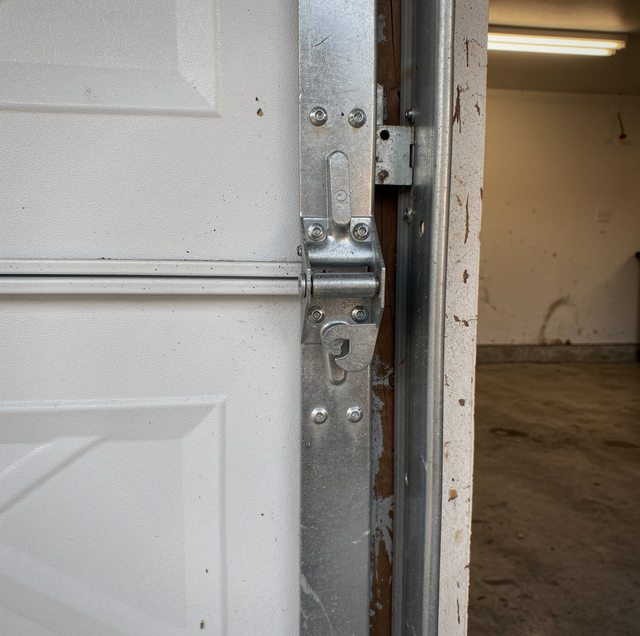
Center hinges and end hinges look similar from across the garage, but they carry different jobs. A center hinge sits at the midpoint of a joint on a wide door and does nothing but allow the two sections to pivot relative to each other; it never touches a roller or a track, so it experiences the least side load of any hinge on the door. An end hinge sits at the edge of the same joint, at the end stile, and carries the roller stem that runs in the vertical track. That roller pushes back against the track wall on every cycle, so an end hinge works against a load a center hinge never sees.
Center hinges carry a stamped number too, but it does not graduate: on a standard residential door, every center hinge is a #1, because it carries no roller and its geometry stays the same from joint to joint. Mixing that up when ordering, treating a center hinge as if it needed the joint's graduated number, or bolting a #1 in place of a higher-numbered end hinge, is a way a repair goes wrong before a technician ever gets involved.
Signs a Hinge Is Failing
A hinge, under normal load, flexes by the same small amount each cycle and returns to its resting shape. A few signs mean that is no longer happening.
A crack across the leaf, starting at the knuckle where the pin passes through and the metal flexes on every cycle, is the clearest sign. A bent leaf is the same problem without a visible break: the hinge has lost its flat seat against the panel, which shifts how far the roller reaches into the track even though the hinge itself has not broken yet. Loose or stripped screws show up after thousands of open-close cycles work a fastener back out of the panel steel it threads into, and once a hole strips, the next screw driven into it does not bite the way the first one did. Pulled fasteners take that further: the mounting holes elongate with repeated flexing until the hinge itself starts to shift against the panel rather than stay fixed.
Moisture adds a second way for a hinge to reach that point. In high humidity, rust forms at the knuckle and around the fastener holes, and rust between the pin and the knuckle stiffens the pivot, so a rusted hinge gets checked for a crack and for loose fasteners, not just lubricated. Where the air stays dry, rust stays light, and a crack or a stripped hole there comes from cycling alone. Either way, a crack does not close on its own; it keeps growing while the door keeps cycling over it.
A hinge with a visible crack across the leaf can let go without warning as the door cycles. Stop using the opener until a technician has replaced the hinge and checked the surrounding hardware.
Wide and Heavy Doors
A wider door puts a longer, heavier section on the same two end hinges a narrower door would use at that joint, and an insulated or custom-material door adds weight on top of that. Both push more shear load through the end hinge at each joint than a standard single door ever sees. Rather than asking one hinge to carry that whole load, a double-wide or heavy door can add a second, closely spaced hinge at the same joint edge, so the roller load and the shear from panel weight split across two hinges instead of concentrating on one.
That second hinge follows the same numbering: it is graduated to the same joint's roller offset, just doubled up to share the load. A technician replacing hardware on a wide or heavy door checks for this pairing specifically, since a double-end joint repaired with only a single hinge leaves one hinge carrying the share meant for two, even if the replacement hinge itself is the correct number.
Replacing a Hinge
The hinges on a garage door carry no cable tension of their own; that load is carried by the shaft, the drums, and the cables instead. Even so, replacing a hinge is still technician work, because a joint has to be supported correctly while the old hinge comes off, and a hinge near the bottom corner sits close enough to the bottom bracket, a separate part that stays under real spring tension with the door closed, that a technician working there stays deliberate about what else is loaded nearby. Never loosen a bolt on the bottom bracket: its fasteners hold the lift cable under full spring tension while the door sits closed.
A proper replacement starts with matching the new hinge to the old one by number and by gauge, since a lighter hinge bolted in place of a heavier one reintroduces the same offset and load problems a mismatched part causes anywhere else on the door. The technician also checks the screws or bolts at the joint, since a hinge that failed due to stripped fasteners may mean the mounting holes in the steel panel need more than a fresh screw of the same size. Once the new hinge is torqued down, the joint gets cycled and watched, confirming the roller rides square in the track before moving to the next one.
Frequently Asked Questions
Not reliably. Hinges are stamped from different gauges of steel depending on the weight of the door they are built for, and the bolt-hole spacing on a heavier-duty hinge may not line up with that of a lighter one. A hinge pulled from a light aluminum door and bolted onto a heavier insulated steel door may fit the joint but carry less load than the joint imposes.
No. Use adds cycles, but neglect adds wear to each one. A dry pivot wears the pin and the knuckle against each other on every cycle, while a lubricated pivot turns on a film instead, so a little-used but neglected hinge is not automatically the safer one.
No. A squeak comes from metal-on-metal contact at the pivot, and a crack is a break in the steel. Lubricant quiets the first and does nothing for the second, and a hinge can squeak and be cracked at once, so a noisy joint still gets a look along the leaf before it is sprayed.
It depends on the hinge. Some end hinges are stamped as a one-piece unit that includes the roller stem socket built into the leaf, while others use a separate roller carrier bolted to the hinge leaf as a small bracket. A technician ordering a replacement checks which design the door uses, since a one-piece hinge and a hinge-plus-carrier setup are not interchangeable parts.
Residential hinges come in 14-gauge steel, while heavy or commercial doors use 11-gauge steel, which is thicker since a lower gauge number means thicker steel.
Not automatically. A single cracked or bent hinge can be replaced on its own with the same number and gauge. The technician checks the hinges at the joints above and below it for the same crack or elongated holes, since every hinge on a door shares its cycle count.
Reserve a hinge and hardware replacement visit — a technician matches each hinge by number and gauge and checks the fasteners and bottom corners around it. Squared Away Garage Door Service serves Cedar Park and Central Texas. Call (512) 456-3781.
