

Garage Door Spring Replacement: What Really Happens
The bang is unmistakable, loud enough that people sometimes call it in as a possible gunshot before realizing it came from the garage. A torsion spring snapping under tension makes a sound out of proportion to its size, and once it happens, the door goes from something you barely think about to something that won't budge, or worse, comes crashing down if you try to force it. Knowing what actually happens during a professional spring replacement helps explain why this repair isn't worth attempting solo.
What the Spring Is Actually Doing
A garage door, even a lightweight aluminum one, typically weighs somewhere between 130 and 400 pounds depending on size and material. Lifting that by hand every time would be impractical, so torsion springs mounted on a shaft above the door do the work instead, storing rotational energy when the door closes and releasing it to help lift the door back open. The spring is wound to a specific number of turns calculated from the door's weight, the drum size, and the spring's wire gauge and length; get any of those numbers wrong and the door will either be too heavy for the opener to handle smoothly or will slam open too fast.
Extension springs, mounted alongside the horizontal tracks rather than on a shaft, do the same job differently: they stretch as the door closes and pull back to help lift it open. Both types wear out through the same basic mechanism, metal fatigue from repeated flexing, but torsion springs are more common on newer installations because they distribute the load more evenly and are generally considered safer once properly installed.
Why Springs Fail
Most residential torsion springs are rated for a specific number of cycles, commonly around 10,000, where one cycle is a full open-and-close. On an average household door used a handful of times a day, that translates to roughly seven to ten years of service. Homes where the garage is the primary entry point, with a dozen or more cycles a day, burn through that cycle rating faster, sometimes cutting the useful life in half.
Metal fatigue is the main driver, but a few things accelerate it. High humidity promotes surface rust on the spring coils, creating weak points that crack under tension more quickly than a clean spring would. Extreme heat over a garage's lifetime also affects the spring's temper slightly, changing how it flexes over thousands of cycles. And a door that's out of balance for any reason, whether from a worn cable or a shifted track, forces the spring to work harder than its rated load on every cycle, shortening its life regardless of how many cycles it's actually seen.
Before the Technician Touches Anything
A spring visit starts with identifying exactly what's installed: torsion or extension, single spring or a pair, and the spring's wire diameter, coil diameter, and length, usually read off the spring itself or measured directly if the original spring is too degraded to read clearly. This matters because installing a spring rated for the wrong door weight is one of the most common sources of ongoing opener problems; a spring that's slightly undersized leaves the opener straining on every cycle, while an oversized spring can make the door lift too aggressively and slam into the header at the top of its travel.
The technician also checks the drums, cables, and the center bracket that anchors the torsion springs to the shaft, since a broken spring under sudden load can stress these components too, even if they look fine at a glance.
Releasing and Replacing the Spring
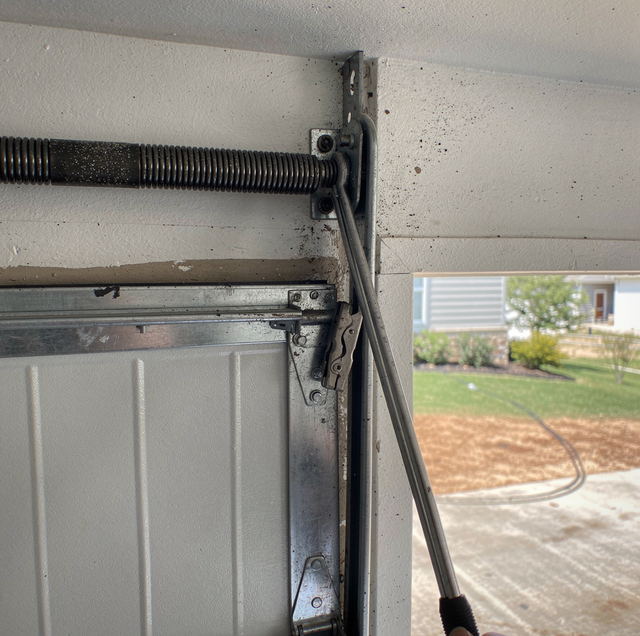
This is the part that makes spring work truly dangerous to attempt without training. A wound torsion spring stores enough energy to cause serious injury or worse if it's released uncontrolled, which is why technicians use a set of solid steel winding bars, sized specifically to the spring's winding cone, to release tension in controlled quarter-turn increments rather than all at once. The door is typically clamped in place with locking pliers on the track first, so it can't shift or fall while the spring is disconnected.
Once tension is fully released, the old spring (or springs, since both are typically replaced together even if only one failed) is slid off the shaft, and the new spring is installed in its place, matched to the door's weight rating rather than simply matching what was there before if the original spec turns out to have been wrong. The spring is then wound back up using the same winding bars, counting quarter-turns precisely to the manufacturer's specification for that spring and door combination.
Why Both Springs Get Replaced Together
On a two-spring setup, replacing only the broken spring and leaving the other one in place is a common shortcut that tends to backfire within a year or two. Both springs are installed at the same time and see roughly the same cycle count, so a spring that hasn't failed yet is usually close behind the one that did. Beyond the near-term failure risk, an old spring paired with a new one rarely matches in tension exactly, which puts uneven load on the door and can throw off the balance test that follows installation.
The Balance Test That Follows
After the new spring (or springs) is installed and wound to spec, the technician disconnects the opener from the door and lifts it by hand to roughly waist height, then lets go. A properly balanced door should stay in place, neither sliding closed under its own weight nor continuing to rise. If it drifts either direction, the spring tension gets adjusted in small increments until the door holds steady at multiple points along its travel, not just one. This test matters because a technically "replaced" spring that's improperly balanced puts ongoing strain on the opener motor, even after the loud-bang problem is solved.
What Extends a Spring's Life Afterward
Once a new spring is in, a light coat of a silicone-based lubricant on the coils, applied every six months or so, reduces the friction between coils that contributes to metal fatigue over time. Standard grease or oil-based lubricants tend to attract dust and grit, which can actually accelerate wear rather than reduce it, so the type of lubricant matters more than the frequency. Keeping the door's overall balance in check, addressing a worn roller or a slightly misaligned track promptly rather than letting the door strain against it, also keeps unnecessary load off the new spring.
Frequently Asked Questions
There's no single number that applies across doors. The correct turn count is calculated from that specific spring's wire gauge, coil diameter, and length together with the door's weight, not read off a general chart, and it's part of why this isn't a job to eyeball. Being off by even a small amount in either direction is enough to leave the door noticeably too heavy or too light for the opener, and getting it right depends on having the spring's exact specifications along with the winding bars and training to count the turns safely under load.
A single-spring system (common on lighter or older doors) places the door's entire counterbalance load on a single component, so if it fails, the door has no assistance rather than partial assistance from a second spring. Two-spring systems, standard on most double-car doors, offer some redundancy: a second spring remains under partial tension if one lets go, though the door will still be noticeably unbalanced.
No. Torsion and extension springs are single-use components once they've fractured or lost significant tension; there's no practical way to weld, patch, or re-temper a spring back to its rated strength. Once a spring shows cracking, rust-through, or has actually snapped, replacement is the only option.
An undersized spring causes the opener motor to work extra hard on every cycle, accelerating wear on the drive gear, belt, or chain, while an oversized spring makes the door rise too fast and slam against the header. The tricky part is that neither mistake is always obvious right away: a slightly undersized spring can feel fine at the wall switch for weeks before the added strain shows up as a burnt-out motor, which is why the balance test done at the end of installation, not just how the door looks going up and down that day, is what actually confirms the spring was sized correctly.
A visual check every few months for rust forming on the coils or gaps opening up between coils under tension can catch a spring nearing the end of its life before it fails outright. A spring that looks visibly stretched or rusted, or makes an audible squeak during operation, is worth having inspected rather than waiting for the bang.
Metal fatigue builds up internally within the coil structure and doesn't always show visible signs on the outer surface until the point of failure. A spring can look clean externally right up until a hairline crack, invisible without disassembly, finally propagates through the coil under normal tension.
A spring replacement is one of the few repairs where the process matters as much as the part itself. Getting the tension, winding count, and balance test right determines whether the door works quietly for another decade or starts giving trouble again within months.
Schedule a spring inspection or replacement — same-day service available. Squared Away Garage Door Service serves Cedar Park and Central Texas. Call (512) 456-3781.
