

Can You Replace Just One Garage Door Spring? When It Makes Sense
Quick Answer: no quick answer exists in source; this box has been removed per instructions.
The bang went off around 6:40 in the morning, and the dog still hasn't come out from under the bed. In the garage, nothing looks dramatic. One of the two springs on the steel tube above the door has a finger-wide gap in it, coils splayed and dull on either side of the break, and the spring beside it looks untouched.
A technician looks at the shaft and says both springs should come off. The question forms before he finishes: the other one is obviously still working, so why is it going in the truck too? Replacing both is usually right; occasionally it isn't, and the difference has almost nothing to do with how the surviving spring looks.
Two Torsion Springs Are One Power Source With Two Inputs
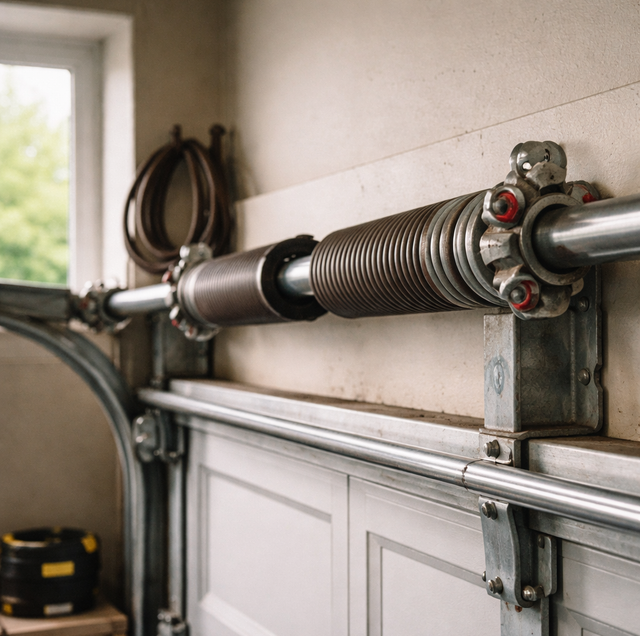
Above the opening runs a steel shaft, an inch or an inch and a quarter across on most residential doors, carried by an end bearing plate at each side and a center bearing in the middle. A cable drum locks to each end with set screws, and a lift cable runs from each drum down to the bottom bracket on its side of the door. The springs ride the same shaft: stationary cones bolted to a center bracket over the opening, winding cones facing outward, where a technician winds them with bars and locks them down.
Each spring is defined by four numbers: wire diameter, inside coil diameter, overall length, and wind direction. Torque climbs steeply with wire diameter, roughly to the fourth power, and falls as inside diameter and coil count grow. Two springs can look identical on the shaft and sit several thousandths apart in wire size, which makes them different parts with different ratings.
The piece homeowners rarely get told is this: because both drums are keyed to one shaft, the springs are not each responsible for their own side of the door. Their torque adds on that tube, and the tube hands the sum to both cables at once. They are one counterbalance with two inputs, wound in opposite directions so both push the shaft the same way.
What an Unequal Pair Does to the Door, and What It Does Not
Start with what it does not do. An unequal torsion pair does not make the door lift crooked. Both cables come off drums locked to the same tube, so they wind at the same rate no matter which spring contributes more. A door hanging cockeyed is telling you something else: a cable off its drum, a drum whose set screws slipped, or a bottom bracket pulling loose.
What it does is under-counterbalance the whole door, unevenly through the travel. With the door closed, the springs sit fully wound at maximum torque, which is also the moment the door's entire weight hangs on the cables. As the door rises, sections roll onto the horizontal track and cable load drops while the springs unwind and shed torque at a matching rate. Two falling curves tracking each other is the trick of a counterbalance system.
A weak spring drags that curve down along its length, and the shortfall bites hardest where demand is highest: the first foot or two off the floor. The door feels acceptable at chest height and dead heavy near the concrete, and the opener grinds at the start of the lift. With the door fully closed, pull the emergency release, lift by hand to waist height, and let go. A balanced door drifts no more than a few inches; a door short on torque sinks. Never pull that release with the door partly or fully open, because a door short on counterbalance can come down hard.
The Spring That Didn't Break Is Not the New One
Fatigue in a torsion spring is a stress story, not a calendar story. Each cycle winds the wire tighter and lets it back out, and the highest stress sits on the inner surface of the coil. A crack starts there and grows on each cycle, and the spring holds full tension right up until it doesn't. Two springs installed the same day on the same shaft have taken the same winds, in the same air, on the same door.
A paperclip bent back and forth lets go at one leg first. The leg still attached is not new. It is next.
Two things make the survivor's odds worse than an even split. At the instant its twin let go, the stored torque on that side vanished, and the full counterbalance demand landed on the remaining spring in one step, along with a shock through the shaft, drums, and cables. And in humid air, the corrosion that pitted the broken coil has been working on the survivor at the same rate. A garage used as the household's main door sees four to eight round trips on a busy weekday, so both springs run out the same clock together.
Nothing on an installed torsion spring says how much life is left: no wear indicator, no measurable stretch, no gauge. Coil gaps at rest, pitting, and orange dust on the concrete are hints, not numbers. That unmeasurability is the real argument for replacing the pair.
Where the Missing Torque Gets Paid For
Something has to make up the difference, and on a door running one new spring beside one tired one, it's the opener. Openers hold or learn a force limit, and a heavier door pushes that setting up. The parts that absorb it are specific: the nylon drive gear in the motor housing, the trolley and carriage, the chain or belt, and the sprocket. That force limit also exists so the door stops and reverses when it meets resistance, and a door the springs no longer hold up narrows the margin that safety function works inside.
Shaft hardware pays too. With torque arriving from one working input instead of two, the tube twists more along its length and the center bearing carries a more lopsided load than the layout intends. A door that lands hard leaves its cables slack at the bottom, which is how a cable jumps the drum groove and the door ends up crooked in the opening for real.
One more failure mode is worth naming. Faced with a shortfall, someone adds turns to the new spring to make the door feel right. Winding past the count that spring's geometry calls for raises its working stress on every cycle, and the part bought to last longer becomes the one that breaks first.
Three Cases Where Replacing One Spring Holds Up
A door that only ever had one spring: plenty of lighter single-car and non-insulated doors run one torsion spring sized for the whole door. There's no pair to match, so you replace what broke. Ask about converting to two while the shaft is apart: the same total torque split across springs at opposite ends reduces the twist the tube carries and leaves partial counterbalance if one ever breaks.
A recent install with a date somebody can verify: if a shop put in a matched pair eighteen months ago and one failed, the survivor hasn't logged the cycles that would put it near its own limit. Verify against the invoice, or a date written on the spring or the jamb, then rule out a sizing error, because if that pair was too light for the door, both springs were too light and calendar age isn't the issue.
Damage instead of fatigue: a spring that came apart because a winding cone's set screws backed out and the cone spun, or because a cable came off and whipped it, failed from an event rather than from cycles. Its twin's fatigue clock is untouched by whatever happened next door, and service history establishes that, not a visual pass.
Extension Springs Are a Different Question
Doors with springs stretched along the horizontal tracks work on different geometry. Each spring pulls through its own pulley and lift cable to the bottom bracket on its own side, with no shared shaft. They really do each carry their own half of the door, which is why a snapped extension spring pulls the door visibly crooked and binds it in the tracks, while a snapped torsion spring leaves it hanging level and simply too heavy to lift.
That independence cuts both ways. An unequal extension pair produces a real side-to-side difference in lift, so matching matters at least as much. But an extension spring can be measured and a torsion spring cannot. At rest, a healthy one's coils sit closed against each other under preload; one that has taken a set is longer relaxed and shows daylight between coils. Compare the survivor's relaxed length against its new mate, check the end hooks and eyelets for opening or wear, and look over the pulleys and the safety cable threaded through each spring, which is what keeps a broken one from leaving the track.
If the survivor's relaxed length matches the replacement, its hooks are tight, and its coils are clean, replacing only the broken spring is defensible on an extension system in a way it never is on a torsion pair. Match by rated pull, color coded on the spring, never by eye: two of the same length can be rated well apart.
What Should Be Measured Before Anyone Answers
Wire diameter comes from laying a caliper or tape along twenty coils and dividing by twenty, which resolves the wire size to the thousandth and, with inside diameter and length, gives the spring's real rating. Wind direction gets confirmed at the cone, where the industry convention colors right-wound and left-wound springs differently. Door weight gets weighed, springs unwound, and a scale under the door, because an insulation kit, a replaced wood section, or an added strut can push a door past what the original springs were sized to hold.
Then the survivor's coils, the shaft for scoring and set-screw marks, the cables at the bottom bracket, and the balance point at the floor, the midpoint, and near the top. A shop that answers "both, always" without touching any of it is reciting a rule, and so is a shop that swaps only the broken spring without weighing the door.
Frequently Asked Questions
Better not to. Residential sectional doors run into the low hundreds of pounds, more with insulated or wood sections, and an opener's maximum door weight rating assumes a working counterbalance. Running on one spring sends that weight through the drive train and leaves the cables slack at the bottom of every cycle. If you must move a car, do it once, with nobody underneath.
Stand inside with the door closed and look at the header. A torsion setup has a steel shaft spanning the opening with a drum at each end, and two springs meet at a center bracket in the middle, winding cones pointing out toward the sides. One spring on that shaft, often off to one side, is a single-spring system. No shaft at all, with long springs running back along the horizontal tracks, means extension springs.
It can be adjusted, and there is a ceiling it cannot be adjusted past. Every opener carries a maximum door weight in its own specifications, and the force settings only move effort around inside that envelope; they do not raise the number. Manufacturer instructions also call for the reversal test to be repeated after any force change, and a door short on counterbalance will not reliably pass it, which leaves the homeowner choosing between a door that fails its own safety check and backing the setting off again.
Not necessarily, and two substitutions are routine. A different inside diameter paired with a matching change in wire size and length reaches the same torque per turn, which is how a supplier fills an order when the exact original is not on the shelf. A longer spring in heavier wire reaches that same torque at lower stress per cycle, which is the entire mechanism behind a cycle upgrade. What cannot be substituted is wind direction. And the torque target itself gets re-derived rather than copied, since the number stamped on a cone describes the spring somebody chose last time, not the door standing in front of you.
A spring swap is the only time the counterbalance is accessible with the door de-tensioned, so it's the moment for parts nobody can touch safely otherwise. The center bearing and both end bearing plates get spun by hand for roughness, the drums get checked for groove wear and set-screw bite, and the cables get inspected at the bottom bracket, where fraying starts because that's where they take the sharpest bend.
Yes, and it changes what is safe to do next. A torsion spring sits at its lowest torque with the door fully open, so a break at that point can pass for a loud bang with nothing visibly wrong: the door is resting on its horizontal tracks and stays up. The energy shows up on the way down. With little or no counterbalance left, that first close can run away over the last few feet and land hard enough to bend the bottom section or throw both cables off their drums. A door that broke a spring while open is better left open until someone with winding bars is standing there, inconvenient as that is.
Nobody can look at a coil of steel and see how many cycles are left in it, which is why this answer splits by system rather than by shop. On a torsion pair, the survivor's remaining life is unknowable, and replacing it hedges against something nobody can measure. On an extension setup, a tape measure and a look at the hooks can settle it. Ask which system you have, what the door weighed, and what the surviving spring measured.
Get the surviving spring checked before you decide — a technician weighs the door, measures both springs, and shows you what the numbers say. Squared Away Garage Door Service serves Cedar Park and Central Texas, and those measurements are what size up a spring replacement in Round Rock or torsion spring work in Hutto alike. Call (512) 456-3781.
