

Garage Door Center Bearing Broken: The Screech Before Failure
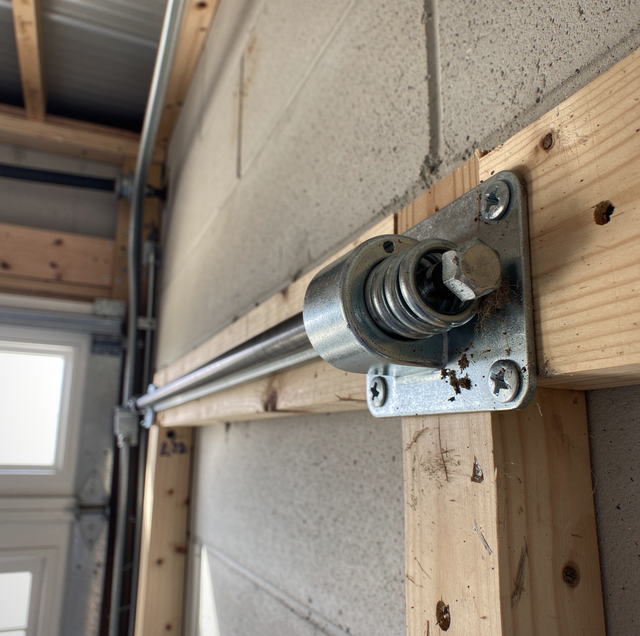
Above the opening, running the full width of the door, is a steel tube. It carries the torsion springs that make a heavy sectional door feel almost weightless as it goes up. Follow it in from either end, and you reach a stamped steel plate bolted flat to the wall, a spring sitting on each side. That is the center bearing plate. If the screech you are hearing comes from the middle of the header, rises as the door moves, and stops when the door does, that plate is where the sound is made.
Quick Answer: The center bearing plate anchors the torsion springs and supports the shaft at its midpoint. A rising screech or grinding from the middle of the header usually means its bearing is drying out or its fasteners are working loose.
What the Center Bearing Plate Actually Holds
The plate does two jobs at once, and they load it in different directions.
The first is anchoring. Each spring has a stationary cone at its inner end that bolts directly to the plate. All the torque the springs hold is reacted through those bolts into the plate, its fasteners, and the framing behind the wall. Nothing else holds that end still.
The second is support. The shaft passes through a collar in the middle of the plate. A bearing in that collar carries the weight of the shaft and springs at midspan, and holds the shaft straight against the bending the drum loads at each end would otherwise put into it. A typical two-spring torsion door rests its shaft on three points: an end bearing plate at each side and this one in the middle.
Behind the plate is framing, not drywall, usually lag screws into a header board across the top of the opening. Whether that board is sound decides how much spring load the wall can hold.
The Bearing Race Inside the Plate
Inside the collar sits either a ball bearing or a sleeve bushing, and which one you have changes how the part announces itself.
A ball bearing has an inner race turning with the shaft, an outer race that stays with the plate, and balls held apart by a cage, packed with grease behind a shield or seal. Manufacturers commonly describe these as sealed or lubricated for life. That phrase describes a design target. Seals are thin, garages are dusty, and the shaft turns under full load on every cycle, so a bearing in service often reaches the end of its useful life well before the label would suggest.
The lighter alternative is a nylon sleeve bushing, common on entry-level builds. No balls, no cage, no grease pack; the shaft rides directly on the sleeve.
Both wear. Sustained heat thins whatever grease remains and helps it migrate out of the race, while humid air reaches a seal hardened with age. A garage used as the household's main door racks up cycles fast, each one turning that shaft under the stored load of the springs.
Why the Noise Arrives Before Anything Drops
Two things go wrong at this plate, and they sound different.
The first is the bearing running dry. Grease thins, migrates, and no longer returns to the contact surfaces. The races touch through a film that is no longer there, and you get a bright screech that tracks the door exactly, starting when the door starts and stopping dead when it stops. Left alone, the tone coarsens, and pitting on the raceways turns it into a grinding you can feel with a hand on the framing nearby.
The second is the fastening letting go. Every cycle swings the load on that bracket between its maximum with the door down and its minimum with the door up, and that fluctuating load is what loosens fasteners. Lag screws back out of the header a fraction at a time, or the wood crushes around the shanks until the holes go oversize. The plate then rocks against the wall under load, which reads as a knock or low groan at one point in travel.
That second failure leaves a visible sign: steel working against steel or wood under load sheds fine rust-colored powder. A reddish-brown streak on the wall below the bracket, or a rim around a lag head, means something up there has been moving that should not be.
What Happens to the Shaft and the Cable Wrap
The shaft is long and comparatively slender, and stays straight only because those three points hold it straight. Take the middle one away, because the bearing has worn oval or the plate no longer sits tight to the wall, and the shaft sags at midspan.
That sag does not stay in the middle. The shaft runs continuously out to a cable drum at each end, so a change at the center affects the angle each drum presents its cable at. The cables sit in helical grooves on those drums and stay seated only at the right angle under consistent tension.
What you see from inside the garage is a door lifting crooked. One bottom corner leads the other by an inch, then by more, and a roller starts binding in its track on the lagging side, adding its own scraping noise. The cable on one drum picks up slack, and slack is how a cable crowds out of its groove, wraps over itself, or leaves the drum completely.
A door that lifts crooked or shows slack cable on one side has already lost even cable wrap. Every further cycle risks a cable leaving its drum, which drops that corner with no warning at all.
Why a Noise From the Middle Is Different From the Ends
Garage doors make plenty of noise that is not urgent. Dry rollers squeal. Hinges creak at the same point in travel every time. An end bearing plate can dry out and sing in nearly the same voice a center bearing does.
What separates the middle from the ends is the load path. An end bearing plate carries the shaft at that corner and takes the downward pull the cable puts into the drum beside it. If it seizes, you lose smooth rotation at one side, a real repair but a contained one.
The center bearing plate carries the shaft at midspan and, on top of that, is the only thing keeping the stationary end of the springs still. Both springs stay wound the same way and push against it in the same rotational direction the whole time; what changes through a cycle is only how hard. Everything the counterbalance stores is reacted through that one bracket, its fasteners, and the wood behind them. Standing back and running the door once tells you whether the sound comes from a corner or from the middle of the wall.
What the Repair Involves
A technician at a center bearing plate is working between two loaded springs, so the sequence starts with control of the stored energy rather than with the bearing. The door gets secured, the shaft immobilized, and spring tension managed before any fastener on that bracket is touched.
What gets assessed is wider than the bearing. Whether the lags have backed out or the wood has crushed around them. Whether the collar has elongated from a shaft wallowing inside it. And whether both drums are still square with matching cable wrap, since a sagging shaft usually has to be reset at the ends as well. Where the framing itself has failed, the repair extends to the framing along with the hardware.
A spring that lets go does it in one second, with the door out of service the moment it happens. The center bearing plate is one of the few parts of that assembly that audibly worsens over weeks and remains fixable while it is still only a sound.
Frequently Asked Questions
Aerosol penetrating oils are thin enough to wash out what grease is left rather than replace it, so a race that has already scored often comes back louder quickly. The lithium and silicone sprays sold for door hardware are formulated for rollers and hinges, and neither one reaches past a shield into a sealed race.
No. A one-piece tilt-up door has no torsion tube at all, and an extension-spring system runs its springs along the horizontal tracks with pulleys, so neither has a center bracket. Very wide openings go the other way, adding intermediate bearing brackets between center and ends.
A bushing wears oval instead of turning rough, so it goes quiet and sloppy while a ball bearing goes loud. The tell is play you can see rather than hear: the shaft lifts and settles inside the collar as the door changes direction, while the corners stay quiet. A bushing that has gone that far is usually replaced with a bearing plate rather than another bushing.
Grease stiffens when cold and thins when hot, so a nearly dry race is often loudest on the first cycle of a cold morning and quieter by afternoon. That pattern is itself diagnostic: a noise that fades after a cycle or two points at lubrication, while a bracket working loose sounds the same on a cold morning as it does on a hot afternoon.
For a while. An opener with generous force settings keeps pulling a door that has grown stiff, so the friction surfaces as motor strain, a slower cycle, or a header that shudders at start-up while the door still finishes its travel. Some units flash a diagnostic code after repeated over-force events.
The stationary cone stays bolted to the bracket while the broken spring unwinds, sending a shock load through the bracket into the header fasteners. A bracket that is already working loose can be found visibly displaced afterward, which is why it is inspected during a spring replacement.
Book a look at the torsion hardware — the crew that handles torsion spring replacement in Austin can read the center bearing plate, the shaft and both drums in the same visit, and covers the identical counterbalance work in Georgetown on the same route. Squared Away Garage Door Service serves Cedar Park and Central Texas. Call (512) 456-3781.
