
Garage Door Closed on Car: What to Check Before Reopening
Quick Answer: A door that closes on a car and stays there means the photo eyes never saw it, and the opener's force side never tripped. Leave the opener alone and the car parked until both are checked.
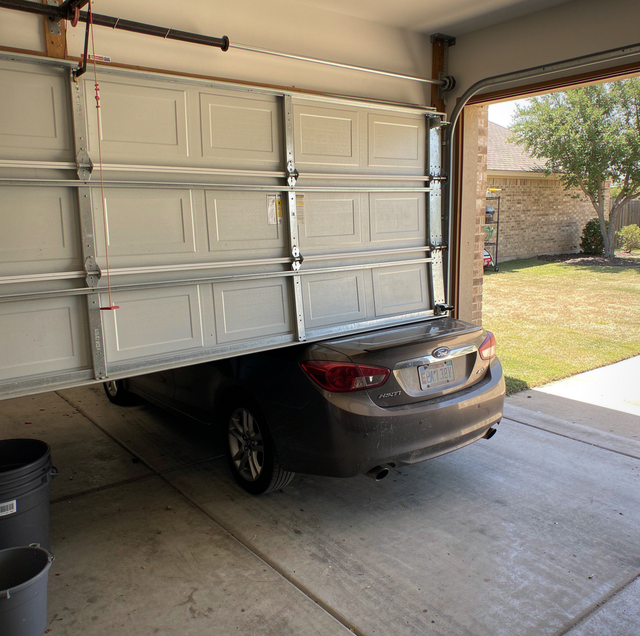
You come back into the garage, and the door is not where it should be. It's down, most of the way, resting on the roof of the car or pinned against the trunk lid, and the car is exactly where you parked it. The door came down onto something already sitting still and stopped there instead of reversing. That fact matters more than how bad the marks look.
Why This Means Something in the Safety Chain Failed
A sectional door is built to stop and reverse when it meets an obstruction on the way down, and residential openers have carried two separate layers of protection for that purpose for decades. That is not a courtesy feature bolted on for peace of mind; it is the reason a door is allowed to close on a command nobody is watching. One layer watches the opening; the other watches how hard the door is working. When a door comes down on a parked car and stays there, one of those two layers did not do its job.
Why the Photo Eyes Never Saw the Car
The first layer is the pair of photo eyes mounted low on each side of the opening, usually four to six inches off the floor. They send an invisible beam across the doorway at that one height, and anything breaking it while the door is closing sends the opener back up. The pair was never built to see anything higher than the beam. A car's roof, a raised tailgate, a bumper on a taller SUV: all of it sits well above where the eyes are aimed, so at their height the doorway was clear.
Where the Opener's Trip Threshold Sits
That leaves the second layer. The opener senses resistance as the door moves and reverses when that resistance climbs past a set point, whether it comes from a person, an object, or a car roof. What decides whether a door reverses is where its trip threshold sits relative to the resistance it meets. On an opener whose force setting was raised at some point, or one whose learned baseline has crept upward year by year as the door's own friction increased, that threshold sits higher than it did when the door was new. The resistance a car roof adds can sit under it.
Many openers set their reference during a setup routine and hold it until someone runs that routine again, so a setting raised years ago to get a stiff door moving stays raised long after the stiffness is gone. Others relearn as they go, raising their threshold with a door that grows harder to move. Either way, that is a finding for a technician to make, not something to guess at from the driveway.
Checking It in the Right Order
This is the order to check one specific incident, before anyone touches either the door or the car.
- Leave the opener alone. No wall button, no remote, no smart-app control. A second attempt tests nothing and risks driving the door into the same resistance again.
- Look at the point of contact first, and note whether the door is resting on the car or has caught on something standing proud of it, like a roof rack, a spoiler, or an open tailgate.
- Note where the door stopped in its travel. The amount of door hanging above the contact point is what the car is now underneath.
- Work out whether the door is bearing on the car or hanging on the opener. An arm still straight and under tension means the opener is holding the door; an arm gone slack or bowed means the door has settled onto the car. Look from several feet back, with nobody under the door.
- Look at how the bottom edge is sitting: flat across a roof or trunk lid, or loaded at one point on a corner, an edge, or a rack rail. A door held at one point puts its weight through a small area of one panel.
- Check that both lift cables are still taut and still wound in their grooves on the drums at each end of the shaft above the opening. A door held up by an obstruction rather than by its counterbalance is where a cable goes slack while the door is still up.
- Only after those checks does the car move. If anything in steps 3 through 6 looks wrong, it stays put until a technician has been out.
Why Moving the Car First Can Make It Worse
Backing the car out is the move that feels productive, and it changes the situation before anyone has read it. The car may be just an obstacle the door came to rest against, or it may be part of what holds the door at that height, in which case driving away removes a support the door is using. That is why the cable check comes first: a slack cable means the counterbalance is no longer carrying its share, and the car has been standing in for it.
If any part of the bottom edge has hooked onto something on the vehicle, moving the car also pulls on the door horizontally. A sectional door carries its load vertically, through its hinges and tracks, and a sideways pull from a vehicle has nowhere to go.
Why the Door Stays Out of Service Until It's Tested
A door that failed to reverse against a stationary car has shown, under real conditions, that its resistance response did not function as intended. Running it up and down afterward proves nothing, because a cycle through an empty opening only shows the door can complete a cycle with nothing in the way. A technician must check the reversal behavior before the door is returned to normal use.
Nor is disconnecting the opener a way to lift the door off the car in the meantime.
The release cord is safe to use only with the door fully closed and the counterbalance intact, and it is never a way to hold a door open.
Until that check happens, the door is out of service, and the opener is left alone.
What the Incident Establishes
A door that came down on a parked car and stopped there has demonstrated a gap in its own protection, under a load that happened to be a car roof.
Before the car moves and the door goes back up, note where the door stopped and what sent it down, because that state cannot be reproduced afterward. A wall button with someone standing at it, a remote from the driveway, a phone from anywhere at all, and a scheduled close are four different situations, and a door that closed with nobody watching changes what the technician looks at first.
Frequently Asked Questions
Not reliably. Most factory alarm systems trigger their shock sensors by light vibration, not by real impact force, so a sounding alarm does not tell you how hard the contact was. A quiet car afterward is not proof that nothing happened either. Look at the point of contact directly rather than reading anything into the alarm.
It changes which layer is left. A loaded rack, a ski box, or a ladder rack lifts the tallest point of the car into the part of the opening the photo eyes were never aimed at, leaving the force side working alone. The height that determines it is where the vehicle crosses the door plane, not always the car's tallest point, because rooflines slope. A permanent rack is worth naming at the visit, since a vehicle never parks in the same spot twice.
Steady lights say the pair is powered and aligned right now, and nothing about this incident. A beam that was never broken reports the same as a beam working perfectly, and the car roof sat above the beam the whole time. On most pairs, the sending eye's light only confirms power, while the receiving eye's light is the one reporting whether it can still see the beam, so a single steady light is worth less than it looks.
The door is secured where it sits before the car moves, so it cannot travel farther once the support under it is gone, and only then does the car come out. Which way it goes after that depends on the cable check: taut cables and an intact counterbalance mean it can be brought back up, while a slack cable means it is walked down to the floor instead, because raising it would load the part that has already shown it is not carrying its share.
That the force side did trip, but only after real contact. A door reversing only after real contact is working with no margin in hand, so the next object in the opening decides the outcome. A car roof is rigid and pushes straight back; something that yields, a cardboard box or a bag of yard waste, gives way instead, so the same setting that finally tripped against sheet steel may never reach its trip point.
After any contact near the tracks, the door's travel limits, the points where the opener "thinks" fully open and fully closed are, can drift out of sync with where the door physically stops. That is checked separately from the resistance and reversal test, since a door can pass one and still be slightly off on the other.
Have the safety chain tested end to end before the door runs again — photo eye and sensor repair puts the beam back where it belongs and the force side back under a threshold that means something, and our crews cover that work across Brushy Creek and the neighborhoods around it. Squared Away Garage Door Service serves Cedar Park and Central Texas. Call (512) 456-3781.
