
The 2-Inch Auto-Reverse Test: What Failing It Really Means
Most people find out whether a garage door's safety system actually works only when it doesn't: a stalled cycle, a straining motor, a door that pushes through something it should have stopped for. There's a way to check it on purpose, in about a minute, instead of finding out the hard way. All of it comes down to one question: if the door met something solid on the way down, would it stop and go back up?
There is a test for that, and it takes about a minute. Technicians call it the 2-inch test, the reversal test, or just the 2x4 test. It is the most useful minute a homeowner can spend on a garage door, and it is the only way to know that a safety system you cannot see is still doing its job.
The Mechanism Behind the Test
Residential openers built over the last three decades carry two separate entrapment-protection systems. They fail independently, which is why one working does not tell you anything about the other.
Non-contact protection: The photo-eye sensors are clamped low on both vertical tracks, typically mounted no higher than about six inches above the floor. They hold an infrared beam across the opening. Break the beam during a close cycle, and the opener reverses before the door touches anything.
Contact protection: The opener's own sense of how hard it is working. If something gets past the beam, or the beam is blocked, dirty, or aimed wrong, this is the layer that catches it. This is what the 2-inch test checks, and nothing else tests it.
The contact layer deserves a closer look because it is invisible from outside the powerhead. As the door travels down, the operator watches the effort it is spending. Older units did this mechanically, through a clutch or a spring-loaded force lever linked to adjustment screws on the housing. Newer units do it electronically: the logic board tracks motor current draw along with pulses from a rotational sensor on the motor shaft (an optical encoder or a Hall-effect pickup, depending on the brand) and compares what it reads against the effort profile it learned during setup. When the door lands on something solid, effort spikes and travel stalls at a point in the cycle where the board expects continued motion. That mismatch is what commands the reversal.
The force setting is closer to a threshold dial than an on/off switch: it defines how much unexpected resistance the opener will absorb before deciding something is wrong. Set too sensitive, the door reverses at nothing. Set too aggressive, the door can push down on a shoulder, a bicycle, or a pet for a noticeable moment before the board decides that counts as an obstruction.
How to Run the Test
Clear the opening first. No people, no pets, no car under the door.
Step one: Run the door fully open using the wall control, standing where you can see the whole door.
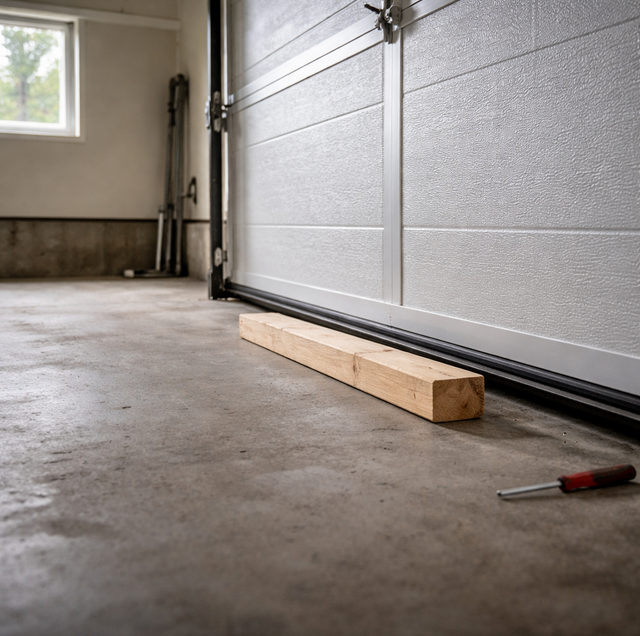
Step two: Lay a solid, non-crushable object flat on the floor, centered in the middle of the opening. A 2x4 laid flat is the standard choice, which puts about an inch and a half of solid wood in the door's path. That is where the loose "two-inch" name comes from. A short length of 4x4 or two 2x4s stacked works as well. Do not use a cardboard box, a plastic tote, a rolled towel, or anything that collapses under weight, since a crushable object absorbs the load and hands you a false pass. Do not use anything you would mind marking up.
Step three: Press the close button and watch the bottom of the door, not the opener.
Step four: The door should contact the wood and reverse immediately, traveling all the way back to open. Prompt and unmistakable is the standard.
Any of these counts as a failure:
- The door keeps driving down and sits on the board, straining.
- The door stops on contact but does not travel back up. Stopping is not passing.
- The door reverses only after you can see the bottom section flex or the whole door shudder.
- The door reverses, but the top section or the opener rail visibly strains first.
Never use your hand, foot, or any part of your body as the obstruction, and do not test with a person standing in the opening. While you are down there, it is worth checking the beam as well: start a close cycle and pass a broom handle through the sensor path near the floor. The door should reverse without contact.
How Often to Run It
Monthly is the interval printed in most opener owner's manuals, and it is a sensible habit for a system with no other warning light. Beyond the monthly check, run it again after anything that changes how the door moves or what the opener expects:
- After spring, cable, roller, hinge, or track work, since the effort profile the opener learned no longer matches the door.
- After a new opener installation, before the job is called finished.
- After the door is struck by a vehicle or comes off its track, even if it appears to run normally afterward.
- After any limit or travel reset, or after the opener is unplugged, reprogrammed, or replaced at the board level.
- Any time the door starts behaving differently, including new noise, hesitation, or a change in closing speed.
Commercial and multi-bay properties benefit from a written schedule rather than memory, since doors that cycle dozens of times a day drift out of adjustment far faster than a two-car residential door.
What a Failed Test Usually Means
Failures cluster into three causes, and they call for different fixes.
Force or travel limits have drifted: The down limit tells the opener where the floor is. If that limit is set past the actual floor, the opener is still trying to drive the door downward after the bottom seal has landed, and the effort required to satisfy that limit is high enough that a solid board sitting in the path falls inside the tolerance. Force and limit settings interact, which is why they are set together and never one at a time.
The door is getting harder to move: Binding or flat-spotted rollers, a bent or out-of-plumb track section, worn hinges, dry bearings, or a counterbalance spring that has lost tension all raise the effort a door needs to travel. A door like that trips nuisance reversals, and the common field response is to raise the force until the nuisance stops. The safety margin goes out with the nuisance. The real fix is the mechanical fault, not the setting.
Something inside the operator is worn or failing: A stripped nylon main drive gear on a chain-drive head, a worn trolley or carriage, a slipping sprocket, a failing rotational sensor, or a logic board that has stopped reading the motor accurately. If the opener cannot sense a stall, no force setting will produce a reliable reversal.
There is also a quieter contributor: a hardened, torn, or missing bottom seal changes how the door meets the floor and how the opener reads that contact. It is a cheap part with an outsized effect on the last few inches of travel.
Why Recalibration Belongs to a Technician
Force and limit adjustment lives inside the opener's powerhead, alongside line-voltage wiring and the motor. Do not open that housing or turn internal adjustment screws yourself. Beyond the shock hazard, an adjustment made in the wrong direction re-creates the exact danger the test exists to reveal, and it does it silently. There is no fault code for "this door now closes hard enough to hurt someone."
A technician also does the work in the right order. Balance comes first: the counterbalance springs carry the door's weight, and the opener only guides it, so setting force on an unbalanced door bakes that imbalance permanently into the safety system. Torsion springs and lift cables hold extreme stored energy and are never homeowner-serviceable, in any circumstance, with any tool. After balance is confirmed and force and limits are reset together, a technician re-runs the same 2-inch test to prove the correction rather than assuming it.
What to Do Until It's Fixed
A door that fails the test is unsafe to operate around people and pets, and that is not an abundance of caution. Repeated failure means the mechanical backstop is gone.
Until it is corrected, keep everyone from walking under a moving door, and stop closing it from a remote or a phone app where you cannot see the opening. If children or animals have access to the garage, use another entry and leave the door in one position rather than cycling it. Do not treat the photo eyes as a substitute; a beam a few inches off the floor does nothing for a person or object above it, and contact reversal exists precisely for the moments the beam is defeated. Do not raise the force setting to make the door behave. And do not keep re-running a failing test to see if it passes on the third try, since each failed cycle drives the door into the board and loads the top section, the top fixtures, and the drive gear.
A passing test is a small piece of information carrying a large meaning: the last line of protection on a door that outweighs almost everything else that moves through the house is still intact. A failing one is worth a service call this week, not next season.
Frequently Asked Questions
It is the same system misbehaving in the opposite direction, and the pattern tells you where to look. A door that reverses at the same point in travel every time usually has something mechanical at that spot: a flat-spotted roller entering a curved track section, a bent track splice, or a hinge starting to tear at its screw holes. A door that reverses at random points more often points to the sensors or their wiring, since most brands hold a steady indicator LED on both eyes when aligned and blink or drop out when not. Low afternoon sun striking the receiving eye directly, a bracket knocked loose by a trash can, or a sensor wire stapled through during a garage finish-out all produce the same intermittent behavior.
Openers from that era often have no photo eyes at all, and their contact reversal is a purely mechanical clutch arrangement that wears with age. The clearest tell is what's missing rather than what kind of drive it has: no low-voltage sensor wiring running to two small units near the floor, and no sensor terminals on the logic board. Retrofit sensor kits do not exist for most of those units, so replacing the operator is generally the recommendation rather than trying to modernize it.
Yes, more than most people expect. The bottom section of a sectional door flexes across its width, so a board placed near one jamb can be partly absorbed by that flex while the rest of the door keeps traveling, which can produce a pass that would not hold up in the center. Centering the obstruction gives the truest reading of what the opener senses. A door with a bowed or previously repaired bottom section can pass cleanly in the middle and behave differently near the edges, which is one reason technicians sometimes test at more than one point across the opening.
Not directly. The test measures the opener's reaction to resistance, not the counterbalance that carries the door's weight, and a door with a fatigued spring can still pass on the day it is tested. A separate balance check, disconnecting the opener and lifting the door by hand to about waist height to see whether it holds position, is what catches a weak spring, and it's a check most homeowners can run safely as long as the door is intact and moving on its track. If the door feels alarmingly heavy from the first inch, drops instead of holding, or anything about the hardware looks damaged or off-track, stop and call a technician instead of forcing it. If you use the red emergency-release cord, do it only with the door fully closed, since releasing a door that is up with a compromised spring lets it come down hard.
Commercial operators are built differently and are often tested differently. Many use a monitored photo eye or a sensing edge, a pressure-sensitive strip running along the bottom bar that reverses the door when compressed, rather than relying on motor-load sensing. Where auto-reverse is not part of the design, the door is typically run on constant-pressure controls, meaning the operator only closes while someone holds the button and stops the instant it is released. Testing a sensing edge means compressing it during a close cycle and confirming the reversal, and the edge's air hose or wiring gets inspected because it takes abuse at floor level.
It raises the stakes on the same tests. Unattended operation, meaning closing the door from a phone or on a timer with nobody in the garage, is built around a warning cycle: the opener is designed to sound and flash for several seconds before it moves, so anyone in the space has notice. Those features also depend on a monitored sensor circuit, and most units refuse remote or timed closing outright if they cannot confirm the sensors are healthy, which is why a smart opener that suddenly stops honoring app-based closing is usually reporting a sensor fault rather than a network problem.
Schedule a garage door safety inspection — get the reversal, force, and balance checked and corrected by a technician. A door that keeps failing the board test afterward usually points to photo-eye sensor repair rather than another turn of the force dial, and that same appointment is open to households across Leander. Squared Away Garage Door Service serves Cedar Park and Central Texas. Call (512) 456-3781.
