

Garage Door Photo-Eyes vs. Sensing Edges: The Safety Gap
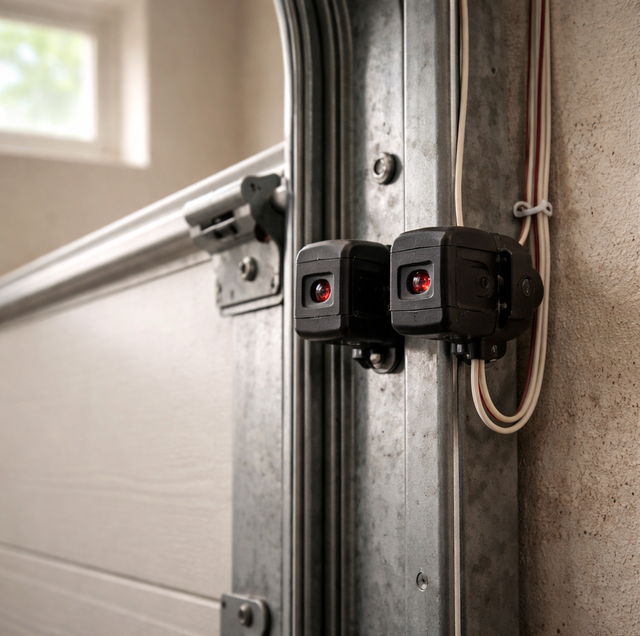
Two different safety devices can be fitted to the same garage door, and they work in opposite ways. One watches a narrow stripe of air near the floor and refuses to let the door travel through it. The other waits to be touched, then reacts to the pressure. Both are called entrapment protection; both exist so a moving door does not close on a child, a pet, a bicycle, or a car bumper, and they are not interchangeable in practice. Knowing which one your door carries, and what it physically cannot detect, is what separates a door you trust from a door you assume is fine.
How a Photo-Eye Pair Works
The two small plastic housings bracketed to the vertical tracks near the floor are a matched pair, not two copies of the same part. One is a sending unit that emits a modulated infrared beam across the opening. The other is a receiving unit aimed back at it, watching for that beam. Both run on low voltage, wired back to the opener's terminal block with two-conductor bell wire, usually one white conductor and one white-with-stripe conductor.
Manufacturer instructions generally call for mounting the pair no higher than six inches above the finished floor. That height is not arbitrary: it puts the beam low enough to catch a small child crawling or lying across the opening, which is the scenario the device exists for.
What the indicator lights tell you: Most brands put a small LED in each housing. A steady light on the receiving unit typically means the pair is aligned and talking; a flickering, dim, or dark receiver light usually means the beam is broken, blocked, or the brackets have drifted out of aim. Colors and behavior vary between manufacturers, so the opener's own label or manual is the reference, not a general rule.
What happens when the beam breaks: If something interrupts the infrared mid-close, the operator stops the door and sends it back to full open. If the beam is already broken when you press the button, the opener refuses the command and signals the fault, often by blinking the overhead light or an LED on the motor head, with the pattern depending on the brand. Most residential operators still allow closing if you hold the hardwired wall control down continuously, a deliberate override for a failed sensor rather than a workaround to live with.
The defining quality of a photo-eye is that it works without contact. Nothing is hit for the door to stop.
How a Sensing Edge Works
A sensing edge is a switch built into the rubber profile that runs along the bottom of the door. Instead of watching for a break in a beam, it responds to compression.
Two designs cover most installs:
Pneumatic edges: The hollow rubber bulb acts as an air chamber. Squeezing any point along it pushes a pulse of air down the tube to an air switch, and the switch signals the operator.
Electric edges: Two conductive strips are held apart inside the profile by the shape of the rubber. Compression pushes them together, closing a circuit. These are common on newer commercial installs because they can be monitored electrically.
The signal has to travel from a part that moves with the door to a controller that does not, which is handled with a coil cord, a take-up reel, or a wireless transmitter on the bottom bracket paired to a receiver at the operator.
Monitored versus unmonitored: A monitored edge carries a terminating resistor at the far end, so the controller constantly reads a specific electrical value across the circuit. A cut cable, a corroded splice, or a disconnected edge reads as a fault rather than as silence, and the operator refuses normal closing until it clears. An unmonitored edge fails quietly, which is why monitoring exists.
Held side by side, a photo-eye is a tripwire and a sensing edge is a bumper. The tripwire acts before anything is touched. The bumper acts only after contact, which means the door has already met the obstruction and will travel a little farther while the switch closes and the operator reverses.
Why Homes Get Photo-Eyes and Commercial Doors Often Get Edges
Openers built for U.S. homes since the start of 1993 have had to include a second, external means of detecting an obstruction, on top of the operator's own internal force sensing. In plain terms, the operator's ability to feel resistance and reverse was no longer considered enough by itself; a separate device had to be watching too. The rule allowed either a non-contact device or a contact device to fill that role.
Nearly every residential manufacturer chose photo-eyes, for practical reasons a technician sees every day. Eyes mount to static brackets on the track, so nothing flexes with every cycle; there is one short wire run and no moving part at the bottom of the door, and they detect before contact instead of after.
Commercial and industrial doors change the math. Openings are wider, curtains and panels are heavier, and traffic includes forklifts, carts, hoses, and pallets rather than one family car. On a rolling steel door with constant traffic, a beam at a single low height near the jambs is easy to block, easy to knock out of alignment, and easy to clear a moment before something else rolls under. A sensing edge covers the full width of the leading edge everywhere it lands, which is what a busy dock or shop bay needs. In those settings, the edge is often the primary external device, with eyes added as the second layer rather than the other way around.
Where Each System Breaks Down
Photo-eye faults are almost always about the beam path or the wire feeding it:
Bracket misalignment: A bike handlebar, a trash bin, or a bumped ladder rotates one housing a few degrees, and the receiver loses the sender.
Clouded or dirty lenses: Dust film, spider webs, or road grime weaken the beam enough to cause intermittent refusals long before they block it outright.
Damaged low-voltage wire: A staple driven through the bell wire during a garage build-out, or insulation nicked behind drywall, produces an intermittent fault.
Corroded terminals: The insulation-displacement quick-connects at the sensor and the motor head oxidize in unconditioned garages and lose continuity.
Sensing edge faults are almost always about the profile or the flexing connection:
Split or cracked rubber: Ultraviolet exposure and impact damage open the profile, water gets inside, and the result is false reversals or a switch that no longer closes.
Flex fatigue at the connection: The coil cord at the bottom bracket bends every cycle, and stranded copper eventually breaks inside intact-looking insulation.
Transmitter power loss: Wireless edges depend on a battery in the bottom-bracket transmitter. A monitored system reports the loss; an unmonitored one simply stops protecting.
Poor fit at the ends: An edge cut short or missing its end caps leaves the last inches of the door width unprotected and lets water into the profile.
One failure mode belongs to both systems: deliberate defeat, where someone disables the device outright so it stops interrupting a close cycle. That repairs nothing. It deletes the entire secondary layer of protection and leaves the door relying on internal force sensing alone, and it is never a legitimate fix, only a way to hide a fault that still needs a technician's diagnosis.
Confirming Yours Is Still Working
A short monthly check tells you more than any indicator light. Start a close cycle and pass a solid object through the beam path near the floor: the door should stop and reverse before contact, not pause or continue. Separately, close the door onto a solid, non-crushable object laid flat in its path: on contact it should reverse immediately, which checks the operator's internal force sensing and exercises a sensing edge too if the door has one. While you're down there, wipe film and webs off the lenses with a dry cloth and check the bottom rubber and the coil cord or transmitter bracket for wear.
If either check fails, stop using the automatic operator and have the door looked at. The wrong response is turning up the force setting so the door pushes through the resistance, which removes the protection the check just proved missing. Force adjustment, control-board diagnosis, and any work involving the springs, cables, or counterbalance hardware are professional-only jobs, as is anything on the line-voltage side of the operator.
Which One Your Door Should Have
For a home, working photo-eyes are the baseline, not an upgrade. If yours are missing, bypassed, or feeding a fault, that is the item to correct first. A sensing edge is worth adding on top of eyes when the door sees traffic the beam covers poorly: an unusually wide opening, a bay where kids and pets move constantly, a threshold where low objects tend to sit.
For a commercial door, the answer depends on the operator's controls and the traffic pattern. A monitored edge, or a monitored edge paired with eyes, covers the full leading edge and reports its own failures rather than going dark. A technician will weigh the operator type, the control style, the door's weight and width, and what actually moves through the opening.
The two systems are not competitors. They cover different halves of the same risk: one catches what is standing in the opening, the other catches what the door has already reached. A door with both, tested and working, fails safe in more than one direction.
Frequently Asked Questions
In principle, a listed contact device can serve as the external detection layer, but retrofitting one to a typical residential opener is rarely simple. Most home operator boards provide terminals only for the sensor circuit the unit shipped with, and adding an edge means a compatible monitored input or an add-on receiver module wired to the head. The model number on the motor head decides what is possible.
External detection acts on the closing cycle, because that is the direction that can trap something. On the way up, the protection is the operator's internal force sensing, which stops travel when it meets unexpected resistance such as a roof rack or a raised truck bed. On most units, the door halts in place going up rather than reversing downward, since reversing would drive it back toward whatever it just hit.
Low-angle direct sunlight striking the receiving lens can temporarily wash out the signal, which is a sun problem rather than a failing sensor and typically clears on its own as the angle changes. A technician can confirm it by checking whether the fault repeats at the same time of day on a clear day, and can shield the lens or swap which side the sending unit occupies if it keeps happening.
Replace them as a matched set. The sending and receiving units are tuned to each other and to the operator's expected signal, and pairing a sensor from one manufacturer with a sensor or head from another usually produces a permanent fault code even though the wiring connects fine. Some universal replacement sets are sold with brand-specific pigtail adapters for exactly this reason, and the pigtail is the part that has to match.
No. Entrapment devices detect obstructions; they do not hold the weight of the door. Falling-door protection comes from separate hardware: the counterbalance system itself, containment cables run through extension springs to capture a broken coil, and on many commercial doors, a governor or drop-stop mechanism. Spring failure is one of the loudest events a door produces, and it makes the door unsafe to operate until a technician has replaced the components under tension.
Powered operators are what triggered the external-detection requirement, so a hand-operated door has no photo-eye or edge circuit. Its safety rests on balance and hardware condition: a properly balanced door should hold position roughly halfway up rather than drifting, and worn hinges, frayed cables, or a loose bottom bracket are what make a manual door dangerous. Add an opener later, and the eyes come with it as part of the installation.
Schedule a test of both safety layers before you assume either one still works — Squared Away Garage Door Service handles garage door sensor repair and door-edge checks across Cedar Park and Central Texas, including Brushy Creek garage door service. Call (512) 456-3781.
