

Garage Door Sensor Blinking? What That Light Means
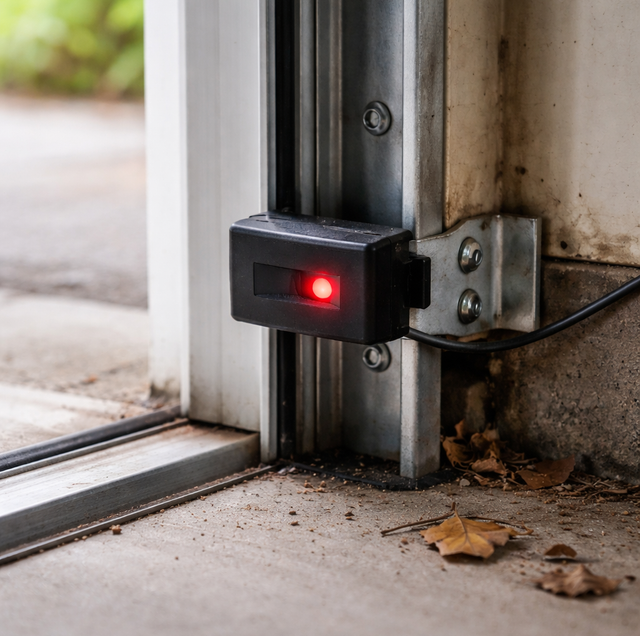
You're on one knee at the bottom of the garage door track, phone flashlight in one hand, staring at a small plastic eye that's blinking at you in a rhythm you can't read. The manual disappeared years ago, maybe in a move, maybe in a drawer nobody's opened since. Last night the door started down, stopped, and rose back up on its own, and now you're here trying to make sense of a light that doesn't come with words, just a pattern.
That blink isn't random, and it isn't the sensor malfunctioning for no reason. It's the only way a small electronic eye has to tell you whether the safety system standing between a closing door and whatever might be under it is working the way it's supposed to.
What Are Those Two Small Boxes at the Bottom of the Track?
Look at either side of the door opening, about four to six inches off the garage floor, and you'll find a small plastic housing bolted to a bracket. One side is the emitter, the other is the receiver, and together they're the photo-eye sensors, sometimes called safety eyes or reversing sensors. The emitter sends a narrow beam of infrared light across the doorway to the receiver on the opposite side. You can't see the beam itself; infrared sits outside the range of human vision, which is exactly why the little LED on the housing exists. It's a visible stand-in for a beam you'd otherwise have no way to check.
The receiver reports what it sees back to the opener's logic board through a pair of low-voltage wires that run along the wall to the motor unit. As long as the receiver reads a steady signal from the emitter, the board treats the doorway as clear. The instant that signal drops out, mid-close, the board reverses the door immediately rather than letting it keep moving toward whatever broke the beam: a bumper, a bicycle tire, a pet, a kid chasing a ball into the garage. That single design decision is the entire reason the sensors exist, and it's why an opener refuses to close the door at all once it decides the beam isn't reliable.
What Does a Solid Light on Both Eyes Mean?
A steady, non-blinking light on both housings means the pair is doing exactly what it's built to do: the beam is aligned and unbroken, and the receiver is getting a clean, continuous signal. Color varies by brand and model; some show green when satisfied, others use amber or white, and a few newer units even change color to flag a fault instead of blinking. The color itself matters less than the behavior. Solid and steady, on both sides, is the state you want, and it means the door will close on the first try without the opener second-guessing itself partway down.
What Does a Blinking Light Mean?
A blinking light, almost always on the receiver, means the beam is getting through some of the time but not reliably enough for the board to trust it. Three things commonly cause this. An obstruction sitting partly in the beam's path, a storage box, a garden hose reel, or a car parked slightly too far forward can interrupt the signal intermittently rather than blocking it outright. A dirty lens does something similar: a film of dust, pollen, or a spider web strand across the glass scatters enough of the beam that the receiver reads it as broken even though nothing solid is in the way. And a slight misalignment, sometimes just a few degrees, can leave the beam clipping the very edge of the receiver's lens instead of hitting it dead-on, which shows up as flickering rather than a hard failure.
Whatever the cause, the opener's response is the same: it won't complete a close cycle while the light blinks, and if you do manage to start the door down, it stops and reverses the moment the board loses the signal.
What Does It Mean When the Light Is Off Completely?
No light at all on one or both housings usually points somewhere different than a blinking light does. Where blinking suggests the beam is present but unreliable, no light at all more often means the sensor isn't getting power or isn't communicating with the board in the first place. Common causes include a low-voltage wire that's pulled loose from the back of the housing, a wire nicked or pinched where it runs along the wall (a lawn tool or a ladder brushing against it is a frequent culprit), a corroded terminal where humidity has worked into the connection over months, or, less often, a sensor unit that's failed internally after years of service. A tripped breaker or a GFCI outlet feeding the opener can also cut power to the whole unit, sensors included, which is worth checking before you assume a part has failed.
Why Would Alignment Drift Without Anyone Touching It?
Nobody has to bump a sensor on purpose for it to drift out of true. A car easing in a little too far, a bike leaned against the wall, or a lawn mower backed past the bracket can nudge the housing just enough to throw off the angle without leaving a mark you'd notice. The mounting bracket itself is usually held with a single wing nut or a small screw, and normal door vibration over hundreds of open-close cycles can work that fastener loose a fraction of a turn at a time until the housing has enough play to tip.
The building itself moves too. Expansive clay soil, common under slabs in many regions, swells and contracts with moisture, and that movement shifts the garage floor and the door frame bolted to it over the course of months and seasons. A bracket that was dead level when it was installed can end up angled by a few degrees as the frame settles, and a few degrees is often all it takes to walk the beam off the receiver's lens. Heat and prolonged UV exposure add a slower version of the same problem, gradually warping the plastic housing or softening the bracket's grip over repeated hot summers, while sudden temperature swings between a hot afternoon and a cool night can flex metal brackets just enough to shift alignment overnight.
Is It a Misalignment or a Wiring Problem?
The light itself usually tells you which category you're dealing with before you touch anything. A blinking light means the beam exists and is being read, just not reliably, which points toward alignment or an obstruction. No light at all means the sensor isn't reporting to the board, which points toward power or wiring. A quick way to narrow it down further: wipe both lenses with a soft, dry cloth and gently press the brackets back toward square with the opposite sensor. If the light steadies, it was alignment or dirt. If nothing changes and the housing still shows no light, the wire or connection is the more likely place to look next.
| Light State | What It Usually Means | Where to Look First |
|---|---|---|
| Solid on both eyes | Beam is aligned and intact | Nothing needed |
| Blinking on one or both | Beam present but unreliable | Obstruction, dirty lens, slight misalignment |
| Off on one or both | No power reaching that sensor | Loose wire, corroded terminal, tripped breaker |
A Different Blinking Light: The Wall Console's Lock Feature
Not every blinking light in the garage belongs to the photo-eye pair at the bottom of the track. Most wall-mounted control panels carry their own small LED, and on many models that light blinks when the console's LOCK or vacation-lock feature is engaged, a setting that disables the remotes on purpose while leaving the wall button working normally. It's an easy blink to mistake for a sensor fault, especially if a remote stopped working the same day, but the two lights sit on different parts of the system and mean different things entirely.
Telling them apart: the photo-eye lights sit low on the track, four to six inches off the floor, and a blink there means the beam is unreliable. The console's LOCK light sits on the wall unit itself, usually near the door-control button inside the garage, and a blink there means a setting is active, not that a part has failed. The faster giveaway is what still works. A LOCK blink leaves the wall button running the door normally while every remote goes dead, whereas a photo-eye blink stops the door from closing no matter what you press it with.
Solid, Blinking, or Dark: Your Next Move
Solid means go. Blinking means something is interrupting the beam. Dark means the sensor has no power at all. That three-way read is the entire vocabulary of the light, and knowing it turns a confusing few minutes on one knee in the garage into a short, specific list: check the lens, check the alignment, check the wire, in that order, before assuming the worst about either sensor.
Frequently Asked Questions
Yes. Low morning or evening sun striking the receiver's lens directly can wash out the infrared signal the same way a bright flashlight in your eyes makes it hard to see anything else, causing intermittent blinking or false reversals that have nothing to do with the bracket's angle. A small shade, even a piece of cut PVC pipe or a short length of angle bracket over the lens, usually clears it up without moving the sensor at all.
A photo-eye uses the emitter-and-receiver beam described above and reacts before anything is touched. A sensing edge is a different technology entirely: a pressure-sensitive strip mounted along the bottom of the door panel that triggers a reversal on physical contact rather than a broken beam. Most residential openers rely on a photo-eye pair as the primary entrapment protection, with the door's built-in force-sensing setting acting as a backup if something is touched directly.
Many openers include a manual override, sometimes called constant-pressure or hold-to-close mode, that lets the door move as long as a finger stays on the wall control, bypassing the automatic safety reversal. It exists for testing and troubleshooting, not everyday use, since it defeats the entire purpose of the auto-reverse system while it's engaged. Releasing the button stops the door immediately, but nothing reverses it automatically the way normal operation would.
Standard residential photo-eyes are built to hold a signal across the width of a typical single or double garage door opening, generally up to sixteen to eighteen feet, but the wider the gap between emitter and receiver, the less room there is for angle error. A pair mounted a few feet apart tolerates a sloppier alignment than a pair spanning a full double-wide opening, where even a small tilt can walk the beam off the lens entirely.
On some newer units, yes. A logic board with Wi-Fi or app connectivity may push a notification to your phone or show a numbered blink sequence on the opener's own readout in addition to, or instead of, the light on the sensor housing itself. If your opener has an app, it's worth checking there before assuming the sensor light is the only place the fault would show up.
Overtightening the mounting screw or wing nut on a plastic sensor housing can crack the bracket tab that holds it in place, which turns a simple alignment fix into a housing replacement. Snug enough to hold its angle without wobbling is the goal; if the housing still shifts under light finger pressure once the fastener feels tight, the bracket itself, not the screw, has likely worn out and needs replacing rather than tightening further.
Get your sensors inspected and realigned — a technician checks the beam, the wiring, and the bracket condition, and confirms the safety reversal is working correctly before leaving. A blink that returns after the lenses are clean and the brackets are square is usually wiring or a control board rather than the eyes themselves, which hands it to garage door opener repair in Pflugerville, and on a unit old enough that matching sensors are scarce, a new opener with smart controls is often the cleaner answer than chasing an intermittent fault. Squared Away Garage Door Service keeps its trucks in Cedar Park and works Central Texas from there; dial (512) 456-3781.
