

Never Bypass Garage Door Safety Sensors: What It Risks
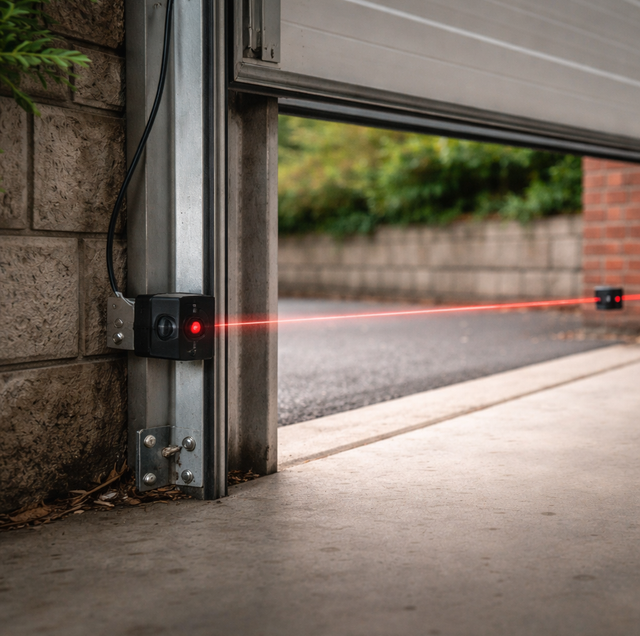
The door starts down, stops a foot off the floor, and rolls back up. You press the button again and get the same result. Nothing is sitting in the doorway, you are already late, and a quick search turns up plenty of people happy to explain how to make the problem disappear by taking the safety sensors out of the picture.
That is the one shortcut a garage door technician will tell you never to take. Not because it fails to close the door, but because it works. The door will close. It will also keep closing on whatever happens to be underneath it.
Two Safety Systems, Not One
Residential openers built since the early 1990s carry two separate forms of entrapment protection, and they work in completely different ways.
Contact reversal: The opener monitors how much force the motor draws as the door travels. If the door meets more resistance than the closing cycle expects, the motor stops and sends the door back up. This layer acts only after the door has touched something.
Non-contact reversal: A matched pair of photo-eye sensors sits low on the vertical tracks on either side of the opening, generally no higher than about six inches off the floor. One eye projects an infrared beam across the doorway, and the other receives it. Break that beam while the door is coming down and the opener reverses before the door reaches whatever broke it.
That low mounting height is deliberate. It puts the beam where a crawling child, a dog stretched out in the shade of the doorway, or a foot stepping under a moving door will cross it. A safety standard adopted industry-wide in the early nineties calls for both layers on residential openers, because contact reversal alone was not preventing injuries; manufacturers can satisfy the non-contact layer with photo-eyes or with a contact device like a sensing edge, though photo-eyes are what nearly every residential opener ships with. A door that refuses to close is one of those systems doing what it was built to do.
Why the Beam Breaks When the Doorway Looks Empty
Almost every "the sensors are broken" call turns out to be one of five things, and only one is a failed sensor.
The brackets have drifted out of alignment: Each eye sits in a slotted bracket held by a single wing nut. A door cycled several times a day shakes those brackets steadily, and a bumped handlebar or a trash can rolled against the track will move one a few degrees. Slab and door-frame movement does the same thing more slowly. The two eyes have to look straight at each other, and a small angle at one end of the opening becomes a wide miss at the other.
The lenses are dirty: Dust film, pollen, and cobwebs all attenuate the beam, and spiders are drawn to the warm sensor housing. The lens does not have to look blocked. It only has to be hazy enough to drop the received signal below the level the receiver needs.
Sunlight is washing out the receiver: Low-angle sun striking the receiving eye can overwhelm the infrared signal it is trying to read, which is why this fault often appears at the same time of day and clears an hour later. A technician handles it with a shade hood over the affected eye or by moving the receiver to the shaded side of the opening.
The low-voltage wiring has a fault: Sensors run on two-conductor wire stapled along the track and up to the opener head. A staple driven a hair too deep, a pinch where the wire crosses a bracket, or a corroded splice produces faults that come and go and look exactly like a bad sensor.
Something really is in the beam: The beam crosses the full width of the opening at ankle height, so a recycling bin corner, a coiled hose, or a bag of soil leaning near the track counts as an obstruction even though it is nowhere near the middle of the doorway.
What You Lose When You Defeat the Sensors
Defeating the photo-eyes repairs none of the five conditions above. It deletes the entire non-contact layer of protection and leaves contact reversal alone.
Contact reversal has one built-in limitation: the door has to hit the obstruction before the opener knows it exists. The motor then needs a moment to sense the change in load, stop, and reverse, and the door is still moving through all of that. Against a stack of boxes, that is fine. Against a child or a pet, "reverses after contact" is not protection.
The margin narrows further on a door that already has a mechanical problem. Force sensitivity is calibrated against a door the springs are properly counterbalancing, so a weakening spring or a binding roller leaves the door heavier and rougher than the setting assumes. Removing the photo-eyes there strips out the one layer that does not depend on the door behaving.
Defeating a photo-eye to stop a door from reversing follows the same reasoning as pulling the battery out of a chirping smoke detector: the symptom goes quiet, and the hazard stays exactly where it was.
There is also the problem of memory. A bypass is invisible day to day and easy to forget about, so nobody who lives in the house has any way to look at the door and know its protection is gone, and the person who did it stops thinking about it within a week. Years later the grandchildren visit. If a door does close on someone, the fact that its protection was deliberately disabled is not a detail anyone can walk back.
The Diagnostic Order That Fixes Most Doors
Run these in order before anyone touches anything. Most doors are closing again by step three.
1. Read the sensor lights: Both eyes carry small indicator LEDs. A steady light on the sending eye means it has power; a steady light on the receiving eye means it sees the beam. Color conventions vary by brand, so check the label rather than assuming. A receiving LED that is dark or flickering points to alignment or the beam path; both LEDs dark points to power or wiring.
2. Clear the whole beam path: Look along the floor from one eye to the other at the sensors' own level rather than from standing height. Anything within a few inches of the floor across that line matters, including items pushed up against the track.
3. Clean both lenses: A soft dry cloth is usually enough. Skip solvents and ammonia-based glass cleaner, which can craze a plastic lens and leave a permanently weak signal.
4. Check the brackets by hand: Sensors sit in hand-tight hardware and need no tools to inspect. Steady one eye and watch the receiving LED as you gently adjust the aim of the other. If the light comes on solid and stays on, alignment was the problem, and the bracket needs snugging so it holds.
5. Rule out the sun: If the fault only shows up in a particular window of the day, say so when you call. That changes the fix from a sensor replacement to a shade or a relocation.
6. Note the pattern: Constant, intermittent, or only after a windy night. That detail often tells a technician whether to look at the eyes, the wiring, or the door itself.
Where homeowner troubleshooting stops: Springs, cables, drums, and the counterbalance system hold enormous stored energy and are professional-only work in every circumstance. The same goes for opener wiring repairs and anything inside the opener head. And no matter how tempting it is while diagnosing, never run the door while someone stands in the opening to watch.
When the Sensors Are Reporting a Different Problem
Sometimes the lights are steady, the lenses clean, the doorway clear, and the door still refuses to seal. The photo-eyes have been ruled out, and the cause sits elsewhere: close-force or travel-limit calibration, a roller binding in a dented track section, a lift cable slipping on its drum, or a spring that no longer holds the door's weight. Those are all findings a technician confirms with hands on the door, and several of them make the door unsafe to keep cycling. This is also the exact scenario where a bypass does the most damage: the door already has a mechanical fault, and defeating the eyes silences the warning while that fault keeps getting worse.
Test the Safety System Instead of Assuming It Works
Manufacturers generally recommend testing both protection layers monthly, and it takes about a minute.
For contact reversal, lay a solid object flat on the floor in the door's path and close the door; it should reverse promptly on touching the object. A two-by-four laid flat is what the trade uses. For the photo-eyes, start the door closing and pass a broom handle through the beam near the floor. Never use a hand, a foot, or any part of your body for either test.
If either test fails, stop using the opener and have the door looked at. A safety system that fails a one-minute test on a quiet afternoon will not perform when it counts.
The Sensor Is the Messenger
A garage door that will not close is reporting a condition, and the report is almost always accurate: something is in the beam, something is misaligned, something is dirty, or something in the door itself has changed. Each of those has a real fix that leaves the door closing with its protection intact. Bypassing the sensors is the only option that trades a working safety system for a closed door, and that trade cannot be undone after the fact.
Frequently Asked Questions
They should be matched as closely as the brackets allow, and wide openings are far less forgiving than narrow ones. The beam spreads as it travels, so a small height or angle difference a single-car opening tolerates can drop the signal below threshold across a double-wide door. If one eye sits visibly lower than the other on a wide door, expect that to be the fault even if the receiving light still glows.
Several major brands use the opener's own work light as a fault indicator, flashing it a set number of times to signal that the sensor circuit is open or misaligned. The blink count and its meaning are printed in the owner's manual or on a label inside the opener head. Checking it separates a sensor circuit fault from a travel-limit or force problem before anyone climbs a ladder.
Rarely. Photo-eyes are sold and paired to the opener's control board, so swapping only the failed unit is a common source of a fault that won't clear even with a fresh part. If the pair is old enough that a matching replacement is unavailable, replacing the opener is often a more reliable fix than chasing discontinued parts.
No, though the outcome looks similar for one cycle. Where a manufacturer builds that function in, it assumes a person is standing at the wall control with the doorway in full view for the whole cycle, and it resets after each use rather than staying off. It exists for the rare case where a door has to be secured before a technician arrives. It repairs nothing and is no substitute for fixing the reason the beam is broken.
An opener built before the early-1990s requirement may predate them entirely, and those units usually cannot be retrofitted with sensors the control board will recognize, so replacement is the normal recommendation. Commercial installations are a separate category and may use different entrapment devices, such as a monitored safety edge along the bottom of the door or a light curtain across the opening, which serve the same purpose through different hardware.
Not on its own, but it can look that way. If the beam breaks partway through a closing cycle, the opener reverses the door to open fully and leaves it there, so a cat crossing the opening or a bin tipping over as the door comes down can leave the garage standing open by morning. A door found open with the opener light on and the sensor LED dark points at the beam rather than at a remote-control or security problem.
Have the photo eyes diagnosed instead of jumpered — garage door sensor repair finds what is actually breaking the beam, and Round Rock garage door repair handles whatever the sensors were reporting. Squared Away Garage Door Service serves Cedar Park and Central Texas. Call (512) 456-3781.
