
Garage Door Opener Water Damage: What Has to Be Checked First
Quick Answer: A garage door opener that has been submerged, splashed, or rained on should never be powered up to see whether it still works. Confirming that the circuit feeding it is dead comes first, and that is a professional's step.
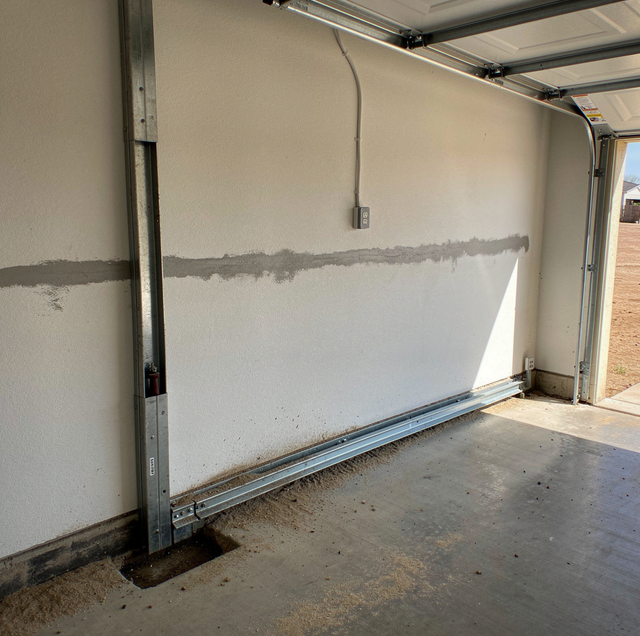
There is a chalky line on the drywall about a foot up from the slab, and below it the paint has gone dull. Silt has dried into a gray film across the floor and packed into the throat of the track. Above that line sit the opener head, its rail, and the receptacle it plugs into. How high the water got determines what was wet, and the order in which everything after has to happen.
The Circuit Feeding That Receptacle Comes First
Water and electricity sharing a slab is a shock hazard before it is a repair question. Nothing gets touched or plugged in until the circuit feeding that receptacle has been confirmed dead at the panel, and confirming it is not a homeowner step.
Standing water can be energized from an outlet, a cord lying in it, or the opener's own steel housing, and a receptacle above the water line can share a circuit with one below it.
The release cord is the first thing most people reach for, because what they want is the car out. It changes nothing about the gate above. Reaching that cord means standing in the water, and the water is the hazard the paragraph above just named. The car waits until the circuit has been confirmed dead. The cord carries a rule of its own. The release cord is safe to use only with the door fully closed and the counterbalance intact, and it is never a way to hold a door open.
Whether the Opener Was Energized When the Water Arrived
This gate splits the job into two repairs.
If the unit had already lost power when the water reached it, water is a contamination problem: silt in the gear grease, minerals drying on the board, corrosion starting at every dissimilar-metal joint.
If it was live, current had a path it was never built to take. Traces on the logic board carbonize where the leakage found them, relay contacts pit, semiconductors fail short. Something upstream may have cleared the fault in a fraction of a second, or nothing cleared at all.
A technician asks early, and the useful answers are ordinary: was the garage light on, did the power drop before or after, was a breaker tripped.
Reading the Height of the Mark Against the Hardware
The mark on the wall maps onto specific parts.
Floor to a few inches: the bottom brackets, the bottom section, the weather seal, and the safety sensors. Photo eyes sit low, commonly within about six inches of the slab, so almost any standing water reaches them first.
Ankle to waist: the vertical track and lower rollers, the lift cable where it lands at the bottom bracket, and any receptacle or cord on that wall. Springs and cables that sat wet rust from inside the coil outward, where nothing shows.
Ceiling height: the head, the rail, and the wiring above the opening, reached only by deep flooding or water from above.
What the Water Can Make Dangerous
Two failures inside the head put a person at risk rather than merely stopping the door. Both sit on a logic board whose fine traces are soldered with dissimilar metals, and water that dries there leaves behind whatever it carried: silt, minerals, and detergent residue all conduct.
The small step-down supply feeding the low-voltage side- meaning the sensor circuit, the wall console, and the radio receiver- is varnish-insulated wire wound tight. Contamination degrades that insulation, and the worst version puts line voltage where only low-voltage wiring is supposed to be.
The relays that switch the motor are the part nobody thinks about: small silver-alloy contacts in a vented plastic case. Corroded contacts fail to make, or make with high resistance and run hot. The one that matters most welds closed, because a relay that will not release is a motor that will not stop on command.
What Can Start Failing Weeks Later
Openers that were wet very often run the day after. Water conducts while it is present, and once it evaporates, the circuit returns to something close to what it was. "I tried it, and it worked" settles nothing.
What remains is residue, and two slow mechanisms act on it. Surface tracking comes first, a small leakage current creeping across a contaminated surface until it carbonizes a path that conducts far better than the residue did. Then corrosion at solder joints and terminal screws, where resistance rises, heat follows, and the corrosion speeds up.
Neither mechanism is visible from the wall button. The symptoms arrive later as intermittent operation, a unit that runs and quits, a burning odor, or a breaker that trips a month after everyone stopped thinking about the water.
What Only Stops the Door From Working
The travel module is how the opener knows where the door is. Some designs use a mechanical limit assembly, a threaded shaft with traveling nuts driven off the gear train; others count rotations with an optical or magnetic sensor on the drive gear. Silt in the threads loses the reference, and haze on a sensor window miscounts. What you see is a door that stops short of the floor, or halts partway up.
Motor windings are enamel-coated copper, and clean water leaves the enamel intact. But the film has pinholes, more with age, and flood water carries grit into every one, so a winding that behaves normally the day after can degrade over the following weeks. Water also washes grease out of the bearings, and the gear reduction, and a dry bearing gets loud, then hot.
If a backup battery is fitted, the pack and its charging circuit are their own item.
Water That Arrives From Above Instead of Below
A soaked opener does not need a flood. A roof leak over the motor head, a failed supply line in a ceiling, or condensation dripping off an uninsulated deck put water into the same places.
Water from above lands on the housing's ventilation slots, so it goes straight in. It arrives slowly and repeatedly, dries between events, and that wet-dry cycling drives corrosion harder than a single soaking does.
The telltales are specific: rust streaks down the top of the housing, a stained patch on the ceiling directly above, limit hardware gone orange while the rest of the unit looks clean. Rusted limit contacts in an otherwise tidy opener almost always mean a drip, and the drip is still there.
What the Repair or Replace Call Turns On
Four things decide it, and none is how the unit behaved on the first try.
Whether it was live when the water reached it, which sets how much of the board and its switching survived. How deep and how dirty, since a clean supply-line soaking and a slab full of yard runoff leave very different things behind. The age of the head, because parts for a discontinued board or travel module often settle it. And whether the source has been fixed: a new head under an active roof leak is a second failure with a date.
One thing is worth protecting while you wait, photographed from the doorway or once the circuit has been confirmed dead. The water line on the drywall, the silt film on the slab, and the rust bloom on the springs record how high it got, and all three vanish the moment the floor is mopped. A technician arriving after cleanup has to reconstruct that height from stains on the framing.
Frequently Asked Questions
It depends on what the water carried. Flood water carries silt, lawn chemicals, sewage, and, where a water softener discharged into the same space, salt. Salt residue is hygroscopic, pulling moisture from humid air long after the board looks dry, so a brine soaking is a harder call than a burst pipe.
The console usually sits at least five feet up, so it survives ordinary flooding, but the two-conductor low-voltage pair feeding it is typically stapled down the jamb to floor level, where it wicks water upward for hours. A shorted pair can present as a button held down, or as a sensor fault with nothing wrong at the sensors, so swapping the console alone leaves the fault in the wall.
They address different events. A GFCI opens when current leaks to ground, which protects people from shock; it does nothing to stop water ruining electronics, and it may never trip on damage that stays internal. A surge device clamps voltage transients from lightning or the utility, a different mechanism from conduction across a contaminated board.
A keypad has a membrane behind the buttons that wicks water and holds it against the contacts, so a wet keypad may transmit repeatedly or go dead. Remote battery contacts corrode with a white or green bloom. Any replacement has to be learned to the receiver, and a receiver that was itself wet may refuse to learn.
By what the corrosion looks like. Fresh rust is bright orange and powdery; older rust is dark, layered, and flaking. White or green salts crusted at terminal screws point to months of activity. A dried mineral line inside the housing marks a past event, and rust only on the underside of the rail and chain points to drips from above.
The header bracket and the hanging straps that carry the rail, since the whole head hangs from them and neither gets a second look on an ordinary service call. The receptacle and its box get checked on the same visit. So does the bottom section of the sectional door, which traps water inside the end stiles and in foam insulation long after the slab is dry.
Book a post-flood opener check now rather than after the intermittent faults start — Round Rock opener repair and garage door service in Austin both cover water-damaged units. Squared Away Garage Door Service serves Cedar Park and Central Texas. Call (512) 456-3781.
