
Parking Garage Door Failures: One Jam Locks Out Everyone
Quick Answer: A rolling steel door failure at a shared parking entrance is not a single-household problem—it locks out every vehicle behind it at once. Because the impact spreads instantly to dozens of households, visitors, and service vehicles, a shared entrance door must be serviced on a shorter interval than a private garage door, and the property needs a documented backup access plan (keypad, manual operation, and a door company that already knows the equipment) before the first jam occurs.
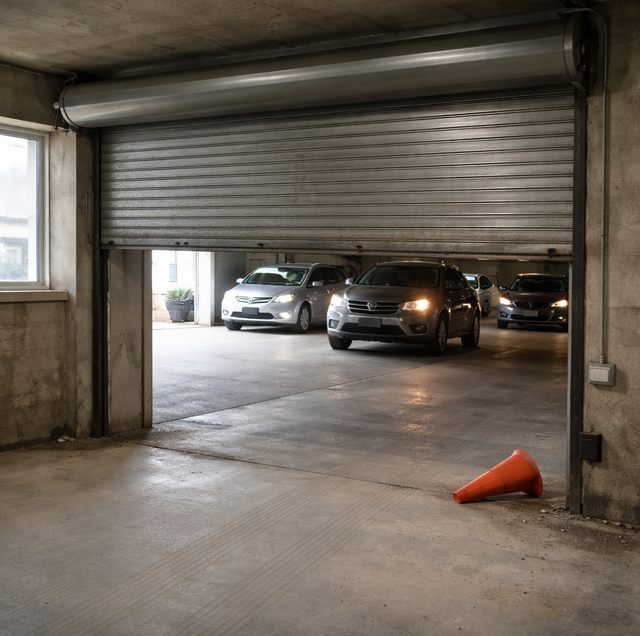
At 7:40 on a Monday morning, the rolling steel door at the exit of a shared parking garage stops four feet off the ground and stays there. Within ten minutes, a dozen cars are stacked up behind it, drivers are late for work, and a property manager is taking calls from every direction. Nobody in that line owns the door. Nobody in that line can move it. Until someone gets it up, nobody gets out.
That is what separates a single garage door failure from a shared access point failure. A homeowner whose garage door won't open loses a morning. A building whose only vehicle entrance won't open has an access problem that lands on every household behind it at once.
One Door, Many Households
A single-family garage door serves one household: a car or two, a handful of openings a day, one person to call when something goes wrong. The rolling or sectional door closing a shared parking structure serves every unit that uses that entrance, plus visitors, delivery drivers, contractors, and the trash truck that has to be inside by 6 a.m. Jammed closed, it strands everyone behind it. Jammed open, the property loses whatever access control that door was providing, and anyone on foot can walk in behind the first car.
The disruption spreads faster, too. One resident with a broken garage door calls one company and waits; a stuck shared entrance generates calls from dozens of households within minutes, usually with three different descriptions of what the door is actually doing.
Where the Garage Door Ends, and the Vehicle Gate Begins
Plenty of communities have both, and they are not the same equipment or the same trade. A rolling steel curtain or a sectional door closing an opening in a parking structure is a garage door: it travels vertically, it hangs on a counterbalance, it runs in guides or tracks, and a commercial garage door company services it. A swing or slide gate across a surface driveway runs horizontally on a gate operator sized for that motion, and it belongs to a gate specialist, the same way a dock leveler at a loading bay belongs to a separate equipment specialist.
Access control is a third thing again, with its own vendor: the card reader, the transponder antenna, the call box, the panel in the electrical room. Sorting out which system is which decides who gets called at 7:40 in the morning, and a resident reporting that "the gate is stuck" when the real problem is the structure's rolling door sends the manager to the wrong vendor entirely.
Why a Shared Door Reaches Its Wear Points Sooner
Springs, rollers, bearings, and operators are rated in cycles, not in years. A door opening for fifty households burns through those cycles in a fraction of the calendar time a single-family door takes, so the install date says little about how much life is left. Ask for the opening count instead. Shared entrances are usually specified with heavier-duty components, which buys time rather than an exemption.
Exposure adds to the count, since a structure door at an open-air deck sits closer to the weather than a home's door does. Heat thins the lubricant on the guides and helps airborne dust bind to what is left of it, and technicians widely observe joints, rubber seals, and the astragal along the bottom bar getting stiffer and slightly more brittle in the cold. Neither end of the range is clearly harder on the equipment than the other, and both stack on top of the cycle count. Clay soil that swells and shrinks with moisture adds one more, shifting the frame a door's guides are anchored to until a curtain drags.
What a Technician Checks Differently on a High-Traffic Door
A maintenance visit on a shared entrance is not the visit a technician runs on a home's door, even when the two look alike from the driveway.
The counterbalance and its bearings: End bearings and bearing plates take a beating on a high-cycle door that a residential door never gives them. Play in the shaft, a bearing starting to run dry, or a spring that has crept out of its set position changes how the door behaves well before anything fails outright. That is technician work, never a staff adjustment.
The operator's duty rating against the actual traffic: Commercial operators come in duty classes based on how many cycles per hour they can sustain without overheating, and a unit that suits a warehouse door opened a few times a shift will run hot on an entrance cycling all morning. Whether the installed operator matches the traffic is a separate question from whether it currently runs.
The sensing edge and the photo eyes: A rolling door usually carries a sensing edge in the bottom bar, wired through a coil cord or take-up reel that flexes on every cycle and eventually fatigues. The photo eyes sit at bumper height in a space full of exhaust and brake dust, so lenses that would stay clean for a year in a home garage build a film in a season.
Evidence of vehicle strikes: The most common thing that takes a shared entrance out of service is not gradual wear. It is a driver following too closely and getting caught by a door already on its timed close, or a box truck clipping the bottom bar. The signs are a bowed bottom bar, a slat pushed out of line, scoring inside the guides, and a curtain that hitches at the same height every cycle.
The close timer and the travel limits: On a shared door, the close timer is a real decision, not a factory default to leave alone. Too short and the door comes down on the second car in line, which is how strike damage starts; too long and the entrance stands open through every rush. Limits drift on high-cycle equipment as well, and a door stopping an inch high at the floor has a bottom seal that is not doing its job.
Ask the servicing company, too, which openings use fire-rated rolling doors, since those carry a separate testing routine handled by a company qualified for that work.
When the Door Fails Open: The Security Side of the Problem
A door stuck closed is loud and obvious. A door stuck open is quieter, often gets tolerated for days, and is the version worth planning for.
The moment a shared entrance stops closing, the property's access plan is running on whatever sits behind that door. Cameras keep recording, but a camera does not stop anyone. The pedestrian doors into the lobby and the stairwells become the actual security line, so it is worth knowing whether those still self-close and latch, because in most buildings nobody has checked lately.
The improvised fixes are the part to head off. Propping a partly open door with a cone, taping over a photo eye so the door stops reversing, or holding the wall button down to force a door past a bind all turn a service call into a repair, and each one removes a safety function that exists because these doors are heavy. Route vehicles away from a door hanging partway open rather than under it, since a curtain that has lost its support can come down without warning. If the outage runs overnight, the honest choices are staffing the entrance, running the door by hand with someone there to work it, or accepting an open garage and telling residents plainly.
Backup Access Worth Having on File Before the First Jam
Because a shared entrance failure reaches so many people at once, the plan for getting people in and out should already exist on paper. Three pieces are worth having ready.
A second way to trigger the door: A keypad or key-switch at the entrance is an alternate input to the operator, a second credential path for when the primary one fails. If the phone app is down, the transponder reader loses power, or a resident's remote dies, a working keypad code still tells the operator to run. Confirm the code works and that more than one person on-site knows it. Be clear-eyed about the limit, though: a second credential helps only when the door and operator are healthy. It does nothing for a mechanical jam, since a door bound in its guides ignores every credential equally.
A manual option, used only when it is safe to use one: Most commercial operators can be disengaged so the door can be worked by hand, and many rolling doors also carry a hand chain hoist. The precondition matters more than the procedure: hand operation assumes the counterbalance is intact. If a spring has failed, the door has lost the thing carrying its weight, and moving it by hand turns dangerous rather than inconvenient, especially for a door sitting partway open. A bang before the failure, a door that suddenly feels far heavier, or a visible gap in a spring all mean hands off and call a technician.
A door company that already knows this equipment: A company that has never seen the property's rolling steel door spends the first part of an emergency call identifying what it is looking at. One that already holds the make, model, operator type, opening location, and service history can go straight to diagnosis. Keep an entrance-by-entrance list, since "the garage door" means nothing at a property with three of them, and confirm once a year that the after-hours number still reaches a person.
A Shorter Service Interval for Equipment Everyone Depends On
An annual visit is often enough on a private garage door, because a missed adjustment there inconveniences one household. On a shared entrance, the same missed adjustment strands everyone parked behind it and takes the property's access control offline at once. That difference in consequence, not a difference in build quality, is why shared doors are generally serviced on a shorter interval, and why a stretching cable or a roller starting to bind is worth catching between visits rather than at the end of one.
Frequently Asked Questions
This is an authorization problem more than a repair problem, and it is worth settling before the door breaks. Name one person on each side who may call the vendor, and give that person a pre-agreed approval limit they can act on without convening two boards; a technician waiting at a stuck door for a second signature is the most avoidable delay in the scenario. Agree on the split formula in advance, usually by units served or active credentials issued, and have the vendor copy both management companies on every service report.
A resident's job is to report it accurately and get out of the way: call the number posted at the entrance rather than the first garage door company in a search result, say which entrance it is and what the door is doing (stopped partway, no response, moving and reversing), and don't stack more cars behind it. Don't pull a release handle, wedge anything under a partly open door, or hold the button down to force it. The follow-up belongs to the manager: one point of contact to the vendor, a notice to residents with an alternate route, and a written record of what failed and what was replaced, which is what turns a third failure into a pattern instead of a surprise.
Yes, in ways that affect both failure modes and repair time. A rolling steel door is a curtain of interlocking slats coiling around a barrel above the opening, with the counterbalance springs inside that barrel and the curtain riding in vertical guides. A sectional door is hinged panels on rollers riding a track that turns horizontal overhead, with springs on a shaft across the header. Damage a rolling curtain and the repair often means individual slats or the bottom bar; damage a sectional and it usually means one panel section.
On a high-traffic door, a new noise is early information rather than a nuisance, and it is worth reporting the week it starts. A rhythmic squeal keeping time with the barrel or shaft turning usually points to a bearing running dry. A metallic grind from the guides often means they have lost their lubricant, or a shifted frame is pushing the curtain sideways. Chain slap or a clunk at the start of travel points to the drive side: a worn sprocket or a loose coupling. A single sharp bang is never routine, since that is a spring letting go.
Usually the access control vendor's, not the door company's. The reader, keypad, or call box is a separate low-voltage device that only closes a momentary contact on the operator's terminal strip, electrically the same event as pressing the wall button. If the wall button runs the door normally, the door, its counterbalance, and its operator are doing their part. Common causes on the access side are a failed weather gasket letting moisture into the housing, a corroded terminal on the low-voltage run, or a lost programming table after a power event.
Less than people expect, and the time to find out is not during the outage. Consumer-style battery backup is common on newer residential openers but far less so on commercial operators, so a shared door with no backup power stops responding. Establish in advance whether the door has a hand chain hoist or an emergency manual release, where the key or chain keeper is stored, and which staff member is trained and authorized to use it. Settle who may leave a door standing open for the duration, since a door opened by hand at 6 p.m. and forgotten at midnight is an open building nobody decided to open.
Arrange a shorter service interval for your shared entrance — commercial rolling steel doors and the commercial door operators behind them get looked at on the same visit. Squared Away Garage Door Service serves Cedar Park and Central Texas. Call (512) 456-3781.
