

Garage Door Spring Bracket Pulling Away: Stop Using the Door
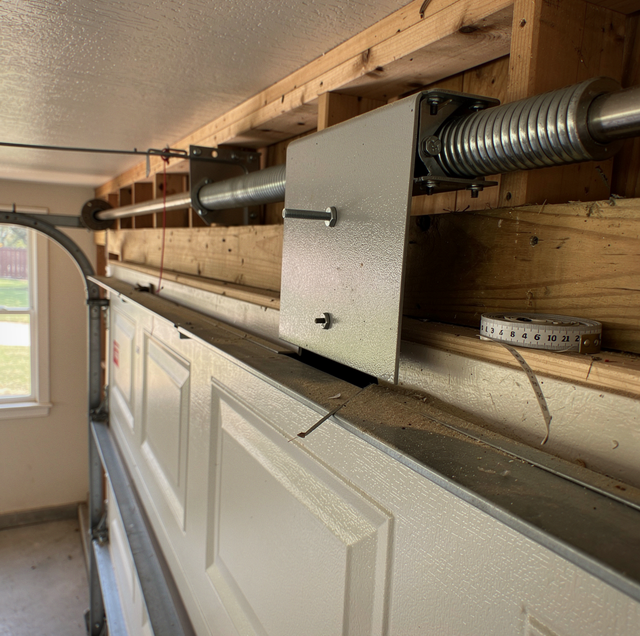
Quick Answer: A center bearing plate lifting off the wall means the fasteners holding your wound torsion spring are losing their grip on the framing behind it. Treat it as a door that stays down until a technician has looked at it.
The measurement is small. The top edge of that steel plate above the center of your garage door stands off the wall by a sixteenth of an inch, maybe an eighth, where it used to sit flat. Behind it, the torsion spring bolted to that plate is wound to cancel the entire weight of the door, and all of that stored twist reaches the framing through this single fitting.
What the Spring Is Holding Back
A residential sectional door is heavy. Once insulation, glass, and steel thicknesses are accounted for, a double door commonly weighs well past 200 pounds, and the torsion spring above the opening is designed to cancel almost all of that weight by storing energy as twist.
That push never reverses direction. It varies in magnitude, strongest with the door down and weakest with the door up, which means the closed door sitting quietly overnight is the condition in which the spring leans hardest on its anchor. High cycle counts add a second kind of wear: a garage serving as a household's main entry sees several openings and closings a day, each one another small tug at the same fasteners.
The Stationary Cone and the Plate It Loads
At the inner end of the spring sits the stationary cone, a cast fitting clamped to the torsion shaft and bolted through the center bearing plate, the part hardware catalogs also list as a spring anchor bracket. The outer end carries the winding cone, where tension was originally set. The spring is permanently trying to unwind, and the stationary cone is what refuses to let it.
That refusal has to go somewhere. The cone hands it to the plate as a rotational load, twisting it about the shaft, which peels one edge of the plate off the wall while pressing the opposite edge into it. A failing anchor usually looks tilted before it looks loose. A typical two-spring torsion door rests its shaft on three points: an end bearing plate on each side and one in the middle, so a plate that moves takes the shaft's center support with it.
How the Plate Gives First
Steel is stiffer than the wood behind it, so the plate shows trouble before the framing announces it. The fastener holes elongate into shallow ovals as the lags migrate. The plate cups slightly, its top edge standing off the wall while the bottom edge stays tight.
None of that changes what the spring is doing. It keeps applying the torque it was wound to, and the plate keeps handing that on, now through a smaller and less square contact area.
The Direction This Joint Is Actually Loaded
A lag screw resists being pulled straight out of wood far less capably than it resists being sheared sideways, and along the peeling edge of the plate, withdrawal is the direction that matters. The lags on that edge are being asked to resist the one load a lag resists worst. The opposite edge is still being pressed into the wall, so it tells you nothing about how much grip is left in the joint as a whole. Running underneath both is a third component: on a two-spring door, the shaft's midspan weight bears down on this same plate as a steady downward shear, present whether the door moves or not.
Almost all withdrawal resistance comes from thread engagement in solid wood. The head and washer matter only for as long as the threads still have something to hold. That is why a lag head standing proud of the plate is such a specific sign. It is a record of withdrawal already in progress. Humidity works the same interface from the other side, building rust on the shank and in the wood fibers around it.
A Single Point in the Header Above the Opening
Two things separate this joint from the rest of the hardware bolted to a door's surroundings. First, it stands alone. Track hardware is spaced along each jamb in two or three places, so a fastener that loses grip in one still has neighbors sharing the same side load. This plate has no neighbors, and nothing takes over what it drops. Second, it is anchored in the header framing spanning the opening, lumber already carrying the building across that span before the door asks it for anything. And the load arriving here is a torque couple about the shaft, so the plate is worked in rotation, levering against its fasteners on every cycle.
The Early Signals Only This Joint Produces
A creak at the very start of the first cycle of the day is usually first. The spring is at its highest torque with the door down; the joint has to break static friction before anything moves, and a plate with elongating holes gives up a small movement at exactly that moment. It goes quiet once the door is traveling.
Then comes geometry. The torsion shaft is meant to read level across the top of the door, and it reads level because three supports hold it on one line. Let the middle one migrate, and the shaft picks up a slight sag or tilt at its center, visible against the top section while the door sits closed. The plate goes out of square about the shaft at the same time; the fitting that used to sit plumb now leans, because the couple is rotating it and the elongating holes are letting it turn.
Neither signal is dramatic, and both have usually been running a while before the third stage, the plate standing measurably off the wall. A bracket almost never travels from flush to failed inside one cycle, which is why a standoff visible from across the garage deserves attention the day you notice it.
Cycling the door to see whether the creak repeats loads the anchor again at its worst moment. Each test cycle asks the same weakened fasteners to do the same job, and the plate only ever stands further off the wall.
Why the Door Stays Down Until It Is Inspected
If the anchor releases, the stationary cone has nothing to react against, the shaft is free to spin, and the counterbalance vanishes at the instant the door is heaviest. Cables go slack and crowd out of their drum grooves as that happens. What remains is a heavy door with nothing holding its weight, above an opening people walk through.
That is also why the emergency release offers nothing useful in this situation. The release cord is safe to use only with the door fully closed and the counterbalance intact, and it is never a way to hold a door open. Down and unused is the only position that keeps the load static and keeps people out from under it.
The part worth carrying into the service call is that this is a framing question before it is a hardware question. New fasteners driven into the same tired wood inherit the withdrawal capacity that just proved insufficient.
Frequently Asked Questions
Yes, and two situations do it quietly. Lags driven into engineered lumber, or into a knot at the fastener line, hold unevenly from the first day. And a hole that has already carried a lag never returns to full withdrawal capacity, so a bracket re-fastened into its original holes after an earlier repair starts out weaker than it did on the first install.
It concentrates the load. A double door transmits its entire counterbalance through a single center bearing plate at a single point in the framing. Two singles, each with its own spring set anchored at its own center, spread a similar total weight across two separate pieces of header. The wider opening also spans a longer structural header, so the framing behind the plate carries more load than the door alone.
Usually both stationary cones land on the same plate, so one piece of steel carries the combined torque of both springs. Heavier doors are often fitted with a longer plate that has more fastener holes. Spring count is chosen for the door's weight and target cycle life, so a two-spring door signals a plate that has been carrying a lot all along.
Then the question moves behind it, and that generally means the wall covering has to come off. Drywall or a finished panel across the header hides whether the lags landed in solid header stock, in a shim stack left over from construction, or in a cavity, and none of that reads from the room side while the plate is still bolted up. Two consequences follow. The repair includes patching whatever had to be opened, and nobody can describe the condition of the wood in advance, because the plate is sitting on the only evidence.
Position separates them. Roller and hinge noise travels with the door, repeating at different heights and shifting as the section producing it moves; a worn roller often sounds different loaded than unloaded, so a door can be noisy going up and quieter coming down. Anchor noise never moves. It comes from one fixed point high and centered above the opening, and it sounds the same every time because the joint that makes it does not travel.
No. Extension springs run alongside the horizontal tracks and anchor at the rear track hangers and at plates near the flag brackets, so that layout has no center anchor to lose. The equivalent failure there is a hanger or anchor plate working loose from ceiling framing. Telling the two apart takes one look: torsion springs sit on a shaft above the opening, extension springs stretch horizontally beside the door.
Line up a torsion spring and anchor repair while the door stays parked — Austin garage door spring replacement and Round Rock spring service are both on our regular route. Squared Away Garage Door Service serves Cedar Park and Central Texas. Call (512) 456-3781.
