

Garage Door Spring Slipped but Not Broken — the Quiet Failure
Quick Answer: A torsion spring can lose every bit of its tension without breaking. If the winding cone slips on the shaft, the spring unwinds quietly, the counterbalance disappears, and the door gets heavy with nothing visibly wrong on it.
Nothing woke anyone up. No bang from the garage in the night, no metallic crack, nothing anybody can point to. The door closed normally last night. This morning it is heavy enough that the opener labors on the way up.
A heavy door with no noise behind it is the one situation where every check from the floor comes back clean. The spring above the opening looks the way it did last week: one continuous coil, no gap, no rust on the concrete. That observation is accurate, and it says nothing about the tension left in the spring.
The Spring Is in One Piece, so the Spring Is Fine
A torsion spring's job is stored energy. Unbroken steel makes that job possible. Whether energy is currently stored in it is a separate question, answered by different evidence.
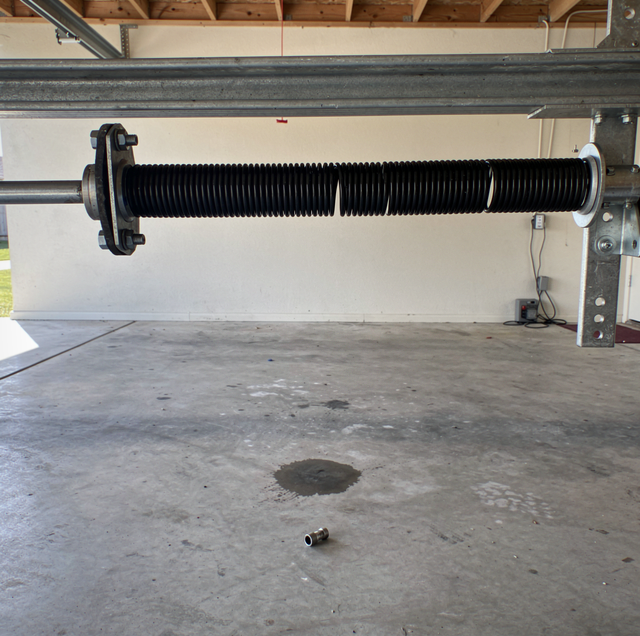
The spring sits on a steel shaft running horizontally above the opening. At its inner end is the stationary cone, bolted to the center bracket. At the outer end is the winding cone, the fitting that matters here, carrying set screws that clamp onto the shaft, on many installs seating against a flat ground into it so they have something square to bite. The counterbalance runs through that grip, out to the cable drums and down to the bottom brackets.
Take the grip away and the spring hands its energy back to nothing. A screw that backs off under vibration, or one that has lost its bite on the seat beneath it, gives the same result: the cone rotates freely, the spring unwinds, and the steel comes through undamaged.
Torsion spring torque never reverses direction. It varies only in magnitude, maximum with the door down and minimum with the door up, so the counterbalance does its heaviest work in the first stretch off the floor.
No Noise Means Nothing Failed
A spring that breaks is loud because the release is instantaneous. The coil fractures; the stored energy is distributed between the two halves, and they slam apart along the shaft. People inside the house describe it as a gunshot.
A cone that slips releases the same energy through sliding contact between two pieces of steel over some number of revolutions rather than in a single event. Sometimes that gives a low groan or a ratcheting rasp. Often it gives very little, particularly with the garage empty.
Silence is a poor witness, and a slip can arrive in stages, each one leaving the door slightly heavier.
The Opener Is Struggling, Which Makes It the Culprit
An opener's motor is sized to move a door that is already balanced. The counterbalance carries the weight; the opener supplies direction and a modest push. Without it, the motor lifts a whole sectional door through a drive never rated to carry it.
It will often still manage for a while because an opener allows a certain amount of ordinary resistance before it flags a cycle as abnormal.
So the symptoms arrive dressed as opener symptoms: a motor labored and slow off the floor, a chain that jumps, a door that stops partway up or reverses at an inconsistent height. Every one describes a motor under a load it was never selected to carry, and a new opener meets the same load.
One Door Means One Spring to Worry About
Plenty of sectional doors run two torsion springs, sized as a pair so each carries roughly half the counterbalance.
When one loses its tension, the other does not fail with it. It keeps doing exactly what it was doing, which is why the door still frequently opens and is left alone for weeks.
Manufacturers commonly rate residential torsion springs by cycles, a standard spring often at around ten thousand open-and-close cycles at the load it was sized for. A spring selected to carry half a door and now carrying all of it spends that rating far faster.
A door with no counterbalance puts its full weight through the opener, the cables, and the top-section hardware on every cycle. Three parts take damage at once, and the first sign is usually one of them failing.
It Still Opens, so It Can Wait
The opener takes the damage first. Running is the easy part of a cycle for a motor; it is the heavy start against a dead weight, repeated, that puts heat into a start winding and a run capacitor. That moment, as the door breaks away from the floor, is also when a chain drive's plastic gear teeth take their beating.
The cables take it next. A lift cable not held tight by a balanced load goes slack and crowds out of its groove on the drum, taking the door out of square on the next cycle.
The door absorbs the rest, with the J-arm pulling against the top section every cycle and loading hinges, the end stiles, and the center stile beyond what a balanced system asks of them.
Pulling the red handle now hands that whole weight to whoever is holding the cord. The release cord is safe to use only with the door fully closed and the counterbalance intact, and it is never a way to hold a door open.
What a Slipped Cone Leaves Behind to Find
Everything below is visible from the floor with the door closed, and the opener unplugged. Nothing on the spring system should be handled, and nothing here asks you to.
The strain the opener showed has a shape. It works hardest in the first foot or two off the concrete and eases the higher the door travels, which is where the counterbalance did its heaviest work. An opener laboring evenly through the whole travel is describing something else.
If the springs were marked, the fastest answer is the mark. Some installers draw a line in paint across the winding cone and onto the shaft for this reason, and a line that no longer meets up says the cone has moved.
On a two-spring door, the springs are each other's reference. Compare the coil spacing, the length along the shaft, and where each winding cone sits. A spring that has given up its winding lies slightly longer than its partner, with visible light between coils that once sat tight. A break leaves a clean separation of roughly two inches instead.
The cable drums deserve a glance, because the same fault happens there. If a drum's set screws lose their bite, the shaft turns while the drum does not, so one cable goes slack and the door rises crooked. That is the more urgent picture: a door running crooked binds the top section in the track's throat and is heading out of it.
Where a flat has been ground for them, set screws hold because it gives them a square surface to press against; on a plain round shaft they bite the steel itself. Either seat is spoiled once a screw has spun on it, the edge rolling over and polishing the surface it gripped. The shaft's seating surfaces get inspected for that reason before anything goes back under tension.
Frequently Asked Questions
Both, for different reasons. An early slip usually traces back to the seating the set screws got at install: one snugged rather than set, or one bottomed on a burr left from cutting the shaft to length. A slip years later comes from vibration at a high cycle count and from steel expanding and contracting in an unconditioned garage. A new spring on an old shaft is the case worth flagging, since the shaft's condition, rather than the spring's, determines whether the new cone holds.
Closing is where a lost counterbalance hides best, because gravity is on the door's side. What changes is control: the door can run down faster than it should and land hard, and the sections and bottom seal absorb that landing every time. The photo eyes remain the safety system that stops a closing door on an obstruction.
In degree, and in what it leaves on the shaft. A cone that has walked a fraction of a turn keeps some of its winding, so the door reads as merely heavy and gets blamed on a dry roller or a stiff hinge. Dragging screw tips burnish a ring or a spiral scar into the shaft, and the length of that scar tells a technician how far the cone traveled. Partial or complete, the turns still in the spring can release the rest of the way on any cycle.
Not by itself. The wire may be undamaged and well inside its cycle life, with the fault sitting in the fasteners and seating surfaces. Age, corrosion, and scoring on the wire feed the decision. On a two-spring door where one has carried the whole load for a while, the springs are replaced as a matched pair, since a fresh spring beside a worn one throws the balance off.
No. That system has no cone and no torsion shaft. Extension springs run horizontally above each side of the door and store energy by stretching. Their equivalents are a spring that has taken a permanent set, one off its S-hook or pulley bracket, or a break. Each should have a safety cable threaded through it.
Yes, if the outlet is reachable without climbing. Unplugging removes the only thing that will try to lift the door, and the chance of somebody else cycling it. The console lock or vacation mode is no substitute: that setting disables the remotes and keypad and deliberately leaves the wall button live. A closed door rests its weight on the floor instead of on the inner carriage.
Get the counterbalance measured rather than guessed at: Hutto torsion spring replacement matches wire size, length, and wind to the weight the door actually carries, and everything else Hutto garage door service touches on that shaft depends on getting it right. Call (512) 456-3781.
