

Garage Door Opener Gear Stripped: The Sound That Gives It Away
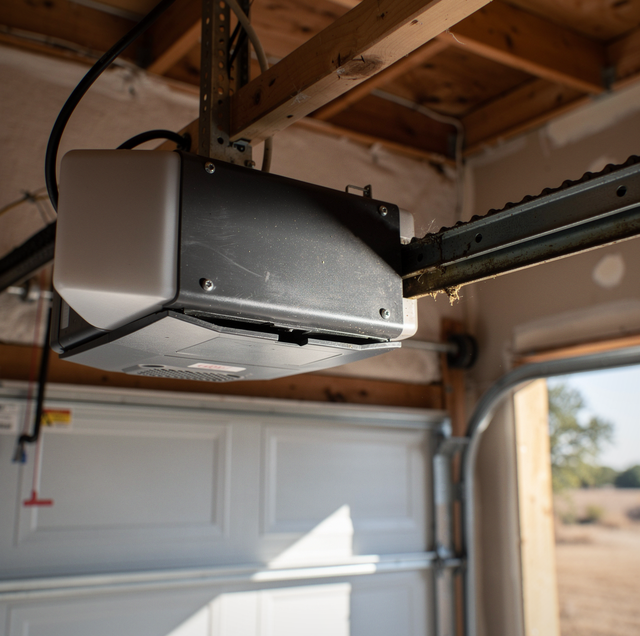
Quick Answer: A motor that runs while the chain or belt stays still usually means the opener's nylon drive gear, turned by the steel worm shaft, has stripped its teeth, or the drive sprocket has sheared. The motor is rarely the problem.
The sound arrives before anything else does. A dry grinding whir rides underneath the familiar hum overhead, runs for the few seconds the door should have been traveling, and then stops. A minute later, there is a thin, hot-plastic smell hanging near the ceiling. The door has not moved. The chain or belt sits exactly where it was, and everything electrical is behaving normally: the light came on, the unit answered the button, the sensor indicators are steady. Something much smaller than any of that has already failed, and it failed before you finished listening to it.
The Grinding Means It Needs Lubricating
A grinding noise reads as a lubrication problem, and there is already lubricant in there. Inside the motor head, a steel worm shaft spins fast and quietly, and a nylon gear rides against it, trading that speed for the torque that moves the chain, the belt, or the screw drive. The pair comes packed in heavy grease from the factory, and a technician repacks it whenever the housing is opened. Dryness is a real failure mode on a neglected unit, but it produces a squeal that wanders with temperature and comes and goes. This noise does neither.
That nylon gear is the softest part in the drive train between the motor and the door, and it is generally the first thing to give. It gets called the fuse of the drive train, and as a description of the outcome that holds up, though whether sacrificial behavior is the design intent or simply what follows from molding a gear out of nylon is not something the part itself settles. Either way, the practical result is the same: an overload lands on a molded gear rather than on the motor's windings or the steel shaft under it. When those teeth shear, the worm keeps turning against what is left of them, and that is the grinding note. The friction heat coming off the ruined nylon is the hot-plastic smell, and it is why the motor keeps running smoothly with nothing at all happening at the door.
The clearest confirmation is not the sound. Open the motor head cover and stripped nylon leaves fine, pale shavings that are collected at the bottom of the case, dusted across the circuit board tray, or packed into the grease itself where the gear meets the worm. A technician looks for those shavings before anything else, because a gear that has lost teeth cannot hide them. The material has to go somewhere, and it goes into the case.
A Sheared Sprocket Is the Same Repair as a Stripped Gear
The two sound nearly identical from the driveway, but they are not the same part. The drive sprocket is the toothed wheel the chain wraps around, mounted on the output shaft above the gear and driven by it. A sprocket can lose a tooth, split at the hub, or work loose on its shaft, and when it does, the motor runs, the gear turns, and the chain still goes nowhere. The order of the parts matters to the repair: a gear failure leaves an intact sprocket behind it, and a sprocket failure often leaves an intact gear underneath.
A chain that has jumped the sprocket entirely is the third member of this group. It kinks or piles up at the motor head and binds against the housing, so the drive train is turning, and the chain is trapped rather than parted. From the floor, all three read the same way: a motor running, a door standing still. A technician separates them by where the shavings are, whether the sprocket teeth are complete, and whether the chain is still seated in its groove.
A trolley that has lost its grip on the chain is a different failure again, because there the chain keeps moving while the door does not.
Retensioning the Chain Will Fix It
A slack chain is a real and separate problem with a real and separate fix: a technician re-tensions it at the threaded adjustment on the carriage end of the rail, and that is the correct answer to that symptom. It is not the answer to this one. A stripped gear or a sheared sprocket has no intact teeth left for tension to pull against, so tightening the chain adjusts the geometry of a connection that is no longer there.
The confusion is reasonable, because slack and shear can sound alike on start-up. A loose chain slaps the rail and rattles through the first few inches of travel; a stripped gear grinds and keeps grinding. The difference is what the door does. The loose chain still moves it, badly. The stripped gear doesn't move it at all. If the door is not traveling, tension is not the variable, and a service call spent on the turnbuckle is a service call spent on the wrong part.
Running the opener repeatedly against a stripped gear will continue to generate friction heat inside the housing. Cut power at the wall outlet or the unit's own switch until a technician looks at it, rather than testing the button again.
The Heat Did It
Heat is part of this, and it is not the whole of it. Nylon softens as it warms, and a motor head hanging near the ceiling of a garage that runs warm through the afternoon holds that heat long after the sun is off the door. A gear that carries a given load cold will deform under the same load hot. But the same teeth get worked from the other direction the rest of the year, because nylon takes up and gives off moisture and changes dimension with temperature, so every warm-to-cool swing across a year shifts the tooth profile slightly against a steel worm that does not shift at all. Openers strip gears in January too, and a gear that failed in February failed for reasons that were building through the previous summer.
What sits beneath both halves of that is load. The most common cause of a stripped gear is a door that has drifted out of balance, so the springs are no longer carrying their share of the door's weight and the opener is quietly doing part of the springs' job on every cycle. Temperature moves the threshold up and down. The imbalance raises the load to meet it, and it is why a gear replacement on its own is only a partial answer.
The Gear Went Because the Opener Is Old
Calendar age is a proxy for cycles, and cycles are what wear a gear. An opener on a garage used as the household's main entrance can run six or eight times a day; the same model on a detached shop door might run twice a week. Ten years of the first is not the same part as ten years of the second, and the number on the label predicts very little on its own.
Newer openers strip gears too. A two-year-old unit hauling a door whose springs have lost tension is being asked for more torque than a fifteen-year-old unit on a balanced door, and the gear is the part that accounts for the difference. What a technician actually reads from an opener's age is what else inside the unit is approaching the end of its own service life, a separate question from the one the gear just asked.
A Louder Motor Means a Bigger Repair
Volume is not a measure of scale here. A stripped gear is among the loudest things an opener does and among the smaller parts inside it. The quiet failures are not automatically the smaller ones either. A belt-drive unit whose gear has gone can sound close to normal, because there is no chain to rattle and no steel running on steel to carry the sound, and a screw-drive unit can go almost silent while the drive train does nothing at all.
Two things do scale with the repair, and neither is volume. One is whether the noise stops when the power does, or whether something is still moving or settling after the unit goes quiet, which points at the door and its counterbalance rather than at the opener. The other is whether the sound arrived alone or arrived with a bang. A sharp report followed by a door that will not move is a spring or a cable, and that is a different visit with different parts on the truck.
Where the Door Is Sitting While You Wait
With the drive train out of the picture, the door is sitting wherever it stopped, held there by its springs rather than by the opener. On a balanced door, that was always true; the opener only supplied the push that started and stopped the travel. A stripped gear removes the push and leaves the weight exactly where it has been all along.
That makes the door's position the first useful thing to report on the phone. Fully closed is a different visit from stopped partway, which is different again from fully open and staying there, and each one changes what gets secured before the housing is opened. Worth saying in the same breath: whether the door moved at all before it stopped, whether it moved smoothly or in a jerk, and whether a vehicle or anything else is sitting under it. Those three details tell a technician more about what caused the overload than the description of the noise does.
Frequently Asked Questions
Yes. Belt-drive and screw-drive openers use the same worm-shaft-and-nylon-gear arrangement, but the wearing part is often molded together with the sprocket or drive collar as a single assembly rather than sold as a separate gear wheel, so a technician typically replaces the whole drive assembly rather than just a gear.
It can, but not because the motor is working hard. A motor turning nothing draws less current than a loaded one, not more. The stress is in the starts. Every press is another inrush through the start winding and the run capacitor, so a door being retried a dozen times in an evening puts far more heat into those parts than a dozen normal cycles would. An opener that has stripped a gear more than once in a short stretch is usually worth having its capacitor checked at the same visit.
If the same overload event that stripped the first gear also bent the worm shaft it rides on, a fresh gear will be turning against a shaft that no longer runs true, and it can shear again quickly. Before installing a replacement, a technician checks the shaft for runout. A worm that no longer runs true will take a new gear apart on the same schedule.
Not the same arrangement. A wall-mount, or jackshaft, opener bolts beside the torsion shaft and drives it directly through a short chain and sprocket, with no rail across the ceiling and no carriage. It still steps motor speed down through a gear set, so a comparable failure exists, but it presents differently: the shaft never turns, the cables stay wound on their drums, and there is no overhead chain to look at for a clue.
No. The safety reversal sensors run on their own separate circuit from the drive gear, so a stripped gear doesn't disable them. A technician working inside the motor head will still retest the sensors before handing the opener back, simply because any time the unit has been powered down and opened up is a reasonable point to confirm they're still aligned and functioning.
Usually, though the first cycle after the repair is where you find out. Travel limits and force values live in the unit's memory, and on most openers built in the last decade they survive being powered down and opened up. On some units, and on any unit whose logic board must be removed to access the gear, those values revert to their defaults. What that looks like on the first run is a door that stops short of the floor, sets down and immediately reverses, or halts a few inches shy of fully open. A technician resets the limits before leaving. If that behavior turns up later, it points back at those settings, and calling it a second gear failure buys a part the opener does not need.
Book a technician to open the motor head rather than guessing at the noise: opener repair in Georgetown covers the gear, the sprocket and the chain, while spring replacement in Leander settles the counterbalance that overloaded them. Squared Away Garage Door Service serves Cedar Park and Central Texas. Call (512) 456-3781.
