

Garage Door Opener Ripped Out of Ceiling: What Actually Failed
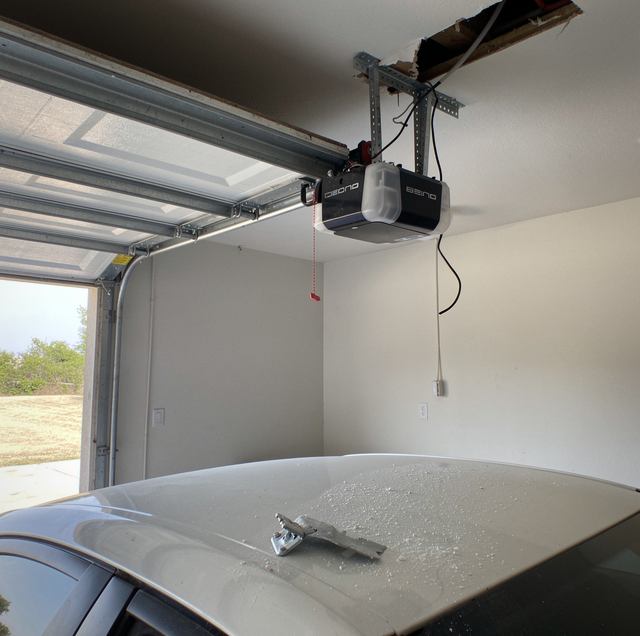
A technician called out for this finds the motor head hanging below the ceiling, still bolted to the rail and still wired, swinging slightly if anyone bumped the car pulling in. The bracket that once held it flat against the framing is bent, sheared, or simply gone, and a scatter of drywall dust and anchor fragments usually sits on the hood or the floor underneath. The door itself, open or closed, often looks untouched. Whatever failed, failed overhead, and it rarely stopped at one part.
Quick Answer: A torn-loose motor head almost always means the mounting hardware missed solid framing behind the ceiling. What matters next is what came down with it, and why your opener was straining hard enough to pull free in the first place.
The Fastener That Let Go
Every opener rail is carried at the ceiling end by a mounting bracket, most often a length of punched angle iron or a pair of strut hangers, held up with lag screws meant to bite into solid wood. Those screws are supposed to land in a ceiling joist. In a lot of failures, they didn't: a single plastic anchor or toggle bolt driven into drywall, with no framing behind it at all, carried the weight for months or years of ordinary use before letting go under one hard pull. In older homes, rust around the lag heads can also weaken that grip well before any obvious overload, especially in a garage that stays humid most of the year. A lag screw that actually reaches a joist can still fail, but it usually fails differently, and the wood is often what gives way.
The Framing Behind the Drywall
When the screws did reach a joist, the joist itself is sometimes what gave out, splitting along the grain right at the lag line while the screw stayed put. A split like that usually means the joist was already thin at that point, or that the load landed near the very edge of the board rather than its center. Some ceilings never had solid backing there in the first place: no blocking was ever run between the joists to give the bracket anything wider than the last half-inch of a single board to grab. A bracket that lags into blocking spanning two joists carries that same load very differently than one pinned to a single narrow edge.
What a Falling Motor Head Takes With It
A motor head doesn't fall on its own, because it's still connected to the rail, and the rail is still connected to your door. If the ceiling end drops, the rail can bow or twist along its length, and the header bracket at the wall end (the point where the rail ties into the framing above the opening) takes on a sudden new angle of pull it was never built for. The J-arm connecting the rail's inner carriage to the top section can bend or pull the top section's bracket loose, especially on an older sectional door where the hardware has already seen years of cycling. Any wiring stapled along the rail for the wall control button or the photo-eye sensors travels with it too, and a hard enough drop can pull that wiring loose at either end, even though it's a separate, low-voltage circuit from the opener's own power cord.
The Electrical Question Overhead
Most residential openers plug into a receptacle mounted near the ceiling, and a torn-loose motor head often ends up hanging from that cord. Its full weight then lands on the plug, on the strain relief where the cord enters the housing, and on whatever staples hold the cord along the ceiling line. A receptacle can be dragged part way out of its box that way, and the cord can be stretched thin at a point that gives no sign of it from the floor.
A dangling motor head is often still powered through its ceiling cord and may be resting against exposed wiring or the receptacle itself. Safely isolating that circuit is a technician's job, handled before anything overhead is touched.
Why the Mount Was Overloaded in the First Place
A mounting bracket rated for the opener's own weight, commonly somewhere in the 20-to-40-pound range for the motor head alone, isn't usually the thing that tears a bracket loose. What tears it loose is the opener being asked to move a door that wasn't moving freely. A torsion spring that has already failed leaves the opener lifting your sectional door's full weight rather than a balanced load, cycle after cycle, until something upstream gives way.
A door bound in its tracks, whether from a bent rail, dry rollers, or debris, fights the opener the same way, and so does a manual lock engaged at the bottom of the door: the opener pulls, the door doesn't move, and the force has to land somewhere. Modern openers are built to sense that kind of resistance and reverse it, though force settings tuned around a healthy door can absorb a fair amount of additional resistance before they trip. The same overload that pulled the mount out of the ceiling is still sitting in the door, and disconnecting the opener does nothing to relieve it. The release cord is safe to use only with the door fully closed and the counterbalance intact, and it is never a way to hold a door open.
A door that cycles many times a day, the way an attached garage used as a main entry usually does, pushes a marginal mount toward this kind of failure sooner than a door that opens once or twice a week.
What This Means Before a Technician Gets There
With the mount torn loose, your opener isn't reliably connected to anything, and running it again on a whim risks pulling the rail, the header bracket, or the top section further out of position before anyone has looked at the framing behind the ceiling. The more useful question to have answered before that visit is why the opener was straining in the first place, since remounting a motor head to solid blocking does nothing for a spring, a track, or a lock that's still fighting it on the next cycle.
Frequently Asked Questions
Often the head itself comes through it. Motor housings survive a fall undamaged internally more often than owners expect, since the drop is usually a matter of inches and the case is built to take vibration. The rail is what needs checking: even one that looks straight can pick up a slight bow or twist from being yanked sideways at one end, and a bowed rail lets the inner carriage bind intermittently long after the mount itself is fixed.
Some ceilings, especially over a garage framed with engineered roof trusses instead of dimensional lumber, don't have a single joist running the right direction near the opener at all. In that case, the fix is to add a blocking piece that spans between two trusses, giving the bracket a wide, solid target instead of relying on a single thin edge.
It can. If a drive sprocket slips a tooth or a belt jumps its track, the sudden jerk when it re-catches delivers a sharp shock load to the rail and mount, different in pattern from the steady overload of lifting an unbalanced door but the same in result: a one-time jolt can pull the same lag screws loose as months of repeated strain.
Usually not right away. The low-voltage wiring for the wall control and the photo-eye sensors runs as a separate circuit from the opener's own power cord and often has enough slack to survive a partial drop. That run gets inspected for pinches and exposed copper at the staple points during the repair, since a nicked wire there can produce an intermittent fault weeks later, long after the mount itself has been fixed.
Parking is fine. Leave the opener alone. If the tear-out happened because the spring had already failed, the door itself is now a full deadweight with no counterbalance behind it, and lifting it by hand carries about the same risk that pulled the mount loose in the first place.
Usually not. A length of punched angle iron that has already deformed under load has taken a permanent set, and a bracket sitting even slightly out of plane hands the rail an angle the header bracket has to absorb at the far end. New stock, lagged into confirmed blocking, gives a clean baseline for whatever the next years of cycling put through it.
Leave the motor head where it hangs and book garage door repair in Austin — the visit covers the blocking, the rail, and a garage door safety inspection that explains what overloaded the mount. Squared Away Garage Door Service serves Cedar Park and Central Texas. Call (512) 456-3781.
