
Garage Door Opener Trolley Broken? What's Actually Failing
Quick Answer: If the opener runs and the chain or belt moves but the door stays still, the trolley's two halves have almost certainly come apart. That joint is a serviceable part on most residential openers.
The light on the opener switches on. The motor hums evenly, the way it always has. Up on the rail, the chain or belt is visibly sliding. And the door itself does not move a fraction of an inch. Faced with all the right sounds and none of the right result, most homeowners reach for the explanation that matches what they already know: the motor burned out, the chain snapped, or the door locked up on the track. All three are reasonable guesses. All three are usually wrong. The part actually responsible sits at the one place where the rail assembly has to hand its motion over to the door: the trolley, sometimes called the carriage or the traveler. On almost every residential chain or belt opener, the trolley is a two-piece assembly. When those two pieces stop holding onto each other, everything upstream keeps running exactly as designed while nothing downstream moves at all.
The Motor Must Be Dead
When the opener light comes on and the unit runs on cue, the drive motor is not the problem. Chain and belt drives both rely on the motor turning a drive gear at the head of the rail; if that gear engages normally, the motor proves itself the moment the light comes up, and the chain or belt starts to travel. A technician listens for the difference between a motor working against real resistance and a motor spinning against nothing, and a separated trolley reads as the second condition within a single cycle. Neither the wiring nor the logic board behind the motor housing needs attention when the fault sits at the far end of the rail, where the trolley rides.
The Chain or Belt Snapped
A chain or belt still visibly moving along the rail rules out a snapped drive component as clearly as a running motor rules out a dead one. What fails is the joint at the far end of that motion, and seeing it clearly means separating the trolley into the two pieces it is actually built from.
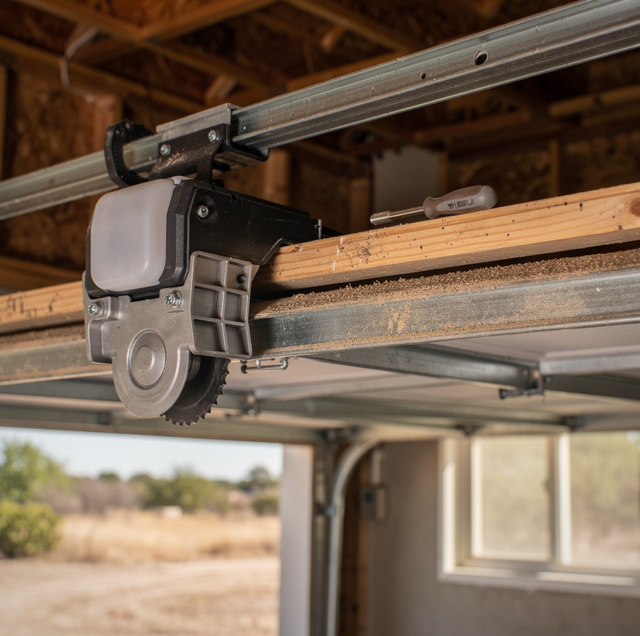
The outer carriage is the piece permanently fastened to the chain or belt. Wherever the chain travels, the outer carriage travels with it, on every cycle, whether or not the door is connected to anything. The inner carriage rides the same rail nested with it, and the inner carriage is the piece that carries the J-arm, the steel arm running down to a bracket on the door's top section. Between the two sits a spring-loaded release pin. That pin, and only that pin, is what turns the outer carriage's travel into the door's travel. Its only contact is with the outer carriage; it does not reach the chain or the belt at any point along the rail.
That pin is exactly what the red release cord retracts. When someone pulls the cord during a power outage, the inner carriage lets go of the outer one; the door is free of the opener, and the outer carriage continues riding the chain by itself. A pin worn round on its engaging face, a return spring that has lost its push, or a cracked inner carriage body produces that same separation with nobody asking for it. The outer carriage still runs the full length of the rail on command. The inner carriage, the J-arm, and the door stay exactly where they were.
That is also why the symptom is so consistent from one make to the next. The visible half of the system is the half that still works, and the half that failed is a joint most homeowners have never seen, sitting inside a plastic housing a foot or two behind the door's top edge.
The Door Is Jammed on the Track
A door that is truly jammed in its track tends to announce itself well before this point. It binds partway through travel, squeals at one particular spot, sits visibly crooked in the opening, and has usually been doing some of that for a while. A trolley failure arrives with none of that history, which is one of the first things a technician asks about.
With the inner carriage separated, the door hangs on its counterbalance springs with nothing attached to it, and what moves it by hand depends entirely on the state of those springs. A door whose springs are intact and correctly adjusted should feel manageable through its full travel and stay put wherever it is stopped. A door with a broken or badly weakened spring is dead weight and behaves nothing like that. So the hand test is a check a technician makes deliberately, on a door whose condition has already been established, rather than a way of finding that condition out.
The rest of the hardware gets its own inspection. The header bracket, where the rail is mounted to the wall above the opening, the J-arm and its bolts, the rollers, and the hinges between sections are all checked separately, and, in a trolley failure, they are usually undamaged. The trolley sits between two working halves of the system, a sound door on one side and a sound motor and rail on the other, with the failed joint in the middle.
The Whole Opener Needs Replacing
A worn release pin or a cracked inner carriage is a serviceable part, and on most residential openers it is sold as a trolley assembly matched to the rail. The motor head, the logic board, the rail sections, and the chain or belt are a separate system from the two-piece carriage that rides on them. When a technician opens the trolley housing, the search is narrow: a hairline crack running through the inner carriage body, a return spring that no longer pushes the pin home, or a pin whose engaging face has worn round, something like a rounded-off door latch that still lines up correctly and no longer grabs. The outer carriage is often untouched, still fastened to the chain and traveling normally, which is part of why a small joint failure can look like a whole-unit problem from the floor.
The Release Cord Already Fixed It
So why does re-latching the trolley through the release cord put the door back in service for exactly one cycle?
Because the release lever acts on the same pin that failed. Re-engaging drives that pin back toward its seat in the outer carriage, and if the pin and its spring are sound, a door that had simply been left disconnected comes back into service and stays there. If the engaging face has worn round, if the inner carriage is cracked, or if the return spring no longer holds the pin out, the two carriages may catch on the first pass and part again on the next, because the joint being reset is the joint that already failed. A door that reconnects, runs once, and disconnects again on the very next open or close is not fixed. It is a worn joint being asked to hold one more time.
The release cord is safe to use only with the door fully closed and the counterbalance intact, and it is never a way to hold a door open. That condition carries real weight here because a carriage that lets go partway through its journey often leaves the door open somewhere other than closed.
The Part in the Middle of a Working System
Two things shape how this repair goes, and neither is visible from the floor. The first is which opener is on the ceiling. A trolley is not a generic part. Manufacturers match the carriage to the rail profile, and to a particular generation of that rail, so a technician reads the make, the model number on the motor head label, and the rail type before a replacement carriage can be matched to it. On a unit old enough that its rail generation has been out of production for years, there may be no trolley left that fits, and that is the one version of this failure where a single worn joint does argue for a new opener.
The second is how often the household has used the release. Every pull of that cord works the same pin and the same return spring that eventually gave out, so a garage that loses power often, or one where a dead keypad or a lost remote sent someone to the cord again and again, has put more wear through that one joint than the opener's age would suggest. A technician who hears that history looks hard at the pin and its seat even when the rest of the assembly appears sound.
Frequently Asked Questions
On many residential carriages, the top cover unclips rather than unscrews, exposing the pin, its return spring, and the seat the pin drops into. A worn one usually shows that seat shaved oval instead of squared off, plus a bright rubbed line along the pin where it has been sliding past the seat rather than dropping into it.
Not in the same way. A screw-drive opener moves its carriage along a rotating steel screw, so the drive nut and the screw threads are wear points a chain model does not have. A jackshaft or wall-mount opener has no rail and no rail-riding carriage at all: it sits beside the torsion shaft and turns it directly, and it disengages via a cable-operated lever on the unit itself.
No. A backup battery keeps the motor and logic board powered through an outage, and manufacturers commonly rate one for a limited number of cycles before it needs recharging, but it has no effect on a mechanical joint inside the carriage. An opener beeping its low-battery alert while the door refuses to move is reporting two unrelated things at once.
Usually not by name. Most logic boards monitor travel time and motor load rather than the carriage position, so a separation presents as a travel or force fault, often as a blink pattern on the motor head or the wall console. The photo eyes stay satisfied throughout, since nothing is crossing the beam, so the opener keeps accepting commands and keeps reporting itself as ready.
By watching both ends of the rail through one cycle. A stripped drive gear stalls the chain right at the motor head, so it barely creeps while the motor races. A failed trolley allows the chain to travel the full length of the rail while the door arm remains still. The distinction is in how far the chain gets, not in anything you need to open the housing to see.
Each cycle that ends with the pin skipping its seat shaves that seat a little wider, so the intervals between failures get shorter until the joint stops catching at all. In the worst case, the inner carriage breaks apart on the rail, leaving the J-arm swinging from the door's top bracket, where it can strike the top section or the header on the next attempt.
Get the carriage assembly matched to your rail generation — Austin opener repair covers trolley replacement, and a new opener installation is the answer when the rail is long out of production. Squared Away Garage Door Service serves Cedar Park and Central Texas. Call (512) 456-3781.
