
Garage Door Emergency Release Cord Broke: Now What?
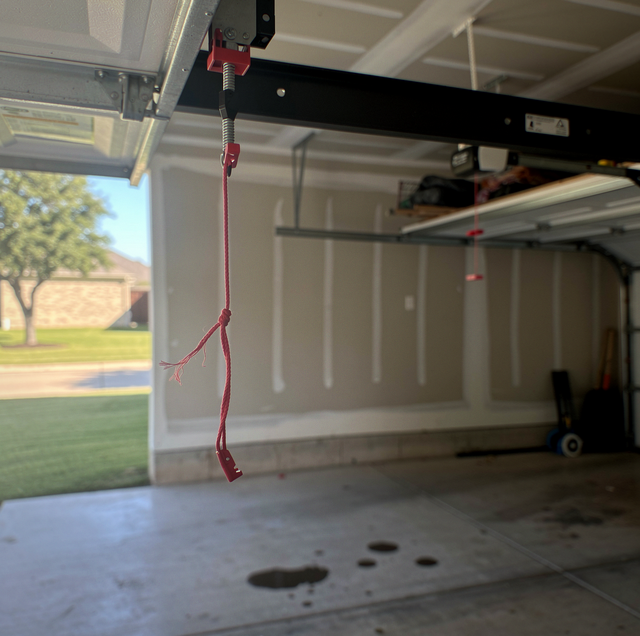
Count the ways into an attached two-car garage and the honest number is usually one: the big sectional door itself, lifted every day by a motor that most households never think about until it stops. The overhead door does all the work, and the accepted fallback for the day the motor fails has always been the same: a red cord and a pin, operated by hand from the garage floor. That cord is what just broke, cracked at the handle, or pulled free somewhere along its length. There is no pin to pull anymore.
Quick Answer: If the release cord itself is gone, there's no built-in way to work the mechanism from the floor. Check the interior door, a side door, a window, the other bay, or a key-holder before calling for entry.
What the Cord Was Actually Connected To
The cord runs to a release pin, a small lever set into the carriage assembly that rides the opener's rail. That assembly is really two parts: an outer carriage, fixed to whatever pulls it (belt, chain, or screw), and an inner carriage, bolted to the J-arm that connects to the door itself. The release pin is what joins the two. When it is pulled, the inner carriage releases the outer one, allowing the door to be raised and lowered by hand without fighting the drive mechanism.
That pin, worked through the cord, is the only disconnect a residential opener is built with as standard equipment. Even when the cord is intact, its job has limits: The release cord is safe to use only with the door fully closed and the counterbalance intact, and it is never a way to hold a door open. With the cord gone, the mechanism it worked is not something to reach, hook, or improvise around, and nothing below asks you to try.
Why This Cord Failed
A few different things end this cord's life, and telling them apart matters for what a technician expects to find. Heat and UV are the slow ones: hanging in a hot garage for years, the cord ages the way a garden hose left in full sun does, going stiff and hairline-cracked long before anyone notices, until one ordinary pull is the one it doesn't survive. A knot at either end can work loose instead of the cord itself failing, especially if it was tied rather than crimped at installation. Sometimes the original cord was swapped out, by a previous owner or a well-meaning handyman, for something never rated for the job: household twine, a shoelace, whatever was on hand. That substitute gives out well before a real replacement cord would. And the molded handle can crack at its neck after years of hard, fast pulls, leaving the remaining cord attached to nothing a hand can grip.
Which Way in Is Still Open
A cord doing its job during an outage is the intended way to move the door by hand, and on a healthy door that is the whole story. Without it, the question becomes which other opening into the building is available tonight.
There's no safe substitute for this cord. Anything improvised to reach the mechanism risks fingers, cables, or a heavy door letting go unexpectedly. If the routes below are unavailable, professional entry is next.
What follows isn't a way to force the door open. It's a walk through every other way into the building, ordered from what sits closest to the house outward to the routes that depend on somebody else, and whether each one is actually open tonight.
1. The Door Between the House and the Garage
If the garage is attached, this is usually the fastest thing to check without touching the overhead door at all. It won't move a car, but it gets a person inside to look at the broken cord, retrieve what's needed, or let a technician come in through the house. It counts as open if the door isn't locked or a house key can reach it, and closed if it's deadbolted from the garage side, which plenty of households do on purpose.
2. A Side or Service Door
Detached garages, and plenty of attached ones, have their own exterior door separate from the big one. It's open if a house key or a hidden spare reaches it, and it serves the same practical purpose as the interior door: a way to get inside and look around, though it won't get a car out. If this door has its own deadbolt and the only key is in a vehicle now stuck inside, this route is closed too.
3. A Window, for Reach Rather Than Passage
Not every garage has one, and where it does, it's rarely sized for a person to climb through. What it's actually good for is line of sight: confirming nothing is leaning against the inside of the overhead door, checking a car's clearance, or passing keys or a phone through to someone already inside. Treat it as a reach, not an exit, and don't force a frame or a screen that was never built to be an entry point.
4. A Second Bay With Its Own Opener
A two-car garage with two separate openers is the one scenario where a car can often still get out tonight. If the second door and opener run on their own motor and their own drive rail, a broken cord on the first door has no effect on the second at all. This route is closed if both doors hang from a single wide opener on a single rail, visible from the floor as a single motor unit serving both openings. It also only helps if the vehicle you need is parked behind the second door, which takes one look.
5. A Neighbor or Key-Holder
Someone with a spare key, a garage code, or simply a driveway to lend for a night solves the immediate problem without touching the door at all. This route is open more often than people plan for: a neighbor or a family member with a key can get a needed vehicle out, or let a technician onto the property.
6. Professional Entry, the One That Actually Fixes It
Every route above gets a person or a car past tonight. Only this one repairs the problem: a technician re-threading or replacing the cord, resetting the release pin, and walking the carriage back into the drive line so the opener runs the door again. It is the one route that works directly on the mechanism rather than around it.
What the Broken Stub Tells Whoever Comes Out
Whatever is left of the cord is worth keeping attached rather than pulling it off and throwing it away. A clean, flush cut close to the handle usually means UV and age did the work gradually. A frayed, rope-like end further down the cord indicates a substitute material that was never rated for the job. A missing knot with no visible break at all means the connection simply slipped, often the fastest of the three to put right. None of that changes which door is used tonight, but it's the first thing a technician checks, and having it intact saves a diagnostic step.
Frequently Asked Questions
Usually yes. The cord and its pull handle are a separate part from the release pin and the carriage itself, so a technician can typically splice in or replace just the cord and handle without disturbing the carriage assembly, provided nothing was damaged when the old cord let go under load.
Manufacturers commonly set the release handle about six feet above the floor, and the rope ships long so an installer trims it to that height. A raised ceiling puts the rail higher and leaves more rope hanging. An overlong cord has a failure mode of its own: it sits in the path of a tall vehicle's roof or a roof rack, and a handle dragged while a truck backs out takes a harder pull than any hand gives it.
No. The release mechanism is entirely mechanical and sits between the carriage and the drive line, with no connection to the opener's motor, circuit board, or wall control. A stuck or broken cord has no effect on day-to-day operation; it only matters when someone needs to move the door by hand.
Rail-driven openers do, whether they run on a chain, a belt, or a screw, and the red is a convention rather than decoration, so somebody unfamiliar with the building can pick the release out of a dark ceiling. Wall-mount openers are the exception: they bolt to the wall beside the torsion shaft and drive it directly, with no ceiling rail and no carriage above the car, so their release arrangement is part of the unit itself.
Not in itself. What has changed is that the household's outage plan is gone, and usually nobody knows it yet. It matters when this gets found: during an outage the broken cord is the second problem of the night, while on an ordinary day with power on the door still runs normally and the repair can be booked at a sensible hour. Either way, everyone who uses the garage should be told the release is out of service, because a household trained to reach for that rope will reach for it.
The pin sits in a molded housing with a small return spring, and both live in the hottest air in the garage. Years of that cycling make the housing brittle, and a weakened return spring can leave the pin sitting partway instead of fully home. When a technician finds the cord intact and the release still doing nothing, the housing becomes the suspect, and the fault lies in the carriage, not in the cord and handle.
Schedule a service call — a technician can reset or replace the release mechanism and get the opener running the door again. When none of the routes above gets you in tonight, same-day emergency garage door repair covers the call, including homes across Hutto. Squared Away Garage Door Service serves Cedar Park and Central Texas. Call (512) 456-3781.
