
Garage Door Spring Winding Accident: What Not to Touch
Quick Answer: Stop. Move everyone out of the garage, leave every tool and part exactly where it fell, do not touch the door, the springs, or the opener, and call a garage door technician. The stored energy is still there.
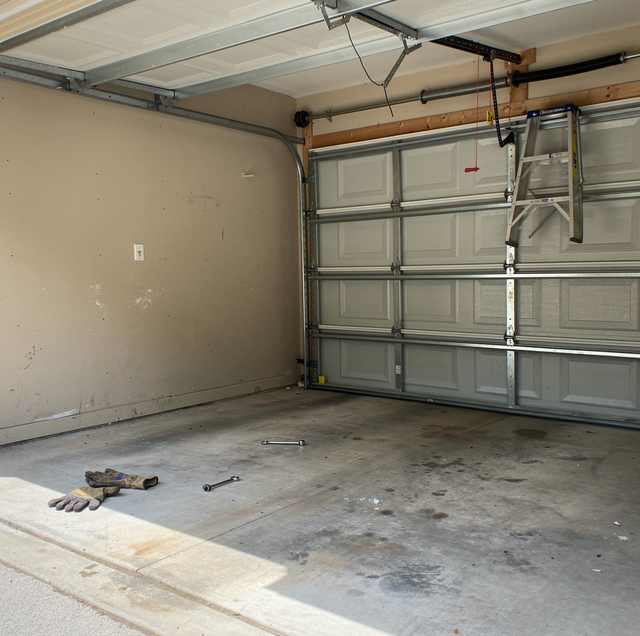
The bar came out of the cone. Or the cone let go of the shaft, or the spring took the turn back from you before you could react, and everything above the door moved at once. Whatever the exact sequence was, you are standing in the garage now with a torsion spring that is neither slack nor properly wound, a door sitting in a position nobody chose, and a decision to make about what to touch next.
If anyone was hurt, call 911 first and come back to this afterward. Everything below assumes the people are accounted for and the only thing still in question is the door.
Step Away First and Keep Everyone Else Back
Distance is the part of this you still control, and right now it is worth more than anything you could do with your hands. Back out of the garage and take everyone with you. A noise like that brings people, and anyone who arrives will walk up to look at the door, which puts them exactly where they should not be.
The hazard is not limited to the space directly under the door. A spring releases along the shaft, and a bar that leaves a cone travels on an arc at head height, and it does not stop at the door. That arc can carry it across the width of the garage and into the wall opposite.
Pets need to be somewhere else too. A dog will walk under a door with no sense that today is different from yesterday.
Next, Leave Every Tool and Every Part Where It Is
The arrangement of things in that garage is part of the current force balance. A bar left in a cone, a clamp on a track, a ladder braced against the header: any of those may be carrying load, and moving one can be the event that releases the rest.
A winding bar still sitting in the cone is holding part of the spring's charge. Pulling it out, bumping it, or lifting it clear is the single most likely way to release everything at once.
The small things count too. A wrench under the door, a phone that skidded across the floor, a socket that rolled into the track: none of it is worth reaching under a door held up by an opener rail. It will all still be there later, with a technician standing next to it. Photograph the garage from the doorway if you want a record, since the camera can get closer than you should.
Leaving the scene alone also gives the technician something to work from. Where the bars sit, which way the cone turned, where the door stopped, and what is still under tension are all readable at a glance by someone who does this every day. Tidying up erases that record and turns the first part of the visit into guesswork.
A Partly Wound Spring Is Still a Loaded Spring
A torsion spring stores energy by being twisted, and it releases that energy along the same path it was wound. A spring interrupted partway through winding is still holding most of what was put into it. What is unknown is the condition of the parts holding that charge.
How much charge is left depends on how far the winding had gone before it slipped. That detail matters to the technician, and it is usually among the first things asked on the phone. A spring under load is held in place by a few specific parts, and those parts are now the only thing standing between it and the room.
[NOTE: Stored tension does not fade. A spring holds the same charge in an hour, overnight, or a week from now, so waiting to decide changes nothing about what the system will do when something moves it.]
What changes with time is only how ordinary the garage starts to look to you, and that is the part that gets people hurt.
The Cone May Not Be Seated on the Shaft at All
A torsion spring has a fitting at each end, and each does a different job. The stationary cone sits at the center bracket and anchors that end of the spring so it cannot turn. The winding cone sits at the outer end and is the one that transfers the spring's twist to the torsion shaft, which it holds by set screws bearing directly on the steel. That connection is what makes the whole counterbalance work, and it is the connection most likely to have been compromised by what just happened.
When a bar slips, the winding cone is often what moved. Set screws can back off, shear, or lose their grip under load. Any of those leaves a cone that may be holding the shaft on a fraction of its intended bite, or riding on little more than friction and the pressure of the spring itself.
You cannot see the difference from the floor. A cone sitting in roughly the right place looks identical whether the set screws are holding properly or holding barely. This is not something to test. Anything that jars the shaft, including running the door, bumping the ladder, or leaning on the framing the hardware is fastened to, can be enough to find out the hard way.
The Door Is Balanced by Nothing Right Now
The counterbalance carries a garage door's weight. The opener supplies only the small push needed to move a door that is already close to weightless. With the springs out of the picture, that arrangement is gone, and whatever position the door is sitting in is being held by something that was never meant to hold it.
If the door is up, it is very likely up on the opener trolley and rail. Those parts are rated to move a balanced door along a track. Suspending a few hundred pounds of steel over a concrete floor for an afternoon sits well outside what they were built to hold. If the door is down, it is resting on the floor, which is the least dangerous position available, yet still not safe, because the next thing that lifts it will be lifting its entire weight. The release cord is safe to use only with the door fully closed and the counterbalance intact, and it is never a way to hold a door open.
The part that catches people is that none of this has to look wrong. A door in this condition can sit level, look ordinary, and even run up and down on the remote if the opener has the strength to drag it. Nothing in that behavior tells you the counterbalance is unfinished. A door that works normally after an interrupted winding is the one most likely to be used again before anyone qualified has looked at it.
Last, Tell the Technician What Went Wrong
Say plainly that the door was mid-winding when it went wrong. Nobody on the other end of the phone is interested in how it got that way, only in what is holding what. Leave that detail out and a technician arrives expecting an ordinary broken spring, with the wrong parts on the truck and the wrong approach to the door.
Then give whatever detail you have:
- Which way it was being wound: Toward the front of the garage or toward the back, described however makes sense to you.
- How far the winding had gone: Barely started, partway, nearly finished. Rough is fine.
- What moved: the bar, the cone, the shaft, the door, or more than one of them.
- Whether anything is still in the cone: And whether anything is clamped, wedged, or propped anywhere on the door.
- Where the door stopped: And whether anything has touched it since.
- Whether the opener was connected: And whether it has been run since it happened.
None of that needs to be exact, and no part of it is a test. A technician who knows a bar is still seated in a cone arrives ready for it. One who finds it unexpectedly has to stop and re-plan standing in your driveway.
One thing is worth doing while you wait. Write the sequence down while you still remember it, because in an hour the order of events blurs into a single noise and a result. That sequence is the one part of this nobody else can reconstruct by looking at the door, and it is often what explains why the spring behaved the way it did.
Frequently Asked Questions
On a two-spring door, both springs sit on the same torsion shaft, and both stationary cones anchor to the same center bracket. The spring you never touched is holding its full charge, and because the shaft ties the pair together, anything that turns the shaft moves both. A technician treats a two-spring counterbalance as one system for that reason, not as two separate jobs.
It removes the chance of somebody pressing the wall button or a remote, which is worth something. It does nothing to the spring's energy, which is mechanical and completely indifferent to whether the opener has power. Whichever it is, the safer approach is to make sure nobody else in the household reaches for a remote, rather than going back into the garage to change anything. A remote works from the driveway, so someone arriving home can put the door in motion without ever setting foot inside or knowing anything happened. Tell the technician the power state rather than changing it.
Yes. The hazard sits inside the garage and does not extend through a closed passage door, so keep that door shut and keep the garage off the route to anything you need tonight. If a vehicle is parked inside, leave it there. Sleeping with a car shut in the garage is a far smaller problem than cycling a door whose counterbalance is unfinished in order to get it out.
That happens often in this situation and is easy to overlook. The lift cables wind onto grooved drums at each end of the shaft, outboard of the end bearing plates that take those cable loads. If the shaft spun during the incident, a cable can go slack and crowd out of its groove, wrap over itself on the drum, or unwind entirely. A door can sit level and still be hanging on cables that are no longer seated where they belong. Checking the drum position and cable seating before any load is put back on the system is one reason this work takes longer than swapping a spring.
It rarely helps. Torsion springs are specified by wire diameter, inside diameter, overall length, and wind direction; the correct set depends on the door's actual weight and height and the drum size, not on what looks similar in a listing. A spring that is close but not right will never balance the door properly, and a mismatched pair is one of the more common reasons a door that was already repaired still feels heavy on the arm.
Sometimes, depending on what the parts absorbed. Winding cones are cast and can crack under a slip without showing much on the outside. Set screws cut flats and burrs into the shaft, preventing the next set from biting cleanly. A spring wound past its rating has already given up some of its service life. Rust pitting from humid air is a separate reason a technician may decline to reuse a spring that otherwise looks serviceable, and on a two-spring door, replacing both together keeps the pair at a matched cycle count.
Book torsion spring replacement in Pflugerville before anything in that garage is moved again, or reach for Hutto emergency door repair if tonight cannot wait. Call (512) 456-3781.
