

Garage Door Safety for Aging in Place: 4 Upgrades That Help
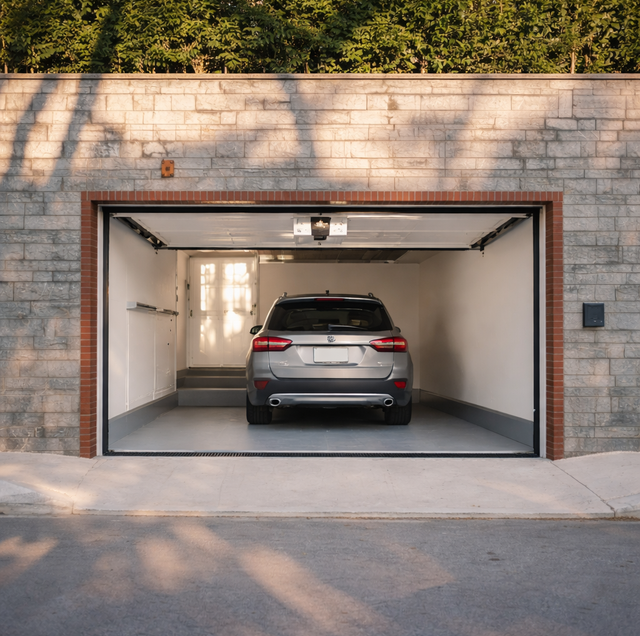
For a large share of households, the garage quietly stopped being where the car sleeps and became the real front door. The formal entry gets used by delivery drivers and holiday guests. Everyone who actually lives there comes in through the garage, hands full, in whatever light happens to be on.
That works fine for decades, and then it starts asking for small adjustments. The good news is that almost every adjustment worth making to a garage entry is mechanical, inexpensive in effort, and invisible to visitors. Nobody walking past the house can tell that the wall control got bigger or that the opener now runs on a battery when the power drops.
Why This Short Walk Asks More Than It Looks
The distance from the car door to the house door is a few steps, but it stacks up more demands than any other entrance. There is usually a threshold or a step. There is a sharp change in light level between outdoors and a dim bay. There is a heavy overhead door on a motor. And the person walking it is almost always carrying something, which means one hand at best and no free hand to catch a rail.
Three age-related changes make that combination harder. Grip and pinch strength are generally among the earlier physical changes people notice, often before overall strength does, so a small button that needs a firm fingertip press can get difficult before a door handle does. The eye's ability to adjust between bright and dim slows down, so the first several seconds inside a dark garage are functionally low-vision seconds. And balance recovery gets slower, which turns a minor stumble on a threshold into a fall instead of a wobble.
None of that calls for a renovation. It calls for the entry to stop requiring precision.
Lighting: More Than the Bulb in the Opener
The lamp in a garage door opener is a single overhead point source, mounted near the ceiling in the middle of the bay. With a vehicle parked underneath, most of its output lands on the roof of the car, and the walking path beside the car sits in that car's shadow. The lamp is also on a timer, so it goes dark on its own schedule rather than when the person is safely inside.
A few changes address the mechanism rather than the symptom:
Bulbs rated for opener use: Opener heads vibrate every cycle, and the housing runs warm. Use LED lamps specifically rated for garage door openers or enclosed fixtures. One quirk worth knowing: some LED bulbs emit enough radio noise to shorten remote range. If remotes suddenly need to be pressed from the driveway instead of the street after a bulb swap, the bulb is the first suspect, not the opener.
A longer light timer: Many openers have an adjustable lamp timer, and the factory setting is often shorter than a slow trip from car to house door. Your installer can change it, or the manual will show the button sequence.
A motion-detecting wall console: Several manufacturers make a wall control that senses movement and turns the opener lights on before anyone touches a button. For someone entering on foot from the driveway, that alone removes the fumble-for-the-switch moment.
Fixtures aimed at the path, not at the eyes: Add light where the walking happens, especially at the step and at the house door where the lock and handle are. Aim fixtures at walls, ceilings, or the floor rather than down at face height. Aging eyes scatter light more inside the eye, so a bare, very bright lamp in the line of sight can reduce what a person sees rather than increase it. Any new hardwired fixture or circuit is electrician work; nobody should be opening panels or splicing energized wiring to solve a lighting problem.
Controls Built for Less Grip and Lower Vision
A standard wall button is a small momentary switch with very little travel and no tactile feedback. A standard remote asks for a pinch and a firm press on a button the size of a pencil eraser. Both are fine for a strong hand and poor for an arthritic one.
Large-button, illuminated wall consoles: These use a broad paddle that responds to a knuckle, the side of a hand, or a closed fist. Backlighting matters as much as size, since the console is usually the first thing touched in a dark garage.
Separated or covered lock and light buttons: Many consoles put a lock button next to the door button. That lock is a vacation feature that disables remotes and keypads. Hitting it by accident produces the classic mystery where the door works from the wall but ignores every remote in the house. A console that separates or shields that button prevents a service call that was never a repair.
Placement, with a tradeoff to talk through: Opener manufacturers direct that wall controls be mounted at least five feet above the floor and within sight of the door, so young children cannot reach them. If five feet is above someone's comfortable reach, the fix is not to lower the console and lose that protection. It is to add a reachable option, such as a remote held in a wall bracket near the house door or a keypad outside. Work the placement out with your installer so whoever operates the door can still see it move.
Remote choice: Keychain remotes are the hardest to operate with reduced grip. A visor-clip remote with well-separated buttons, or a single-button remote, is easier and less likely to trigger the wrong door.
Keypad Entry Instead of a Key Ring
A wireless keypad mounted outside the door removes one of the most fine-motor tasks in the whole entry sequence: aligning a key with a lock cylinder, often in bad light, often with gloves on or a bag in the other hand.
Keypads use rolling-code radio, meaning the code transmitted changes with every entry, so a captured signal cannot be replayed later. The user only has to remember a PIN. Backlit keys make the pad usable after dark, and some manufacturers now offer fingerprint-reader versions for anyone who has trouble remembering or seeing a number sequence.
The temporary-PIN feature matters for aging in place specifically. A home health aide, a neighbor, or a family member who visits twice a week can be given a code that works, then have it deleted, with no key copied and nothing to retrieve later.
Two practical notes. Keypads run on their own battery, commonly a 9-volt or a pair of AAs depending on the model, and a fading battery shows up as intermittent response rather than a clean failure. If the pad works some mornings and not others, replace the battery before assuming the opener has a problem. And mount the pad where a person is not standing under the door opening while using it, at a height that works whether they are standing or seated.
Battery Backup and What Happens Without It
An opener is a line-powered motor. When the power goes out, motorized operation goes with it. The fallback is the emergency release cord, which disconnects the trolley from the door so the door can be raised by hand. Pull that cord only when the door is fully closed: releasing the trolley on a door that is up, or that has a weak or broken spring, lets the door drop under its own weight with nothing left to control it.
The reason a full-size door can be lifted by hand at all is that the counterbalance springs are carrying nearly all of its weight, the way a counterweight carries the sash in an old double-hung window. When those springs are correctly sized and in good condition, the door feels light. When they are weak, out of adjustment, or broken, the same door is brutally heavy and can drop. Springs and cables are under high tension and are professional-only, without exception, for any household member of any age.
So for a person who depends on the garage as their easy entry, the manual release is not a plan. It is a last resort that assumes strength, reach, and a door in good balance all at once.
Battery backup solves that directly. It is a rechargeable battery, either built into the opener head or mounted alongside it, that keeps the opener running through an outage. Manufacturers advertise a limited number of cycles per charge, and units generally run at reduced speed on battery to stretch it. Backup is now standard equipment on many new residential openers, and requirements for new installations vary by location, so your installer can tell you what applies where you live. The battery itself is a wear item with a finite service life and gets replaced periodically, like the battery in a smoke alarm rather than like the opener itself.
The Safety Systems That Matter More With Age
Every opener made in recent decades has two independent protections, and both deserve a check when someone is using the door daily and may be slower to move out of the way.
Photo eyes: A pair of sensors sits on the tracks near the floor, mounted no higher than six inches above it, projecting an invisible beam across the opening. Break the beam while the door is closing and the door stops and reverses. Misalignment from a bumped bracket, a spider web, or low sun glare leaves the door refusing to close at all. The small indicator lights on the sensor housings tell you whether they are seeing each other.
Auto-reverse on contact: If the door meets resistance while closing, the opener should reverse. The standard check is to lay a two-by-four flat on the floor in the door's path and close the door; it should contact the board and go back up. Run that test periodically.
If the door starts reversing for no obvious reason, the wrong response is to raise the opener's force setting so it pushes through. Increasing force to overcome resistance defeats the protection that reversal exists to provide, and it hides the real cause, which is usually a binding roller, a dry or bent track section, a hinge coming loose, or springs losing tension. That resistance is information. Have it diagnosed rather than overpowered.
A Sensible Order to Take This On
Start with what protects a body: verify the photo eyes, confirm auto-reverse, and have a technician check door balance and hardware during a service visit. Then lighting, which is cheap and returns the most on a dark evening. Then controls and a keypad, which remove the fine-motor demands. Then battery backup, which removes the outage scenario entirely.
Most of it can ride along with one annual service appointment. That matters for a reason beyond convenience: this whole list works best when it is handled as ordinary maintenance rather than as a response to a specific decline. A brighter bay, a control that answers to a knuckle, a keypad instead of a key ring, and a door that still opens when the block goes dark are simply a garage that has been set up well. The person using it gets to keep the routine they have always had.
Frequently Asked Questions
Accessibility guidance generally treats roughly four feet above the floor as the upper limit of a comfortable forward reach from a seated position, and that drops when the control sits behind something deep like a workbench or a chest freezer. Reach is only half of it, though. A power wheelchair or walker needs clear floor space to turn near the control and near the house door, which usually means relocating storage bins and recycling containers away from that corner. In practice, moving the clutter and adding an outdoor keypad accomplish more than swapping the button style.
Connected openers, marketed under names like myQ, report the door's open or closed state to a phone app, can send an alert when the door has been left open past a set number of minutes, and allow a remote close from anywhere. For a family member checking in from another city, that answers the "did Dad leave the garage open again" question without a phone call. The limitation is worth understanding: those features run through the home's router and internet service, both of which typically go down in a power outage even when the opener itself has battery backup. Remote monitoring is a daily convenience, not an outage plan.
Test it deliberately rather than waiting to find out. With the door closed, unplug the opener, then run one full cycle from a remote. A healthy unit will operate, usually noticeably slower, and most models chirp or show an amber or red indicator to signal battery mode. Plug it back in afterward and let it recharge. Two edge cases cause surprise failures: a battery that has been left fully discharged for a long stretch, often because the opener is on a switched receptacle someone turned off, may never accept a full charge again, and replacement batteries are model-specific rather than a generic part off a shelf.
The overhead door is only half the entry, and the passage door is where most trips happen, because it usually combines a raised threshold with a step down into the garage. A lever handle instead of a round knob, switches on both sides of the door, a graspable handrail where there is more than one step, and enough level landing outside the door swing all reduce that risk. Before replacing that door, check with your building inspector or contractor. The door between an attached garage and living space commonly has to meet particular requirements, including self-closing hardware and a specific type of door construction, so an ordinary exterior slab may not be an acceptable substitute.
Not by itself. The counterbalance springs carry the weight, so a heavy door that is correctly sprung feels about the same at the handle as a light door that is correctly sprung. Problems come from mismatch. Adding an aftermarket insulation kit, swapping a solid panel for one with glass inserts, or replacing a single section with a heavier one changes the door's weight without changing the spring, and the door then feels heavy, drifts down when stopped partway, and overloads the opener. Springs are selected for a specific door weight and a rated cycle life, so any weight change is a conversation with a technician, never a homeowner adjustment.
Openers that can close with nobody present, such as a timer-to-close setting or a close command sent from an app, are built to give both an audible and a visual warning before the door moves, generally a beeper plus a flashing light. That pairing exists precisely because one channel may not reach everyone. With significant hearing loss, the flashing light is doing the work, so its position and brightness matter more than usual. In a household where someone might be standing in the opening and unable to move quickly, turning off timer-to-close entirely is often the safer configuration. Ask your installer which warning options and settings your specific model supports.
Book a garage door safety inspection and have the reversal force, photo-eye height, and warning signals set around the person who uses the door most, which is what a Pflugerville garage door service visit is for. Call (512) 456-3781.
