
Commercial Door Sensing Edge: The Gap Photo-Eyes Leave
Quick Answer: A sensing edge is a compressible profile fastened along the bottom bar that works alongside photo-eyes, not instead of them. It supervises the entire closing stroke at floor level and catches contact-based obstructions that a single infrared beam, which only watches one fixed plane, cannot see.
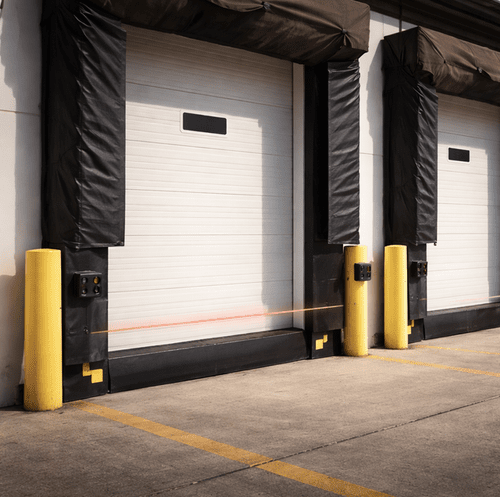
A photo-eye protects one line. An emitter on one side of the opening sends an infrared beam across to a receiver on the other, and the operator watches that beam the whole time the door is closing. Break the line, and the door reverses. Stay above it, below it, or out of the narrow plane it sweeps, and the door keeps closing as though the opening were empty.
On a residential door, that single line covers most of what can go wrong. On a commercial opening, the math shifts. The door is taller, the span is wider, the cycle count is higher, and traffic underneath carries material at every height from the floor to the top of a mast, so the share of the closing stroke one beam supervises shrinks as the opening grows. A sensing edge closes that gap on a different principle, which is why it belongs alongside the eyes rather than in place of them.
What a Single Photo-Eye Beam Covers
A photo-eye pair is a non-contact device, and that is its advantage: it sees an obstruction before the door touches anything, which is what you want protecting people walking through an opening. Emitter and receiver mount in the guides or on the jambs, aimed at each other, and the board treats the beam as a continuously present signal that it reverses on losing.
The limits follow from the same design. The beam is a line, not a field: one height, one plane, one path. On commercial installations that height often sits higher than you would expect, because brackets mounted low in a bay with forklift traffic get replaced constantly, and every inch the eyes move up is another inch of unsupervised band underneath. Beams also dim and drift in service: lens film builds from dust in dry air and from condensation in cool damp air, and a bracket clipped by a pallet corner throws the aim off. Most boards flag a hard failure of the eye circuit, but a partly obscured lens that still passes signal is the harder case, since nothing faults and the range shortens quietly.
The Gaps One Beam Leaves Open
Below the beam: Anything lower than the beam plane is invisible to it. A pallet lying flat, a coiled air hose, a dock board lip, a wheel chock. None break the line, and all meet the bottom bar.
Above the beam: A load projecting over the top of a pallet jack, fork tines carried high with nothing under them at beam height, a shrink-wrap tail hanging off a raised load. The beam clears behind the vehicle, the operator resumes closing, and the tail of the load is still in the path at a height nothing watches.
Across a wide opening: A long span tightens the alignment tolerance. A bracket knocked a fraction of a degree at one jamb moves the spot far enough at the far jamb to sit at the receiver's edge, where a little lens haze finishes the job. On a wide door with a flexible curtain, the bottom bar also does not always arrive in exactly the plane the eyes assume.
The common thread: a beam reports presence in one line and cannot report contact. If a load shifts after the beam is clear, only a contact device catches it.
What a Sensing Edge Adds That a Beam Cannot
A sensing edge is a compressible profile fastened along the bottom bar for the full width of the door, linked back to a board that watches for compression anywhere along its length. The construction varies (an electric strip, a pneumatic channel, or a newer optical path built into the profile), and monitored versions of any of the three supervise their own wiring, reporting a fault if a lead is cut or damaged rather than staying silent. What matters more than the construction is the position: the edge travels down with the door and supervises the entire closing stroke at floor level, rather than one fixed plane partway up the opening.
That position is also its limit. An edge only reacts once contact has already happened, so it works as a second line behind the eyes, not a replacement for them. The operator's own force sensing is a third, blunter layer still: it watches motor load, and on a large, well-balanced door a soft or low-mass obstruction may not raise that load enough to register quickly. A light curtain, which projects a band of beams instead of a single line, improves on one photo eye without adding an edge's ability to sense actual contact. Each layer catches something the others miss, which is why commercial specifications increasingly call for more than one working together.
Doors That Need the Edge, Not Just the Eyes
Forklift and pallet-jack traffic: The classic failure is the trailing edge of a load. The vehicle clears the beam, the operator resumes closing, and the tail of an overhanging pallet is still under the door at a height the beam never watched. Loads also shift on the tines, so a corner that sat inside the vehicle profile going in is not always inside it coming out.
Openings that close unattended: Auto-close timers, loop detectors, card readers, and building automation close doors with nobody confirming the path. When no one is watching, the door's own devices are the entire safety case.
Variable-height obstructions: Rolling carts, stacked totes, rack ladders, waste bins staged near the door, dock boards left half-deployed. What sits near an opening changes by shift, and a fixed beam height cannot follow that. An edge riding the bottom bar covers whatever height contact happens at.
High-cycle doors: More cycles mean more chances for something to be in the opening at the wrong second, more wear on eye brackets between service visits, and, on a wide curtain arriving with a lead at one end, contact the beam was never positioned to see.
What Goes In Along With the Edge
The work in a retrofit is usually not the profile. It is getting a reliable signal from a moving bottom bar back to a fixed control. A hardwired link uses a coil cord or a spring-loaded take-up reel: no batteries, no radio, but the cable is exposed to snagging and abrasion at the guide. A wireless link puts a transmitter on the bottom bar and a receiver at the operator, so nothing trails down the wall, at the cost of a battery to service and a housing that has to survive impacts and hosing.
On the control side, current commercial boards carry monitored inputs for entrapment devices. The board expects a specific signature from the edge at all times, and if that signature disappears, the fault gets reported rather than ignored. Depending on the operator, a faulted edge restricts the door to constant-pressure closing at the wall station or stops it from closing under normal control. That turns a dead safety device into an operations problem somebody has to call about, instead of protection quietly going missing.
Testing What Is Already on the Door
Test the two devices separately, because testing them together only tells you at least one worked. For the photo-eyes, start the door closing and break the beam with an object held at the mounted height, keeping your body out of the opening. For the edge, with the beam clear, set a solid object on the floor in the door's path and let the bottom bar meet it; it should reverse on contact, not after pushing. Repeat at both ends and near the middle, since guide-entry damage shows first at the ends and an edge that responds at mid-span can be dead in the last inches at one jamb.
The visual check is short: wipe the lenses, confirm the eye brackets sit tight and square, and run a hand along the profile looking for cuts, embedded debris, and rubber gone hard. Anything past that belongs to a technician. Spring tension, cables, drums, bottom bar removal, and the operator's power wiring are professional-only work, and a bottom bar ties into the counterbalance system whether or not the door looks relaxed on the floor.
Deciding Whether Your Door Needs One
The question is less about the door than about what moves under it: material passing through on equipment, loads that overhang, closings nobody watches, or an opening tall enough that one beam plane covers a small fraction of the travel. If the door has already contacted something once, the case is finished.
Most openings that end up with a bent bottom bar and a damaged load were protected the whole time. The photo-eyes were clean, aligned, and doing exactly what they were built to do, which was watch one line. The obstruction was never on it.
Frequently Asked Questions
Usually, though it depends on the control. Older operators without a dedicated edge input can often take an interface or relay module that turns the edge signal into a reverse command the board understands. The first check is mechanical rather than electrical: whether the bottom bar offers a usable mounting surface, and whether the guides clear the profile plus its retainer, since added depth changes how the door seats.
It can, and it is a common source of nuisance faults after routine service. A new astragal is taller than the flattened one it replaced, so the door reaches the floor sooner and the edge can sit in light compression at full close. That light compression can trip the edge every time the door nears the floor, so the door reverses just short of fully closed instead of seating. The fix is a down-limit reset, so the door lands with the edge only just touching.
Yes, and dock aprons are where it shows up, since they are often pitched for drainage. If the floor falls away at one end, the bottom bar meets the high side first and compresses the edge there while the low side still has a gap, so the door reverses every time it tries to seat. Remedies include a deeper profile with more compression travel, an angled bottom bar matching the slope, or a threshold correction.
Yes, and it is the failure mode that catches people out. A profile that has gone stiff or dry-rotted can stop transmitting compression to the sensing element inside it even though the rubber still looks intact from a few feet away, so the door can contact an object at full force before anything registers. Flexing the profile by hand at several points along its length, not just eyeballing it, is the only way to catch that condition during a routine check.
That descent is a different mode of operation from normal motorized cycling, since the release drops the curtain under a governor rather than the operator. Some fire-rated assemblies pair that release with an auxiliary bottom-bar sensor built into the fire door's own listing, one that briefly checks the fall on contact and then lets the curtain continue closing rather than reversing back open, since a fire door has to end up closed. Ask your service company whether your door's release system includes that auxiliary sensor, and keep the answer with your facility records.
Sometimes, on doors where more than one hazard sits at the bottom bar. A door closing directly against a dock leveler lip, for instance, can carry one edge for the floor-level hazard and a separate edge or pressure strip where the door face would otherwise pinch against the leveler's raised lip when no trailer is present to hold it down. Whether a second device earns its cost depends on how often that specific geometry is actually in play at your dock, which a technician can assess on a site visit.
Put the bottom edge on the same test list as the photo-eyes — our commercial door repair in Round Rock covers both devices in one visit, and a sensing edge is one of the safety parts and upgrades that can be fitted to a door already in service. Squared Away Garage Door Service serves Cedar Park and Central Texas. Call (512) 456-3781.
