
Loading Dock Door Problems That Put People at Risk
The near-miss that changes how a crew runs a dock door usually looks the same: a driver steps backward off the dock plate to guide a pallet jack, the door comes down on its timer, and he ducks out of the way with a foot to spare. Nothing gets damaged. No one files anything. The door has usually been closing early for weeks, and the crew has simply adapted to it.
That is the pattern worth paying attention to. Loading dock doors rarely fail all at once. They degrade, people compensate, and the compensation becomes the routine until the day someone is carrying something, or looking the wrong way, or new on the job and unaware of the workaround everyone else has memorized. The failures below are common, mechanical, and diagnosable, and every one of them ends with a person in the path of something heavy.
Why Dock Doors Fail Differently Than Other Doors
A commercial dock door lives a harder life than almost any other opening on a building. It cycles far more often than a residential door; it sits in a traffic lane where forklifts and pallet jacks pass within inches of the tracks and jambs, and it is expected to close against a floor edge that ends in a four-foot drop.
Three things drive most of the wear:
Cycle volume: A busy dock may open and close a door dozens of times in a shift. Every cycle loads the counterbalance system, flexes the hinges and rollers, and drags the bottom seal across the floor. Springs and cables are rated by manufacturers in cycles, and a door running a heavy schedule reaches its rated life in a fraction of the calendar time a low-traffic door would take.
Impact: Sectional dock doors get hit. A forklift mast clips a panel, a pallet corner catches a track, a trailer backs in slightly off-center and nudges the guide. Each impact is minor on its own. Cumulatively, they bend tracks out of plumb, flatten roller stems, and knock bottom sections out of square.
Contamination: Docks are dirty. Dust, grit, and debris work into roller bearings and track channels. A roller that should spin instead skids, which wears a flat spot, which makes the door bind, which makes the operator work harder.
None of that is dramatic. It shows up as a door that is a little slower, a little louder, a little less square than it was. And each of those symptoms maps to a specific hazard.
A Door That Does Not Seal at the Floor
The bottom astragal, the flexible rubber or vinyl strip on the lowest section, is the part that takes the most abuse and gets replaced the least. It flattens, splits at the ends, tears where a pallet caught it, or hardens until it no longer conforms to the floor. Cold stiffens the material and makes it crack; sustained heat and UV exposure soften and deform it. Either way, the strip stops sealing.
The immediate consequence is a gap at the dock edge, and the gap is a hazard in two directions.
Visibility: Light leaking under a closed door is not the problem. The problem is the reverse condition, where a door that appears closed is not fully down, and the bottom edge sits a few inches above the floor at one end. A worker walking the dock in low light reads the door as closed and does not register the edge. In a partially open state, the bottom section is at shin and ankle height, which is exactly where people do not look.
Debris and water intrusion: A failed seal lets in whatever is on the apron outside. Grit tracks in on wheels and boots and collects at the threshold. Water follows the same path, whether it is rain blowing under the door or meltwater running off a trailer. The threshold area is already the busiest square footage on the dock, and it becomes the slickest.
There is a related failure that looks the same but comes from a different place. If one side of the door lands and the other does not, the bottom section is out of level. That usually means one lift cable has slipped or stretched relative to the other, or the drum is out of adjustment. This is not a self-service condition. Lift cables on a sectional door are under load from the counterbalance system, and adjusting them means working with that system. A trained technician with the proper winding tools handles cable and spring work. Nobody else should be near it.
What a technician checks on a sealing complaint
A useful inspection on a door that will not seal covers the astragal condition end to end, the floor itself for cracks or spalling that prevent a flat landing, the level of the bottom section across the opening, the down-limit setting on the operator, and the condition of the bottom brackets. That last one matters because bottom brackets on a torsion-spring door are cable-attachment points and carry spring load, which puts them firmly in the professional-only category.
Slow, Hesitant, and Erratic Doors in Forklift Traffic
A door that has slowed down changes the geometry of every trip through the opening. Operators learn the new timing by starting the door earlier and driving through closer to the edge of its travel.
The mechanical causes are usually identifiable:
Worn or seized rollers: A steel roller with a failed bearing skids in the track instead of rolling. Nylon rollers wear grooves into their treads. Either condition increases drag through the whole travel.
Track misalignment: Tracks knocked out of plumb by an impact pinch the door at some point in its travel. The door slows or hesitates at the same spot every time, which is a useful diagnostic clue.
Hinge and end-hinge wear: Elongated hinge holes let sections shift relative to each other, so the door racks slightly as it moves and binds in the guides.
Counterbalance degradation: As springs lose torque with age and cycles, the operator carries more of the door's weight than it was sized for. The door gets slower, the motor gets hotter, and the whole system moves toward a failure that will not be gradual.
Operator or drive issues: Chain slack, a worn drive sprocket, a failing motor, or a trolley problem on a jackshaft unit.
The safety consequence is the pinch point. A sectional door's hinge line closes as the door moves through the curve of the track, and a person's fingers on a panel face at the wrong moment go into that closing joint. The commercially available answer is pinch-resistant section profiles, where the panel edges are shaped so the joint does not present an open gap that fingers can enter. Manufacturers market these as a standard feature on many commercial lines now, and on an older door they are a genuine reason to consider replacement rather than another repair.
The other consequence is the door itself as a moving mass in a traffic lane. A slow door in a busy aisle produces queuing. Queuing produces impatience. Impatience produces a forklift driver deciding the gap is big enough.
When Dock Seals Wear, the Door Inherits the Problem
Dock seals and shelters, the compressible pads or fabric curtains a trailer backs into, are a separate piece of equipment from the door itself, usually serviced by a dock-equipment specialist rather than a garage door technician. Their condition still matters here because a torn or collapsed seal changes what the door has to tolerate.
A collapsed side pad lets a trailer contact the guide or the wall directly instead of the pad absorbing it, and a torn header curtain lets water run down inside the jamb and into the track. That moisture corrodes hinge hardware and roller stems over time, which feeds directly into the binding and slow-travel problems described above. On a walkthrough, note whether the pads still make continuous contact with a docked trailer and whether the header curtain is intact, and flag failures to whoever holds that part of the maintenance contract even when it isn't the door vendor.
Door Timing and Dock Levelers
This is the interaction that produces the worst outcomes, because it puts a moving door in the same space and time as a person and a piece of deployed equipment.
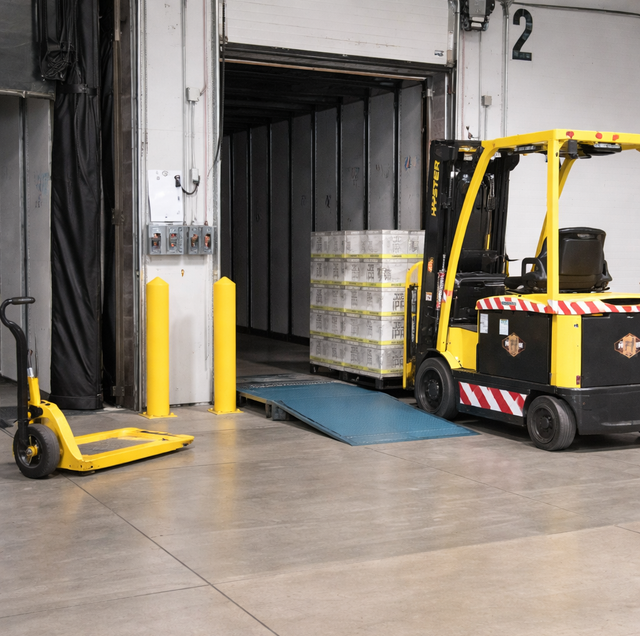
A dock leveler bridges the gap between the dock floor and the trailer bed. When it is deployed, its lip rests on the trailer and the ramp spans the space between. Somebody has to walk that span, and often somebody is on it with a pallet jack.
The failure modes:
A door that closes on a timer while the leveler is still deployed: Auto-close timers are set for the fastest normal cycle and rarely revisited. A slow load, a driver checking paperwork on the plate, or a jam on the pallet jack puts a person under the opening past the timer's expiration.
Photo eyes positioned for the door, not the dock: The reversing sensors on a commercial operator sit low, near the floor on each jamb. They see across the opening at that height. A person bent over on the leveler ramp beyond the sensor plane, or an object on the plate outside the beam path, does not register. The sensor is doing its job. Its job is narrower than the space that needs protecting.
Sequencing that permits both at once: On docks without interlocks, nothing prevents the door from operating while the leveler is deployed. The controls do not know about each other.
The equipment answer is interlocking: control wiring that prevents the door from closing while the leveler is out of its stored position, or that prevents the leveler from deploying until the door is fully open. Vehicle restraints, the hook or wheel-chock systems that hold a trailer against the dock, are frequently tied into the same interlock logic so the trailer cannot pull away while the leveler is on it. Anything involving control wiring, interlock circuits, or the operator's power connections is electrician and door-technician work. Do not open a control panel to inspect wiring.
The procedural answer, which costs nothing and can be implemented immediately, is to change how the door is operated. Disable or substantially lengthen a timer that closes doors during active operations. Require the door to be closed manually by a person with eyes on the opening rather than by a clock. Train drivers and dock staff that the door is not closed until someone confirms the dock plate is clear.
Reading the Warning Signs Before Someone Gets Hurt
Most of the failures above announce themselves. The trick is treating the announcement as information rather than noise.
Changes in sound: A grinding, scraping, or rhythmic knocking noise that was not there before points to rollers, hinges, or track. A loud bang during operation deserves an immediate stop and a call, because it can indicate a spring or cable event.
Changes in speed or smoothness: Any door that has visibly slowed, that hesitates at a consistent point, or that jerks during travel has a mechanical cause worth finding.
Visible gaps or light where there was none: Daylight along the bottom or the sides indicates seal wear or a section out of alignment.
Damage nobody reported: Dented panels, bent track sections, and flattened seals accumulate from unreported minor impacts. A dock crew that has normalized hitting the door will not volunteer this, so it has to be looked for.
Workarounds: The strongest signal available. If people are propping, holding, timing their run, or telling new hires "you have to be quick through that one," the equipment has already failed in the way that matters.
Documenting these observations in a simple log, with the date and what was observed, gives a technician real diagnostic history instead of a shrug. It also makes the difference between a replacement roller scheduled on a slow Tuesday and an unplanned shutdown with a trailer in the bay.
Building an Inspection Rhythm That Holds
Daily visual checks by the dock crew catch the obvious: new damage, light gaps, debris in tracks, seal condition. These take a minute per door and require no tools.
Periodic professional service covers what the crew cannot safely assess. A technician evaluates counterbalance condition, cable integrity, roller and hinge wear, track alignment and plumb, operator function including limits and reversing behavior, and the condition of any safety devices and interlocks. Industry guidance for commercial door equipment generally holds that doors in high-cycle service need service intervals set by cycle count rather than by calendar, and a busy dock door may warrant attention several times a year where a low-use door needs it annually.
Testing the reversing function is the one operator-level test worth doing regularly, and it is simple: with the door closing, break the photo eye beam with an object and confirm the door reverses. If it does not reverse, the door should be taken out of service until it does. That test takes seconds and verifies the one safety device the crew can check without a technician, and the one most likely to catch an obstruction directly under the door itself, though as the leveler discussion above makes clear, it doesn't extend to the ramp or the plate beyond the doorway.
None of this is really about protecting the door; doors are replaceable. A slow door, a gap at the threshold, or a timer set five seconds too short each narrow the margin between an ordinary shift and an injury that changes somebody's life, and every one of them gives warning before it gives out. Put the daily walk-around and the reversal test on somebody's actual task list, not just in this article, and those warnings start getting used instead of just noticed.
Frequently Asked Questions
Torsion springs are manufactured in different wire sizes and lengths to reach different rated cycle counts for the same door weight, and suppliers commonly stock high-cycle versions of the same spring for exactly this reason. A high-cycle spring achieves its longer life through a different wire-diameter-and-length combination that lets it operate at lower stress for the same lift. Swapping to a high-cycle set is a common upgrade on a dock door that has been eating standard springs, but sizing and installation are strictly technician work. Two doors in the same bank can need different spring sets if one serves a busier lane.
Many jurisdictions require wind-rated doors on commercial buildings, and the requirement usually depends on the building's location and the size of the opening rather than on it being a dock. A wind-rated door uses reinforcing struts, heavier-gauge track, and often additional wind locks or a reinforced end-stile design. A replacement door that is not rated where a rating is required can create a problem at inspection or at insurance renewal. Check the specific requirement with your local building official or a commercial door contractor familiar with your area before ordering a replacement, rather than assuming the existing door's specification is current.
As a supplement, yes, not as a substitute. A flashing light or audible signal wired to fire during the closing cycle gives someone on the dock plate a few extra seconds of warning distinct from the door's own sound, which matters in a bay where the motor and drive chain already compete with forklift traffic and idling engines. It does not fix a door that seals poorly or reverses unreliably, and it does nothing for a photo eye's blind zone; it buys reaction time on top of hardware that already works correctly.
Commercial operators include a manual disconnect, typically a chain-hoist release or a pull cord depending on the operator type, that disengages the drive so the door can be moved by hand or by hoist chain. The critical caveat is that the manual release relies entirely on the counterbalance system holding the door's weight. If the springs are already weak or a cable is compromised, releasing the operator can let the door drop. Because of that, the disconnect should only be pulled with the door fully closed, and never on a door with a known counterbalance problem. Battery backup units exist for commercial operators and are a reasonable addition on a dock that cannot stop working during an outage.
A sensing edge, a compressible strip running the full width of the bottom bar that reacts to contact anywhere across the opening rather than at one fixed beam height, is the standard answer on high-traffic commercial doors. It does not replace the eyes, which still catch an obstruction before contact happens; it catches whatever the eyes' one line missed. A door running constant forklift and pallet-jack traffic without one is carrying a real gap in its own coverage, not just a theoretical one.
Responsibility for dock equipment in a commercial lease is usually assigned in the lease document itself, and it varies widely: some leases put all exterior building components on the landlord, others make the tenant responsible for anything they use daily, and triple-net arrangements commonly shift maintenance to the tenant entirely. Dock levelers and restraints are sometimes handled separately from the door itself. Read your lease's maintenance and repair provisions, and if the allocation is unclear, raise it with the property manager and your own attorney before a failure forces the question. Getting the answer in writing before there is a damaged door is far easier than after.
Put the dock doors on a technician's route before a near miss forces it: commercial garage door repair covers the drag, the floor gaps, and the worn hardware, and commercial door operators get retimed so a closing door and a working leveler are never fighting each other. Squared Away Garage Door Service serves Cedar Park and Central Texas. Call (512) 456-3781.
