

Commercial Door Cycle Ratings: The Spec That Decides Lifespan
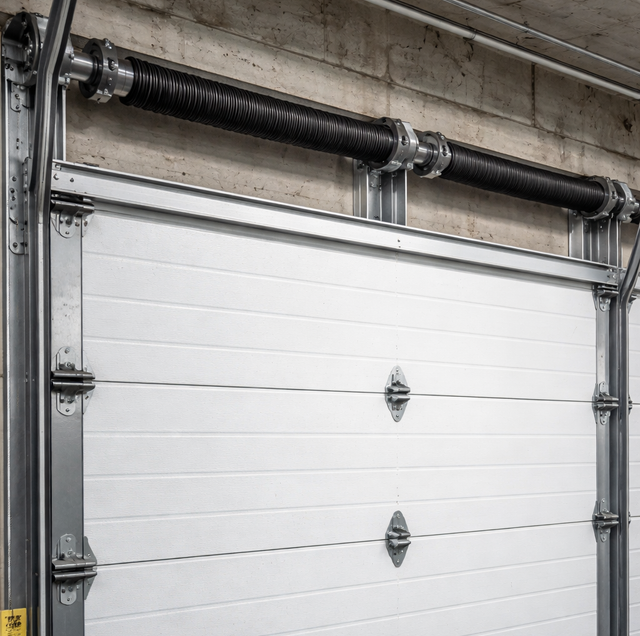
A torsion spring can hold up a residential door for a decade and fail in under a year on a distribution warehouse, same wire size, same installer, same lubrication schedule. Nothing was defective. It spent its whole rated life in nine months instead of ten years, because the door it counterbalanced moved a hundred times a day instead of four. That gap is what cycle ratings exist to describe.
What a Cycle Means in Door Hardware
A cycle is one complete open plus one complete close. Raising the door in the morning and leaving it up until closing counts as one cycle when it comes back down, not two.
Every rating on a spring chart, a hardware spec sheet, or an operator's data plate is denominated in cycles, not years. Time enters only through corrosion, lubricant breakdown, and impact damage. Everything else is counted in movements, so a door running twice a day and one running sixty times a day age at very different rates while the calendar reads the same for both.
Why Identical Parts Wear Out on Different Timelines
Residential and light commercial hardware can look nearly identical from the floor. What separates them is the stress each part absorbs per cycle and how many cycles the design was validated for.
Spring fatigue: A torsion spring stores the door's weight as twist, unwinding several full turns on each opening and winding back on each close. Bend a paperclip back and forth, and it snaps, not because any single bend was excessive but because of the count. Spring steel behaves the same way at a scale you cannot see: cracks start at the wire surface and grow with every stress reversal until the wire parts. Stress per cycle is fixed at manufacture by wire diameter, inside diameter, and length relative to the load, which is why two springs holding the same door can have very different service lives. Winding, adjusting, or replacing one is professional-only work; the stored energy is more than enough to cause serious injury, and it stays stored whether the door is up or down.
Roller and bearing wear: Plastic wheels, or a few loose ball bearings, do fine at household counts. Push them into the thousands of cycles a month, and the wheel flat-spots or the race goes loose, so the roller skids instead of rolling and drives wear into the track and the stem. Nylon-tired rollers on sealed bearings hold alignment far longer under the same traffic.
Hinge and section wear: Every hinge pivots once per cycle. Thin-gauge hinges elongate at the pin, the oval hole lets sections shift out of plane, and the steel around the fasteners begins to tear. Heavier-gauge hinges with reinforcement at the fastener points are among the least glamorous differences between the grades, and among the most load-bearing.
Track and shaft flex: Lighter track flexes on each pass, working fasteners loose and letting the track drift out of alignment, and bearing plates with plain bushings wear oval and let the shaft wobble. A torsion shaft undersized for the door's width deflects under load, moving the cable drums out of plane and loading the two cables unevenly.
How Manufacturers Publish Cycle Ratings
Cycle ratings come from the component maker's own testing, not from a universal industry constant. Residential torsion springs are commonly advertised in the neighborhood of ten thousand cycles as a baseline, with high-cycle options sold at several multiples of that, though figures and test conditions vary between manufacturers. Treat a published rating as expected life under favorable conditions, not a guarantee with a date attached.
Two things the number leaves out matter more than the number. A rating covers one component, and a door's life is governed by the shortest-rated part in the assembly, so high-cycle springs paired with residential rollers, thin hinges, and a plain-bushing bearing plate only relocate the failure. Published life also assumes the door is balanced, lubricated, and free of binding; one that drags in the track, or whose counterbalance no longer matches its weight after panels were changed, burns through its rating faster than the chart suggests.
Counting What Your Building Really Runs
Hardware gets specified by door size far more often than by usage, and that is backward. An 8-foot shop door at a busy service bay can outrun a 16-foot dock door at a slow one by a wide margin.
Count instead. A dock door sees at least one open and one close per truck, plus every trip a forklift or a person makes through it; a multi-tenant bay racks up the sum of every tenant's traffic; a fleet or apparatus bay cycles on a shift schedule. A tally kept for one representative week, or a reading from the operator's built-in cycle counter, multiplied out to a year, is the most reliable method.
The arithmetic is unforgiving. A door cycled 40 times per weekday runs a little over ten thousand cycles a year, putting a baseline residential-rated spring at the end of its published life in roughly twelve months. The same spring on a home door running four times a day would take roughly seven years to get there. With an annual number in hand, the question turns concrete: how many years do you want between planned counterbalance replacements, and which cycle column covers that many years of your traffic.
What Commercial-Rated Hardware Changes
Upgrading is not one part; it is a matched set:
- Counterbalance sized from a high-cycle column: Larger wire on a larger inside diameter, sometimes split across two or four springs, on a shaft rated to match.
- Sealed bearings at both ends of the load path: Nylon-tired rollers on sealed ball bearings, and end bearing plates with sealed bearings instead of plain bushings that wear oval under continuous load.
- Heavier track and stiffer mounting: Wider, thicker-gauge track with more bracket support, so flex per pass drops.
- Cables and drums matched to the load: Cable diameter with a safety margin over the door's weight, drums matched to door height and cable size. Professional-only, like the springs.
- Section reinforcement: Struts across sections and heavier end stiles, so panels do not fatigue at the attachment points.
Sizing each of those to the counted traffic, rather than to the door's dimensions, is the practical fix here.
Operators Carry Duty Ratings of Their Own
A residential opener is engineered around a household's handful of runs per day, and its motor, gear train, and control board all have thermal limits. Run one at commercial volume, and it starts cutting out mid-shift long before anything visibly breaks.
Manufacturers group commercial operators into duty classes tied to expected cycles per hour and per day, from light and medium duty up through heavy and industrial, and build them to suit: continuous-duty motors, heavier gear reduction, and mounting styles chosen for the opening, whether trolley, wall-mount jackshaft, or hoist. Control wiring differs too, since commercial installations may run momentary-contact or constant-contact stations depending on the door and the entrapment protection fitted to it.
A residential operator asked to run at commercial volume also wears out on its own cycle schedule: motor windings, gear teeth, and control-board relays are cycle-rated components too, and pushing them past their duty class heats and fatigues them faster than the door's own cycle count would suggest. Work on the power supply or control wiring, particularly on three-phase units, belongs to a licensed professional with the circuit de-energized.
Signs the Hardware Is Undersized for the Traffic
- Springs breaking on a repeating interval measured in months rather than years.
- Gray metallic dust along the track and on the floor under it, pointing to rollers or stems grinding rather than rolling.
- Hinge holes gone oval, with pins visibly loose in them.
- A door drifting closed on its own, or feeling heavy at the halfway point, both signs of a counterbalance no longer matched to the door.
- Fraying on the lift cables near the drum or the bottom bracket. Stop using the door and call a technician; that assembly is under tension.
Service Intervals Measured in Cycles, Not Months
Once a door's annual cycle count is known, preventive maintenance can be scheduled against it instead of against a calendar that has nothing to do with how hard the door works. A high-count dock door may need several professional visits in the same span as a low-traffic door needs one.
Environment stacks on top of the count in both directions rather than replacing it. Heat thins lubricant and lets airborne grit wash into bearings, while cold thickens it and makes steel less forgiving of shock loads. Damp air corrodes spring wire and raises friction, while dry, dusty air scours bearing surfaces. None of that outweighs cycle count as the main driver, but each shifts the interval at the margins.
Between visits, owner-level upkeep stays light: keep the track clear, wipe it clean rather than greasing it, lubricate hinge pins and roller bearings from a safe standing position, and log the counter reading. Spring tension, cables, bottom brackets, and the electrical supply stay with the technician. If a lease, an insurer, or a corporate standard sets its own inspection schedule, confirm the specifics against those papers with a licensed door contractor.
Bringing a Number to the Conversation
When you call for replacement hardware, hand the technician a cycle count rather than a door size. A week of tallied openings, or a reading off the operator's counter, turns the request from something stronger into a specific column on a spring chart and a specific operator duty class.
Frequently Asked Questions
Nothing on the spring states its cycle life outright. A technician measures wire diameter, usually across a set number of coils and then divided out, along with inside diameter and wound length, and cross-references those against the maker's chart alongside the door's weight. A frequent point of confusion is the painted winding cone: the convention is black for a right-wound spring and red for a left-wound one, which marks wind direction only and says nothing about cycle rating. Some suppliers add a tag at installation, worth photographing for the next service call.
Generally not, at the same dimensions. Manufacturers usually publish lower cycle figures for galvanized wire than for oil-tempered wire of equal size, because the coating process changes the wire's fatigue behavior. Galvanized springs get chosen for corrosion resistance in wash-down bays, agricultural buildings, and spaces with chemically aggressive air, where an oil-tempered spring would pit and fail early from surface corrosion rather than fatigue. Ask for the galvanized cycle column when sizing for those spaces.
For the counterbalance, no. A door traveling only part of the way unwinds the spring proportionally less, so a programmed mid-stop position does consume less spring life than full travel. The operator is a different matter. Most cycle counters increment once per run command regardless of distance, so on a door used mainly for partial openings the counter overstates spring wear while still fairly representing the motor's workload. Short runs are also harder on a motor than the distance suggests, since each start draws peak current.
Sometimes, though it is not a bolt-on. The conversion needs enough shaft length and headroom for the added spring, a center bearing bracket positioned to carry both, and often a heavier shaft, and the pair must be sized as a matched set to the door's weight rather than doubling what is there. Two springs also do not mean twice the cycles, since life comes from the wire size and geometry chosen off the chart. What the setup reliably buys is a safer failure mode: one broken spring leaves the other holding part of the load rather than the full weight dropping onto the cables. Professional-only work.
A rolling steel door has no hinges or roller-in-track assembly to wear out. Its curtain of interlocking slats coils onto a barrel, and the counterbalance springs live inside that barrel. Wear moves to the slat interlocks, the endlocks, and the slat ends riding in the side guides, plus the barrel spring assembly, greased at manufacture and serviced far less often but a much larger job when it comes due. Galling in the guides is the usual early symptom, and rolling doors carry cycle classes too.
At counts where even high-cycle sectional hardware would be consumed quickly, usually interior openings between temperature zones or high-throughput freight areas. High-speed doors run a flexible curtain on a roll rather than rigid sections on a counterbalance, so the wear items become the curtain, the drive, and the guides instead of springs, rollers, and hinges. Many carry a breakaway bottom bar that releases on impact and resets itself, which matters in aisles where forklift strikes, not fatigue, are the real failure mode.
Count the cycles your busiest opening really runs, then let a technician size the hardware to that number — we service commercial sectional overhead doors throughout the Round Rock service area. Call (512) 456-3781.
