
Fire-Rated Roll-Up Doors: What Inspectors Check First
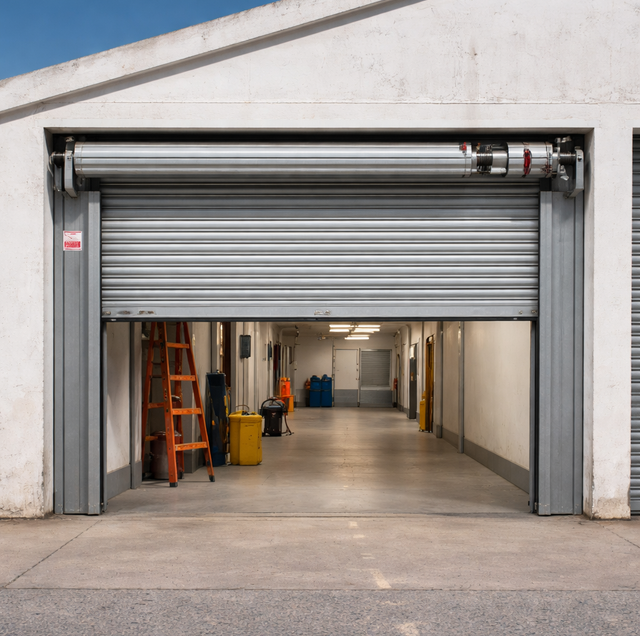
The rolling steel door between a warehouse floor and the office suite beside it gets treated like every other door on the property. It goes up at the start of a shift, comes down at the end of one, and nobody thinks about it in between. If that door carries a fire rating, it has a second job, and it will be asked to do that job exactly once, with nobody standing there to help it along.
That second job is why a rated door gets inspected on a schedule while an ordinary roll-up door does not. The inspector is not really checking whether the door works. The inspector is checking whether it will close by itself when the building tells it to, and whether it can still prove what it was built to withstand.
None of what follows is legal advice. It describes common inspection practice so you know what to expect and what to ask about; the specific rating an opening needs, the exact testing frequency, and how a deficiency gets resolved are set by adopted codes and interpreted locally, so confirm those specifics with your local fire marshal or code official rather than treating this article as the final word.
What a Fire Rating on a Door Describes
A rated wall is built to hold back fire for a set period. Cut an opening through it, and you have created a weak point, and the rated door is what brings that opening back up toward the wall's performance. In the trade, it is called an opening protective.
The rating is a duration: how long the assembly held up in a controlled laboratory fire test before it stopped containing the fire. For rolling steel doors, ratings commonly run from three-quarters of an hour through an hour and a half, three hours, and four hours. The number is not a prediction about a real fire, which behaves nothing like a test furnace. It measures demonstrated resistance under repeatable conditions, chosen to suit the wall the door sits in.
Two things follow, and they drive most of an inspection. The door performs only as an assembly: curtain, guides, hood, the counterbalance inside the barrel, the release hardware, and the way it all fastens to the wall were tested together. And it performs only if it is closed. A rated door standing open during a fire is a hole in the wall with hardware attached.
Where Rated Roll-Up Doors Turn Up
The warehouse-to-office wall is the common case, because the two sides carry different fire loads and occupancies. Rated coiling assemblies also appear at mechanical and electrical equipment rooms, boiler rooms, flammable storage, corridors dividing tenant spaces, and openings near exit stairs. A rated counter shutter over a service window carries the same expectations as a full-height door. If you are unsure whether a door is rated, the label settles it.
How the Door Knows to Close
An unrated roll-up door closes because somebody presses a button. A rated door has to close with nobody pressing anything, and it has to work with building power gone. The oldest and still most common release path is a chain of fusible links: small metal links held together by a low-melting alloy, sitting in the release line, separating when heat reaches them. They are interconnected so the loss of any one link releases the door, and they are placed deliberately, one near the headplate, one close to the ceiling on the door side of the wall, and one on the far side, clear of the dead-air pocket that forms in a ceiling corner where hot gases move slowly. The line between them is normally stranded steel cable, routed through conduit where it crosses the wall, without sharp bends and never plastic-coated. Many buildings also tie the release into the fire alarm so the door drops on an alarm signal rather than waiting for heat.
Once the release lets go, gravity does the rest. The curtain is not driven down; it falls, and a centrifugal governor limits how fast. Both extremes are dangerous: a free-falling curtain can injure anyone beneath it, while a curtain that creeps takes too long to close the opening. Average closing speed is commonly checked against a window of roughly six to twenty-four inches per second.
The governor, the counterbalance springs inside the barrel, and the release assembly are professional-only components. They store or control real energy, and none of them is a maintenance-staff item.
What the Inspector Looks At on the Door Itself
Before anything is tested, there is a visual pass over the assembly. The recurring items:
The rating label: A permanent label from the testing agency carries the rating and identifies the listing, and it has to be present and legible. A label painted over during a wall repaint is one of the most common field deficiencies. Paint does not make the door unrated; it makes the rating unverifiable, which for inspection purposes lands in the same place. Stripping the paint or having a listing agency re-label the door is the fix.
Field modifications: Anything added after the assembly was listed is suspect: a bracket welded to a guide, a sign bolted through the hood, conduit strapped to the curtain, a non-listed lock on the bottom bar. Replacement parts are expected to be the manufacturer's, since the door was tested with those parts in it.
The curtain and its hardware: Bent or torn slats, fatigue at the slat ends, broken or missing endlocks, and a bowed bottom bar all give a curtain a reason to bind partway down. Forklift contact is the usual cause, and the damage looks cosmetic from twenty feet away.
Guides, hood, and fasteners: Guides need the fire expansion clearance the manufacturer specified, because steel grows as it heats and a curtain in a pinched guide will jam. Mounting and assembly bolts have to be present and tight, and welds get checked against the installation instructions.
The release train: Fusible links, sash chain, and release cable have to be clean, flexible, and unkinked. Paint, heavy dust, grease, or a spray-on coating changes how a link responds to heat.
The Drop Test, and Why It Runs Twice
The functional part of the inspection is the drop test. The release is triggered, the curtain descends under its own weight, and the technician confirms it travels full height without binding, seats completely on the sill, and gets there at an acceptable speed. A rolling door is held closed by its guides and its own weight rather than a latch, so the counterpart to the latching check on a side-hinged fire door is confirming the curtain seats and stays down. A door that stops three inches shy of the floor has failed, even though it looks closed from across the room.
The technician then resets the door per the manufacturer's instructions and drops it a second time. A door that closes once but cannot be re-armed correctly would sit in the wrong state for the next year, so the second drop is the proof that the reset took.
Testing is expected at least annually, and the person doing it should be trained on rolling steel fire door systems specifically, not doors in general. Results go on a test form, with pass or fail recorded separately for the visual inspection, the operational check, and each drop.
The Failures That Have Nothing to Do With the Hardware
A large share of deficiencies involve a door in perfect working order that cannot close, either because something is in the way or because somebody made sure it would not.
Pallet racking set too close to the opening, product staged under the curtain, a pallet jack parked in the guide line, a cord or air hose run through the opening, or a chain wrapped around the bottom bar all defeat the assembly outright. So does a wedge or a kick-down holder. A rated door has to be self-closing or automatic-closing, so the only acceptable way to hold one open is a device that releases on an alarm, never a physical block.
The floor gets the same attention: the curtain has to land on a sill, and a sill buried under swarf, packaging, or the edge of an anti-fatigue mat will stop it short. Most of this is housekeeping rather than service work, since staff who use the opening daily have no idea the door above them is anything other than a door. Marking the floor works better than a sign nobody reads.
When a Door Does Not Pass, and Where to Confirm Specifics
A failed door is expected to be repaired without delay and retested afterward, and the repair is no place for improvisation. Swapping in a slat, endlock, governor, or release device that was not part of the listed assembly can invalidate the rating even if the door then runs smoothly. While it is out of service, the opening is still a hole in a rated wall, and what the building should do in the meantime, whether that means a fire watch, a temporary barrier, or a limit on use of the space, belongs to the authority having jurisdiction.
Keep the paperwork either way. The acceptance test record from the original installation is generally kept for as long as the door is in the building, and annual records stay on file for a period your inspector can specify.
If nobody at your property can produce last year's test record for a rated opening, that is the door to start with. Have it inspected and drop-tested by a technician trained on rolling steel fire door systems, get the visual findings and both drop results in writing, and take any deficiency list to your local fire marshal or code official.
Frequently Asked Questions
Yes, and many are, but the specification differs. A door meant only as a barrier can be a simple manual assembly, while a rated door in a daily traffic opening is usually built with a heavier counterbalance and often a motorized operator paired with a fail-safe release that disengages the drive so the curtain falls by gravity. The tradeoff is wear: normal cycling ages the same counterbalance and guides the fire function depends on, so a busy rated door needs service between annual tests, not only at them.
It depends on what the wall is holding back. A fusible link responds only to heat, and standard links are commonly rated around 165 degrees Fahrenheit, with higher-temperature links specified for hot spaces such as boiler rooms so the door does not drop on a warm afternoon. Heat has to build at the opening before a link lets go, so a release tied to smoke detection or the building alarm closes the door earlier. Openings meant to hold back smoke, not only flame, are often specified with both.
Briefly, yes, since the curtain has to travel full height with nothing underneath it. Facilities with several rated openings usually schedule them in one visit and reroute forklift traffic for the morning rather than testing one door at a time across separate days. Plan for the door that drops and will not reset: a faulty governor or release device can leave the opening down until parts arrive, so a spare governor or release assembly on hand shortens that downtime considerably on a facility with more than a few rated doors.
Resetting belongs to a technician trained on that door, not to maintenance staff, because a curtain can be rewound into the open position and look armed while the release is not properly engaged. A heated link gets replaced rather than reinstalled, and so does a stretched sash chain. If the door came down in a real alarm rather than a test, the slats, endlocks, and guides took a load they never see in normal use and should be inspected before it goes back in service.
Some listed releasing systems add a time-delay feature that holds the curtain briefly after the alarm so occupants can clear the opening, or an obstruction-sensing option that pauses partway down and retries rather than continuing to press against whatever is in the way. Both are specified deliberately for a particular door, not standard on every rated assembly, so check the release hardware's own listing rather than assuming either feature is present.
Leaving a dead door hanging in the wall is the worst option, since it is still an assembly an inspector will evaluate and it will keep failing. When an opening is truly abandoned, the accepted fix is to close it with construction matching the rating of the surrounding wall so the wall runs continuous again. Until then, the door is still the opening protective and is treated as one.
Walk your rated openings with a technician before an inspector does — we handle rolling steel fire door service and the follow-up commercial garage door repair when a drop test turns up a fault. Call (512) 456-3781.
