
Commercial Garage Door Preventive Maintenance: What to Log
Ask a facilities manager how last year's spring inspection went and the answer is usually "fine" or "it passed." Ask what the technician actually found on the spring itself, and the trail often goes cold at a checked box. That gap between a passed inspection and a usable record is where unplanned downtime gets manufactured, one thin service ticket at a time.
Every preventive-maintenance visit produces two things: work performed, and information. The work is what the invoice describes. The information tells you which door is quietly heading toward failure, and it only survives if the technician writes it down in a form somebody can read six months later.
What Separates a Record From a Row of Checkmarks
A checklist answers one question: was the item inspected? A record answers a different one: what condition was it in? On paper they look similar. Over three visits they behave nothing alike.
"Springs, OK" tells you a technician looked. A line reading "torsion springs original to the door, wire size and length taken off the spring markings, light surface rust at the winding cones, no coil separation" gives next year's technician something to measure against.
Three properties make the difference:
Measured, not judged: A number, a position, a photo, or an observation rather than a grade. "Track alignment good" is a grade. "Vertical track plumb at both jambs, slight roller play in the horizontal run" is an observation someone else can re-check.
Comparable across visits: The same fields in the same order, photos from the same vantage points, so a change stands out without anyone hunting for it.
Filed by door, not by date: The record belongs to Door 7. A visit report covering eleven doors in one narrative is nearly useless a year later, because nobody can pull the history of the one door that keeps failing.
Counterbalance Notes That Predict a Failure
Springs, cables, drums, and the shaft turn a nuisance into an outage, and they are professional-only territory from the first touch. What belongs in the record is not the adjustment, which is the technician's work, but the condition found.
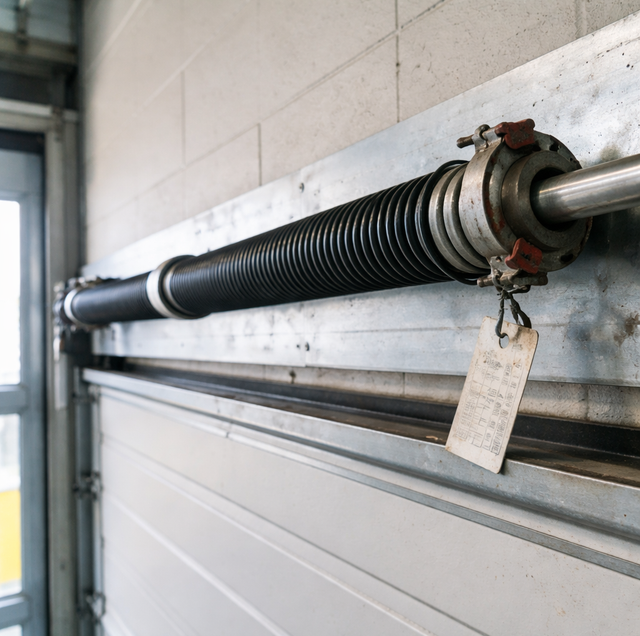
Useful entries: whether the springs are original or a replacement and the date of that replacement, the wire size, length, inside diameter, and wind direction read off the spring or the installer's tag, any rust or coil separation, and whether the door runs one spring or two. Cables get their own note covering condition at the drum, at the bottom bracket, and along the length, with broken strands called out by location rather than as a general "fraying." A cable wearing at the same spot each time points somewhere else, usually a drum, bracket, or track issue, and that pattern only surfaces if the location went down on paper the first time.
The balance test result belongs in writing as a finding, not a checkmark. Where does the door sit when released at mid-travel: does it hold, drift down, or climb? That one sentence, captured every visit, is the cleanest early warning you get on a counterbalance losing its rating.
Track, Rollers, and Hardware Readings
Track notes are where facilities lose the most information, because "aligned" gets written where a reading should go. Worth capturing: whether the vertical tracks are plumb and the horizontal runs level and properly supported, the clearance between roller and track, the condition of roller stems and bearings, and whether any section shows a flare, a dent, or elongated bolt holes.
Hinges are numbered on a sectional door, and the numbers matter. Recording "cracked hinge, number 2, right side, section 3" means the next technician arrives with the right part instead of a guess. Same for bottom brackets and the strut count per section.
Slab and jamb movement is a slower story: buildings settle, and a frame that shifts even slightly shows up first as a track needing re-shimming, then as a door binding on one side. Noting shim adjustments by location turns that from a recurring mystery into a pattern.
Safety Device Results, Not the Word "Tested"
Photo eyes, sensing edges, and reversal behavior are the items most likely to be logged as a bare checkmark, and the ones where a bare checkmark is worth the least.
For each door, the record should state which type of entrapment protection is installed, since it varies across a multi-door facility: a photo-eye pair, a monitored sensing edge on the bottom bar, a non-monitored edge, or a constant-pressure control station where the door runs only while somebody holds the button. A monitored edge signals the operator when its connection is lost; a non-monitored one does not, which is exactly the detail worth having in writing.
Then the results: what the beam height measured, whether the eyes were realigned or only cleaned, what the door did when the edge was activated during travel, and whether the reversal was immediate or sluggish. Note the force and limit settings as found and as left. A force setting raised at some point to push the door through resistance is a finding in itself, because the resistance is the real problem and a stronger push only buries it behind more motor torque. Anything involving the operator's wiring, the control station, or a power connection stays with a qualified professional.
Panel Condition and a Consistent Photo Set
Photos are the cheapest part of the record and the most frequently skipped. The value isn't in one good picture; it's in the same three or four camera positions repeated at every visit.
Shoot each door leaf from inside and outside, plus a close frame on any damage, the spring assembly and shaft, and the operator's data plate. Date the images and file them with that door's record. Dents, skin delamination, rust along a bottom section, a weather seal going brittle, and paint chalking all progress at a pace nobody notices in person but that a photo pair makes obvious. Steel and its coatings get worked from both directions: heat and sun fade finishes, cold stiffens lubricant and makes hardware brittle, and constant cycling grinds at the same parts year-round.
Damage notes should record the cause where it's known. A dent from a forklift mast at a loading position is a layout and training issue that will repeat; hail dimples across the top sections are a claim question. Only the record separates the two later.
Building a Running Log Per Door
The single change that does the most for a multi-door facility is giving every door a permanent identifier and one continuous file behind it.
Label the doors physically: A stenciled number or durable tag on the jamb, matching the log. Staff reporting a problem can then name the door instead of describing where it is.
Record identity once: Manufacturer, model, section count, door size, track configuration, operator make, model, serial, horsepower, and the entrapment protection type. This is what gets the right part on the truck for the first trip.
Capture usage, not just condition: Many commercial operators keep a cycle count in the control board menu, and reading it at each visit turns "this door gets used a lot" into a rate. One cycle is one open plus one close. A door running many times an hour and a door running twice a day should not share a service interval.
Track parts by number: What was replaced, the part number, and the date. That is how you learn a roller or hinge on one opening keeps failing while the identical part next door lasts years.
Give open items an owner and a due date: Anything deferred needs a name and a date, or it becomes an outage with a paper trail proving everyone saw it coming.
Read across a few visits and the trends surface on their own: force settings creeping upward, one door needing track shims every service, a cable wearing at the same point, a cycle count far outrunning the rest. Each is a small note in isolation. In sequence they work the way tread-depth readings on a tire do, where no single measurement decides anything, but the slope tells you when to act.
Who Else Reads the Record
The log stops being an internal habit the moment somebody outside the building asks for it.
A manufacturer warranty claim on a section or an operator generally goes better with service history attached, though coverage language differs by brand and product line, so your own paperwork is the place to confirm what yours requires. Insurance claims after a storm or an impact are easier to support with dated before-and-after photos than with recollection. A new contractor can absorb a labeled file in an afternoon instead of rediscovering the building over three visits. And capital planning gets less speculative when you can point to the doors whose records show them nearing the end of a service life, rather than arguing from the one that broke last.
None of this needs a large system. A folder per door, a phone camera, consistent fields, and a technician willing to write in specifics will outperform any expensive platform full of checkmarks.
Frequently Asked Questions
A door's real maintenance clock is its cycle count, not the month printed on the invoice. A dock door cycling dozens of times a shift may warrant quarterly or monthly attention, while a rarely used equipment bay can often go annually. Manufacturers publish duty classifications for operators (standard, heavy, and industrial duty are common labels) tied to expected cycles per hour and per day, and matching your interval to that classification is more defensible than picking a number. If a door's cycle count doubles because a workflow changed, the interval should move with it.
Either works, with two cautions. If your contractor keeps the history in their own system, ask for an exportable copy, because that history usually does not follow you if you change vendors. And whatever the format, put a scannable tag or QR sticker on each jamb linking to that door's file, so a technician at the door can add to the right record without guessing at a naming convention. Keep each file as long as the door and operator stay in service; it carries over at a lease turnover or a building sale.
Part of it, yes. Visual condition notes, photo sets, keeping the log current, wiping photo-eye lenses, clearing debris from the bottom track, and reporting new noises are reasonable in-house tasks that make the professional visit more productive. The line is firm on anything under tension or under power: springs, cables, drums, the counterbalance shaft, and any wiring or control connection belong to a trained technician with proper winding bars and lockout practice.
Four things get skipped most often: the spring specifications written out rather than called "standard," which lubricant was used and where (an unsuitable product on rollers and hinges creates its own wear), a photo of the drum and bottom bracket area on each door, and an explicit note about any door that could not be fully serviced that day, whether it was blocked by pallets, a parked trailer, or an active production line. That last one matters because an unserviced door otherwise disappears into a report that reads as complete.
Yes, and a sectional door leaves gaps. A rolling steel door's record should cover curtain slat and endlock condition, the bottom bar and astragal, guide clearance and wear, the hood, the barrel and its counterbalance, and on motorized units the brake and clutch. High-speed fabric doors add their own fields: breakaway resets since the last visit, curtain tears, side-seal condition, and drift in the photo-eye or radar activation zone. Keep a template per door type instead of forcing one form to cover everything.
Start with a baseline survey rather than a routine visit. Photograph everything from the angles you plan to reuse, note current condition even where nothing needs work yet, and pull a build or manufacture date off the door's data plate or spring tag where one exists, since that is often the only way to establish a door's real age in a building nobody has records for. Treat the first two visits as calibration, since the first tells you condition and the second, read against it, starts showing rate of change. Buildings inherited with no records often turn up a door or two already well past due, which is better learned on a scheduled morning than mid-shift.
Hand the logging to the crew doing the work — our garage door maintenance tune-ups come back with these fields already filled in, and the same paperwork follows our multi-family property door service. Call (512) 456-3781.
