
Commercial Garage Door Service Agreements: 7 Questions to Ask
Most commercial garage door service agreements get sold on a single number: visits per year. Two visits, four visits, monthly on the busy openings. It is the easiest figure to compare across bids and close to the least useful one, because it says nothing about what a technician touches during those visits, how quickly anyone arrives when a dock door jams open an hour before shift change, or who keeps the service records if you change vendors next year.
An agreement is a scope document before it is anything else. The useful version tells you which openings are covered, what happens to each one during a visit, what gets corrected under the agreement, what gets quoted, and how the vendor proves any of it took place. The seven questions below are the ones that separate a real maintenance program from a recurring invoice with a checklist stapled to it.
How Often Will a Technician Be On Site, and What Happens During the Visit
Wear on an overhead door is driven by cycles, not by the calendar. Every open-and-close puts one more load reversal through the torsion springs, one more pass of the cables around the drums, one more rotation of the roller stems in the hinges, and one more start-stop on the operator's gearbox and brake. A door on an active shipping bay can run more cycles in a week than a rear exit door runs in a year, so a program that puts both on the same twice-a-year schedule over-serves one and under-serves the other.
Ask the vendor to set frequency by use, then ask what the visit consists of. A credible task list, written per opening, generally covers:
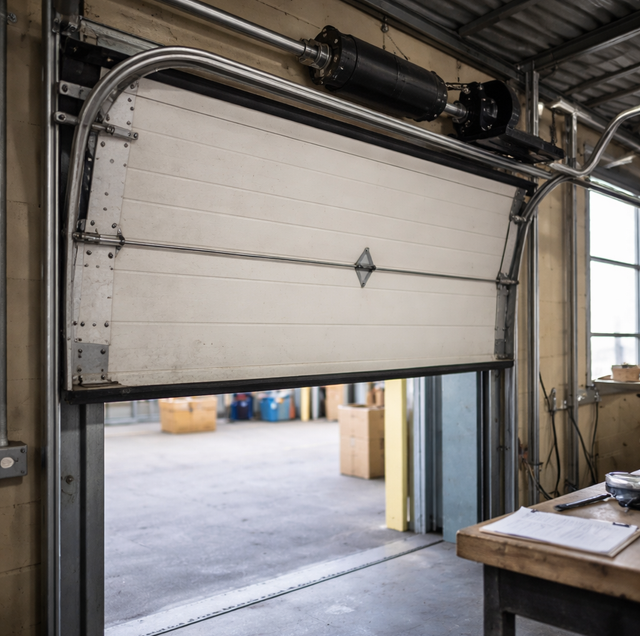
Counterbalance and lift hardware: Inspection of the cables where they wrap the drums, looking for broken strands, corrosion, or the splayed-out condition technicians call birdcaging; drum set screws; end bearing plates; hinges, roller stems, and track fasteners.
Operator and drive: Chain tension and sprocket wear on chain-driven units, gearbox condition and any sign of oil weeping, brake function, and limit settings verified by watching the door run rather than by reading a label.
Seals and guides: Bottom astragal condition, jamb seals, and on rolling steel doors, the guides, endlocks, and hood.
Lubrication: Applied where the manufacturer specifies it and with what the manufacturer specifies. General-purpose penetrating sprays are solvents first; they wash existing lubricant out of a bearing and leave very little behind.
One line matters more than the rest. Springs, cables, drums, and bottom brackets hold enormous stored energy, and adjusting or releasing them is professional-only work. Your agreement should make clear that this is the technician's job and never a facility staff task, no matter how routine the adjustment sounds over the phone.
Which Openings Are Covered, and How Is Each One Identified
Coverage disputes almost always start with an ambiguous asset list. A door that is not on the list is out of scope, and "all overhead doors at the property" stops working the moment you add a building, wall off a bay, or inherit a tenant space with three more openings than anyone counted.
Ask for a per-opening list with a unique ID that is physically tagged at the door and matches both the vendor's system and your own maintenance software. Each entry should carry the door type (sectional, rolling steel, fire-rated rolling, high-speed), the manufacturer and model where the data plate survives, the operator type (trolley, jackshaft, hoist), and the control station in use. That list is the backbone of everything else in the agreement, including the service history discussed further down.
What Does the Response-Time Commitment Measure
"Four-hour response" is a phrase, not a definition. It can mean a callback from a dispatcher, a technician assigned in the scheduling system, a truck in your lot, or a working door. Those are four different promises, and only the last two change your day.
Ask what starts the clock, what pauses it, and what ends it. Ask how the vendor defines business hours, how weekends and holidays are handled, and whether after-hours calls route to a live person or a voicemail box someone checks in the morning. Ask whether the agreement buys you position in the queue ahead of non-contract callers, since during a widespread outage that priority is the only thing that matters.
Then ask about tiers. A door stuck closed on your only outbound dock stops production. A door stuck open leaves the building exposed to whatever the weather is doing, heat and humidity through one part of the year, cold and driving rain or snow through another, plus an unsecured opening overnight. Those two failures deserve different response commitments, and a vendor who tiers them is thinking about your operation rather than their route sheet. Finally, ask what the remedy is when a commitment is missed, and whom you escalate to by name.
What Is Included in the Visit and What Gets Billed Separately
The useful way to present this is two lists, not a paragraph of qualifiers. Scheduled labor, inspection, testing, lubrication, limit and travel adjustment, fastener tightening, and small consumables such as set screws and hardware are commonly inside the agreement. Replacement parts and the labor to install them, including springs, cables, rollers, hinges, panels, curtain slats, operators, control stations, and safety devices, are commonly billed separately. Damage from impact or misuse sits outside almost every agreement.
Parts availability deserves its own question. Curtain slats, non-standard-width sections, and operator control boards are frequently special-order items, and a vendor's answer about what rides on the truck versus what waits on a supplier tells you how long a bad day lasts. Ask what interim measures they use while a part is in transit, such as securing the door in the closed position or switching a properly equipped door to manual operation, and ask who signs off on that arrangement.
How Are Safety Systems Checked and Recorded
Entrapment protection is the part of a commercial door program most likely to drift out of compliance quietly, because a defeated photo eye does not stop the door from working. It only stops the door from stopping.
Powered operators are grouped into classes according to where they are installed and who is expected to use them, and the class governs which kinds of entrapment protection are acceptable. The practical version: if an operator closes the door with a momentary button press, it needs a working external protection device, such as a monitored sensing edge along the bottom bar or a photo eye across the opening. Without that device functioning, closing is supposed to happen only while a person holds the close button down and watches the opening. Ask the vendor to test and log each device at every visit, and ask what they do when they find one bypassed.
Fire-rated rolling doors carry a separate obligation that facility teams often inherit without being told. These doors are meant to be drop-tested on a set schedule, and again after any repair to the closing system, by someone trained for it. Worth knowing: a failed test is a finding you correct, not one you schedule around, and the door has to be reset to normal operation by that same trained person once testing is finished. Confirm your agreement actually includes this test rather than assuming routine maintenance covers it.
Who Owns the Service History for Each Door
Per-door records matter for a simple reason: a history you cannot take with you is the vendor's asset, not yours. Ask two things before signing. Will records be delivered to you after each visit rather than produced only on request, and can you export them in a format you keep if you change vendors or your contractor is acquired? A verbal assurance that records are kept is not the same as a delivery commitment written into the agreement.
How Does the Agreement Renew, Change, or End
Read the administrative terms with the same attention as the technical ones. Look at the initial term, whether renewal is automatic, and how much notice a change requires. Ask how doors get added or removed mid-term when you take on space or decommission a bay, and whether the visit schedule adjusts with them. Ask who your point of contact becomes if the vendor is acquired or your assigned technician leaves.
Contract language around termination, liability, and indemnity should go to whoever normally reviews agreements for your organization rather than being interpreted from a summary. If you lease the space, check your own lease and confirm with the property manager which party is responsible for door maintenance before you sign, so you are not buying coverage the building already provides.
Putting the Seven Questions to Work
Send these questions in writing before the walkthrough, and ask for answers in writing alongside the proposal rather than verbally on-site. The comparison gets easy fast: a vendor who services what they sell answers in specifics, the task list per door type, the clock definition, the two billing lists, the record format, while a vendor who talks around half of them has already shown you how the relationship will run once you have signed.
Frequently Asked Questions
Often not. Levelers, restraints, dock seals, and bumpers are a separate equipment family, and plenty of door companies service one and not the other. If your loading area includes them, ask directly whether hydraulic and mechanical levelers are both within the vendor's scope and whether their technicians carry the hydraulic components and lip-hinge hardware for those units. Splitting the two across vendors is workable, but you want the split named in the agreement rather than discovered when a leveler lip stops returning.
Yes, and it is a detail proposals often leave out. If the operator tracks cycles internally, put in writing that the technician reads and records that number at every visit rather than leaving it to happen only when someone remembers, since a counter nobody reads is no better than not having one at all. For doors without a counter, the agreement can instead call for a technician's usage estimate based on observed wear, logged the same way, so every door builds a usage trend in its file even without the hardware.
They can, but only if the vendor is set up for them. High-speed doors use a different design vocabulary: a breakaway bottom bar that releases on impact, a self-repairing curtain that re-seats in the guides, a variable-frequency drive controlling acceleration, and often a light curtain rather than a single photo eye. Service usually depends on brand-specific training and parts access, so ask whether the vendor is an authorized servicer for your make, since unauthorized work can affect the manufacturer's warranty.
Impact damage falls outside routine maintenance coverage almost everywhere and is handled as a billable repair. What varies is process. Ask whether the vendor produces an impact report with photographs and a parts list you can hand to your own insurer or safety group, since that record is what turns a repair into a preventable-incident data point. If the same opening keeps getting hit, guard posts or bollards set outside the door line usually hold up better over time than the panels do. Check your own policy and internal reporting rules for how such damage should be filed.
Often, and it is worth asking for specifically if you operate more than one site. A consolidated agreement can standardize the task list and record format across locations, so a door at one facility gets the same inspection depth as a door at another, and it usually simplifies scheduling and invoicing to a single point of contact. Confirm the vendor actually services every location directly rather than subcontracting distant sites, since a subcontracted response can fall outside the commitments negotiated for the primary agreement.
They should, and they are the openings most often left off. A door without a powered operator still has springs, cables, drums, guides, and seals that wear, and a chain-hoist door adds reduction gearing and a holding brake that need inspection of their own. Because these doors have no controls to fail, they tend to fall out of the maintenance conversation until someone cannot get one open. Ask that every opening on the property appear on the list with its type noted, powered or not.
Price the scope, not the visit count — we put the per-door task list and the response window in writing for commercial garage door repair, right down to after-hours emergency repairs in Round Rock. Call (512) 456-3781.
