
Commercial Door Safety Compliance: 3 Things OSHA Expects
Search the federal workplace safety rules for a chapter on overhead doors, and you will not find one. There is no OSHA standard written specifically for overhead doors in general industry. What exists instead is a general obligation on every employer, plus a product safety standard governing how powered door operators are built. Most of what a business needs to do sits between those two, and the confusion comes from not knowing which is telling you what.
This is informational, not legal or compliance advice. What applies to you depends on your industry, your equipment, your building official, and sometimes your insurer. Confirm your obligations using OSHA's published resources or a qualified compliance professional.
Two Sources of Rules, and What Each One Governs
The workplace side is a general duty: an employer keeps the workplace free of recognized hazards likely to cause serious harm. It names no parts and no brands. A powered door that can crush a worker is a recognized hazard, so the duty attaches even though no line says "garage door." In practice, what a facility can show usually comes down to whether the hazard was known, whether protection existed, and whether it was maintained, but how that gets weighed in a specific case is a question for OSHA's resources or a compliance professional, not this article.
The equipment side is different in kind. UL 325, a widely adopted entrapment-protection standard for automated doors and gates written by a safety certification organization rather than a government agency, defines how an operator must behave: what happens when something interrupts the closing path, and which protective devices must be present for a given mode of operation. Manufacturers build and list their operators to it. It is voluntary on its own, but once a jurisdiction adopts it into code, it stops being optional in any practical sense.
The split runs like this: the equipment standard covers the operator as sold, and the workplace duty covers everything after, meaning whether that protection stays connected, aimed, tested, and respected.
Expectation One: Entrapment Protection That Works
A powered door that can close without someone holding a control is the case that matters most. Timer-to-close doors, motion-activated doors, and doors closed remotely, all move while nobody is necessarily watching the opening.
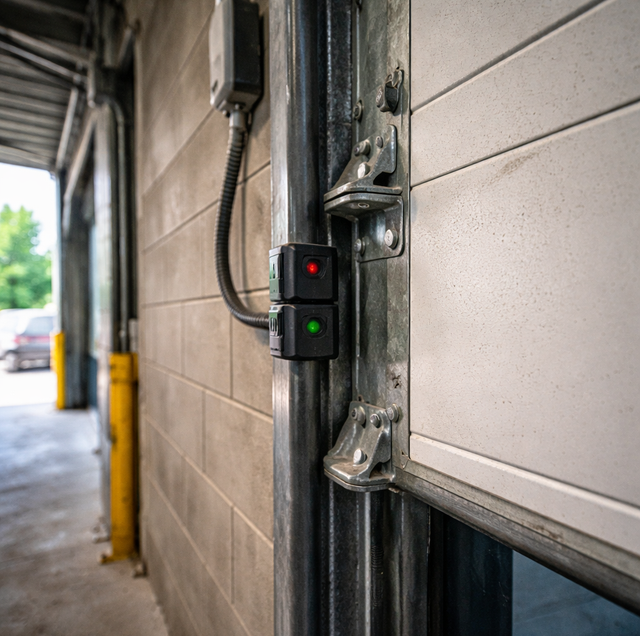
Two families of devices cover that opening. A non-contact device, typically a photo-eye pair casting a beam across the doorway, reverses the door when something breaks the beam before contact. A contact device, typically a sensing edge along the bottom bar, reverses the door once something presses the edge. Their coverage differs: one watches the plane of the opening, the other reacts only after the bottom bar has touched something.
The operator's internal obstruction sensing helps too, but only after contact, which on a heavy insulated sectional or a steel curtain is the part you were trying to prevent in the first place.
What fails in the field is rarely the concept and almost always the installation:
- Lenses fogged or coated: Concrete dust, exhaust film, and condensation cut the beam's margin until it trips on nothing or fails to trip at all.
- Brackets knocked out of alignment: A pallet jack or forklift mast clips the mount, and the beam drifts off the receiver. The indicator light on most photo-eye pairs shows this first.
- Sensing edge damaged: A cut, a crushed section, or a pulled connector interrupts the circuit the edge depends on, and a wireless edge transmitter with a dead battery reports nothing.
- Sun angle washing out the receiver: Low sun down an east- or west-facing dock line can overwhelm a receiver, which is why a door may misbehave at only one time of day.
The right response to a protective device that is not working is to take the door out of automatic operation until it is repaired, not to run it and remember to be careful.
Expectation Two: People Who Do Not Defeat the Devices
Nearly every defeated safety device started as a real frustration: a door kept reversing on a beam misaligned by traffic, production stopped, and someone solved the wrong problem instead of the real one. What results looks normal from across the room and shows up nowhere in a service history, because nothing was reported broken. The tells are visual, not exotic: an eye that no longer sits in the doorway's path, a sensing edge with tape or a wrap across it, a control wedged so it stays made. If a device is not sitting where it was installed and aimed the way it was aimed, treat the door as unprotected and call it in, regardless of whether it still seems to work.
Two things prevent them. The first is fixing root causes so the workaround never gets invented. If a forklift keeps hitting the same bracket, the fix is a guarded or relocated mount, or a bollard, not a longer zip tie. If lenses foul weekly, cleaning goes on the weekly schedule. A door that nuisance-trips at one hour of the day is a diagnosis worth calling in, not a quirk to work around.
The second is a short, specific awareness message employees can hold in their heads:
- Nobody walks or drives through a doorway while the door is moving, in either direction.
- Nobody races a closing door on a pallet jack or a forklift.
- A door that hesitates, shudders, changes sound, or reverses for no visible reason gets reported the same day.
- No one modifies, blocks, relocates, or bypasses a safety device, and there is a named person to escalate to instead.
Control placement matters as much as training. A push button or key switch belongs where the person operating the door can see the full opening; a wall control around the corner invites exactly the habit the standard was written to prevent.
Expectation Three: A Testing Routine You Can Show
Testing turns the first two into something checkable, and takes a couple of minutes per door.
Non-contact device test: With the doorway clear of people, start the door closing and interrupt the beam from the side with a long object such as a broom handle. The door should reverse promptly and fully. Never test a beam with a hand, a foot, or any part of a body.
Contact device test: With the doorway clear, place a solid, non-crushable object (a 2x4 laid flat works) on the floor in the door's path so the bottom bar will land on it squarely, then start the door closing from the control and stand clear. The door should reverse on contact. Never hold an object against a closing door or test the edge with a hand.
Visual pass: Confirm both photo-eye housings sit firmly in their brackets and point at each other, indicator lights read normal, lenses are clean, the sensing edge is uncut, and no cord is chafing where the door moves.
A monthly interval is a common manufacturer recommendation. A door cycling constantly through a shift deserves a shorter one than a door that opens twice a week, so match the interval to real duty and write down what you chose.
Then keep the safety-specific record separate from your general maintenance log: door identifier, date, which of the tests above were run, pass or fail on each, and the corrective action with a service ticket number if a contractor was called. A record settles no legal question on its own, but it shows whether a fault is recurring rather than new, and it is the paper an inspector or insurer will ask for first.
Work That Belongs With a Specialist
Some of what sits behind a safe door is never maintenance-team work, whatever the schedule says.
Springs, cables, drums, and counterbalance parts: These hold the door's weight under high tension and release it violently when they let go. Adjustment and replacement are professional-only, on residential and commercial doors alike, as is a door that has come off its track with the counterbalance still loaded.
Anything inside an energized panel or conduit: Operator power feeds, disconnects, and control wiring in a live enclosure belong to a licensed electrician.
Fire-rated rolling doors: These carry their own periodic testing and reset requirements, a specialty with its own qualification expectations. Use a technician trained specifically on fire-rated door testing, and file that paperwork with your fire protection records.
Vehicle gate operators, loop detectors, card readers, and access control: A perimeter swing or slide gate is a different class of equipment with its own protection requirements, and the detection and credential side belongs to a gate specialist or your access control vendor.
Dock levelers, seals, and restraints: These share the opening with the door and belong to a separate dock equipment specialist.
A company that installs and repairs sectional and rolling steel doors, operators, sensors, tracks, cables, and panels is the right call for the door itself and the wrong call for the fire alarm interface or the driveway gate.
A Practical Place To Start
Walk the building once and list every powered door: type, location, operator make, whether it can close on a timer or only under someone's hand, and which protective devices you can see. Test each one that day and note the result. Doors that fail, that have no non-contact device, or that carry one mounted outside the door path are your first service call. Then set the interval and put the next three dates on a calendar.
Frequently Asked Questions
Entrapment protection requirements attach to powered operation, so a push-up or chain-hoist door with no motor is a different case. Its hazards live elsewhere: the hoist chain should sit in a wall keeper so it cannot swing into an aisle or a forklift path, and the counterbalance holds stored energy whether or not a motor is attached. The trap is retrofitting. Adding an operator changes what applies to that opening, so protective devices and control placement belong in the conversion plan, not after it.
Low, generally no more than about six inches off the floor. Crews on commercial dock doors sometimes raise the eyes to clear debris and forklift contact, which quietly creates a blind zone underneath the beam. If contact damage is the reason, the better fix is protected or recessed mounting at the correct height, or a second pair mounted higher while the low pair stays put.
Newer operators watch the sensor circuit continuously rather than reading it only during a close cycle. If the wiring is cut, shorted, jumpered, or the device stops answering, the operator recognizes the fault and drops out of automatic closing, usually reverting to a mode where the door closes only while someone holds the control. The old bypass tricks backfire on this equipment: rather than quietly disabling the sensor, they announce themselves.
The conversion is what triggers the requirement, not the age of the building. A door that has run for years on a chain hoist with nobody thinking twice about it now needs entrapment protection sized to how it will actually close, and the control placement, sensor type, and testing routine all get decided as part of that conversion project rather than added piecemeal afterward. Loop in whoever is installing the new operator before ordering it, since the protective devices are often chosen to match a specific control board.
Beyond the reversal tests above: photo-eye alignment and lens cleaning, indicator lights, chafing on sensor cords, loose lag bolts in jamb brackets, cracked hinges specifically at the sheet-metal ends where they take the most flex, rollers with play in the stem, and torn weather seal. Anything touching the counterbalance or a live electrical enclosure stays with a technician, as covered above.
Equipment is generally built and listed to the standard in force when it was manufactured, and older installations are not re-engineered every time a standard is revised. Two things commonly change that: replacing the operator, which brings the new operator's own requirements and listing with it, and changing how a door is used, such as converting a hand-operated door to timer or remote closing. Because adoption varies by jurisdiction, confirm your situation with OSHA's resources or your building department.
Put the entrapment tests on a schedule instead of on somebody's memory — book a garage door safety inspection and we leave a dated record behind, on one opening or on a whole building's worth of commercial garage door services. Call (512) 456-3781.
