

How Heat Shortens the Life of Springs, Rollers, and Openers
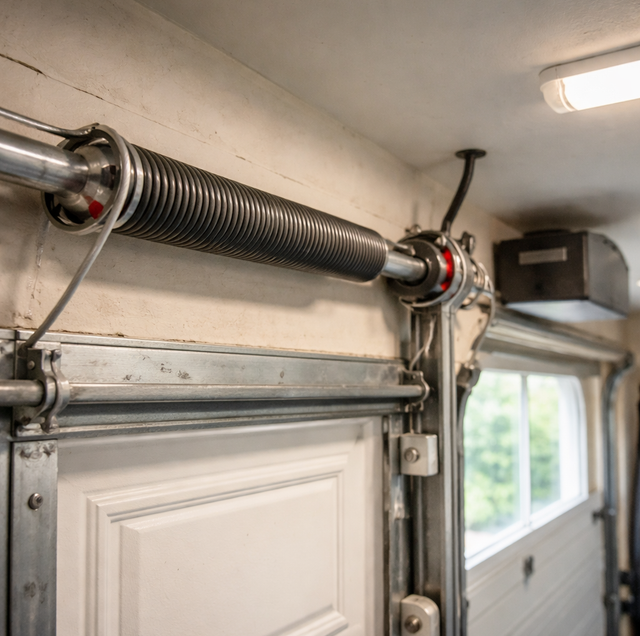
Heat rarely breaks a garage door part on the day it is hot. Spring steel does not go soft at any temperature a garage will reach, and no torsion spring ever failed because a thermometer hit a number. What a long hot stretch does is slower: it thins the grease holding metal off metal, drives a daily moisture cycle across bare steel, and ages the electronics under an uninsulated roof deck, all on the one assembly in the house cycled several times a day.
Then, months later, on an ordinary morning, a spring lets go with a bang. The heat did not do that in an afternoon. It spent a year setting it up.
What Heat Actually Does to a Torsion Spring
The spring above the opening is a helical torsion spring: hard-drawn or oil-tempered steel wire wound over a shaft, storing enough energy to lift a door that can weigh well over a hundred pounds. Despite the name, the wire barely twists. As the coil winds tighter, the wire works mostly in bending, and the highest stress sits at its outer surface, so surface damage matters far more than anything happening inside the wire.
Springs fail by fatigue rather than by wearing down evenly: every open and close is one load cycle, and a crack starts at a surface flaw, grows a fraction at a time, and stays invisible until the rest lets go at once.
Heat reaches that surface indirectly. A garage that bakes all afternoon cools overnight, and when the steel drops to the dew point of the humid air around it, condensation forms on the coils: dry by mid-morning, wet again the next night. That rhythm etches shallow pits through thin galvanizing and through the oil finish on oil-tempered wire, and a pit is a stress riser where local stress runs far above the average. Fatigue cracks start at pits, so a spring that would have made its rated cycle count falls short.
Warm steel is also slightly less stiff, so a hot spring gives back a little less lift than on a cool morning, and that loss lands on the afternoons when a garage used as the family's main entry runs hardest.
What heat does not do is worth saying plainly: no garage reaches the temperature where spring steel loses its temper. A hot summer does not soften a spring; it corrodes the surface, strips the lubricant, and lets fatigue do the rest.
Grease Is the First Thing the Heat Takes
Every rolling and pivoting joint depends on a lubricant film thick enough to keep two loaded metal surfaces apart: roller bearings, hinge pivots, the bearing plates the shaft turns in, the cable drums. That film is thin by design, and its thickness follows the lubricant's viscosity at the joint's running temperature.
Viscosity falls as temperature rises, and grease does more than thin. It is base oil held in a soap thickener, and heat pushes oil out while speeding its oxidation. It behaves like cooking oil left in a hot pan, first running thin, then darkening into a tacky layer that grips whatever lands in it. What stays in the joint is dry soap residue, varnish, and dust.
Inside a roller bearing, the film separating a ball from its race is measured in millionths of an inch to begin with. Thin it past the point where it holds the surfaces apart and the high spots touch, the race work-hardens, and flakes lift out. That is the rumble you hear months before a roller visibly shakes the door. A dry bearing at the end of the shaft squeals, then wears its race out of round, which lets the shaft wobble and load the cable drums unevenly.
Nylon and Steel Rollers Do Not React the Same Way
Two properties separate a nylon wheel from a steel one in a hot garage: how much each grows when it heats, and what each does under a long-held load.
Thermal growth: unreinforced nylon expands several times more than steel for the same rise in temperature. Stem, bearing, and track are all steel and grow together; the nylon wheel does not. On a hot afternoon it sits tighter in its track than it did that morning, and the press fit onto its bearing loosens a little more with each heat cycle. Once the wheel slips on its bearing instead of turning with it, the roller drags and wears a flat band on one side.
Creep under load: nylon carrying a steady load in a hot garage deforms slowly and never fully springs back. A door left closed for two weeks rests on the same few contact points the whole time, which is why the first opening after a trip starts with a thump-thump. Nylon is hygroscopic as well, swelling slightly in humid air and stiffening again in a long dry spell, which leaves it likelier to crack at the hub.
Steel rollers skip both problems: wheel and track expand at the same rate, and steel does not creep. What steel gives up is quiet, and the common unsealed versions run an open bearing that loses its grease to heat and then packs with dust.
Where the Opener Feels It: Windings, Capacitor, Board
The motor: on a chain-drive AC motor and a belt-drive DC motor alike, the life-limiting part is the thin enamel insulation on the winding wire. That insulation ages chemically, and motor engineers have leaned on the same rule of thumb for decades: each additional ten degrees Celsius of sustained winding temperature roughly halves its expected life. A motor's own heat rise stacks on top of the air around it, so the same unit in a hot garage runs hotter windings its whole life than one in conditioned space.
The thermal protector: most openers carry a cutout that opens the motor circuit when it overheats and closes once it cools. The door stops partway, nothing else looks wrong, and several minutes later it runs normally. That reads as an intermittent electrical fault; the motor is protecting itself.
The start capacitor: a capacitor-start AC motor needs an electrolytic capacitor to get the rotor moving, and electrolytics are the most heat-sensitive parts in the unit: the electrolyte escapes through the end seal at a rate that climbs steeply with temperature. As capacitance drops, so does starting torque, and the classic pattern is a door that starts fine in the morning and only hums by late afternoon.
The logic board: the board sits in the hottest layer of the garage, since hot air stacks at the ceiling. Its own electrolytics dry out, and the supply gets noisier: shorter remote range, a door that ignores the wall button, then works again after dark. Every daily heat-and-cool cycle also flexes the solder joints on heavy through-hole parts, since board, components, and solder expand at different rates. A joint on a relay, or on the terminal block where the sensor and wall-control wires land, can open a hairline crack, so contact follows the temperature instead of the switch.
Heat also damages the board's surge protection. Many boards clamp incoming spikes with a metal-oxide varistor, and an MOV gives up a little capability with every surge it absorbs while heat raises its standing leakage. A board that has run hot for several summers in an area that also gets storm-season spikes has less margin left than its age suggests.
Heat Moves the Building Around the Door
Expansive clay soil gives up moisture during a long dry heat and shrinks, then swells again after heavy rain. The slab and the jambs, the vertical tracks are lagged into, move with it, and a small shift at the floor becomes a larger error at the top of the rail. Rollers ride hard against one flange, hinges take a side load they were never built for, and a steel section that grows across its width as it heats has less clearance to grow into. All of it reaches the opener as force: openers learn what normal travel takes and reverse when it takes more, so thinned lubricant, a tighter track, and a warm spring returning less lift can add up to an obstruction reported with nothing in the doorway.
The Cold Half of the Same Story
None of this is a summer-only problem, and the two halves of the year are linked. Grease that thinned and oxidized through the heat is the same grease that stiffens on the first hard freeze, when viscosity climbs the other way steeply, so the year's highest starting torque demand arrives while the motor is cold and the lubricant is thick.
The link that matters most sits in the spring. Steel loses a little fracture toughness as it gets colder, so a fatigue crack that grew quietly through the hot months is likeliest to run all the way through on a cold morning. That is why springs break on the coldest day of the year when the damage was done during the warm ones. The wear runs year-round; only the trigger changes.
What Each Warning Sign Usually Points To
| What you notice | What is usually behind it | Where to look first |
|---|---|---|
| Door feels heavier by hand, worst on hot afternoons | A spring partway through its cycle life, plus the small loss of lift from warm steel | Balance test with the opener disconnected |
| Rumble or scrubbing that continues with the opener disconnected | Roller bearings on oxidized grease and dust, or a wheel slipping on its bearing | Rollers and their bearings |
| Hums without turning, mostly late in the day | A start capacitor that has dried out and lost capacitance | The capacitor, not the door hardware |
| Stops partway then runs again minutes later, or intermittents that clear overnight | Thermal cutout tripping, aged electrolytics, or a cracked solder joint | Motor temperature and board condition |
Frequently Asked Questions
Type matters more than brand. Spring coils, hinge pivots, bearings, and the opener rail want a garage-door grease or a light lithium or synthetic grease that stays put when hot; the spec for that is the dropping point, where the soap thickener stops holding its oil. Penetrating spray is a solvent, not a lubricant. And never grease the inside of the track, which then collects grit and lets rollers slide instead of roll.
More than almost anything else in the system. Backup batteries, sealed lead-acid or lithium, lose calendar life faster the hotter they are kept, on the same halving-per-ten-degrees pattern that governs capacitors and winding insulation. The failure is quiet: the battery ages while the opener runs on line power, and you find out during an outage. Most units flash a battery light or report a fault in the app first.
That timing points at the photo-eyes, not the force settings. The sensors send a modulated infrared beam, pulsed at a set frequency so the receiver can tell its partner's signal from daylight. Low sun lined up with the driveway can saturate the receiver, which then cannot pick the pulse out of the glare. The tell is a window of time that drifts through the calendar with the sun angle, and never an overcast day.
Pull the emergency release and work the door by hand. Noise that continues by hand is mechanical: a rumble that speeds and slows with the door is a roller bearing, while a squeal fixed near the ends of the shaft is a bearing plate. Spring noise is a dry metallic crunch from coils rubbing, usually with coils that look rough. Noise only present with the opener engaged is the drive: a worn gear, a loose chain, or the rail carriage.
A technician works outward from the highest-consequence part. The spring first: coil surface for pitting, the gap between coils at rest, and a hand balance check against the door's weight. Then the ends of the shaft, since bearing plates show grease loss earliest, then the cable drums, where a set screw that backed off lets the cable wrap unevenly. Rollers and hinges next, then travel and force settings.
Both, and the keypad has it worst because it is the one part of the system mounted outside. A wireless keypad on a sunlit jamb runs well above garage air temperature, and heat is what drains a coin cell or AAA pack fastest, so a keypad that works at breakfast and not at four in the afternoon is usually reporting battery voltage rather than a rejected code. Ultraviolet exposure also stiffens and cracks the rubber or membrane keys, which lets water reach the contacts underneath and corrode them green. The practical answer is placement: a keypad moved a few inches under the trim, or given a small hood, spends the afternoon in shade, and a set of batteries in it lasts through a summer instead of dying in the middle of one.
Almost nothing here looks like heat damage when it finally fails. It looks like a spring that broke early, a roller that got loud, an opener that quit for no reason anyone can name. The parts that come up short in a hot climate are rarely the ones that were abused. They are the ones that spent years slightly dry, slightly pitted, and running warmer than their ratings assumed, until an ordinary morning asked for more than was left.
Book a maintenance tune-up before the next heat stretch — a technician checks spring balance and coil condition, roller bearings, shaft bearings, track alignment, and opener force settings in one visit. Heat works on a schedule, and a set of coils that survived last August makes no promise about this one; when the balance finally goes it is torsion spring replacement in Hutto that puts the door back where it belongs, and the identical summer load is why Georgetown spring replacement calls bunch into the same few weeks every year. Cedar Park is home base for Squared Away Garage Door Service and Central Texas is the territory; (512) 456-3781 reaches dispatch.
