
Resident Garage Door Emergencies: The After-Hours Triage
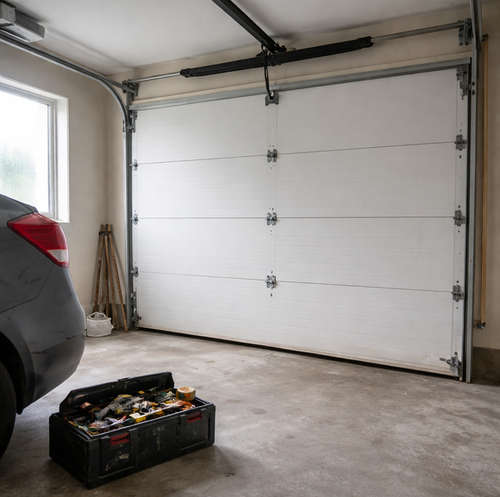
An after-hours call about a garage door falls into one of two very different categories, and the difference determines whether a technician needs to be on-site within the hour or whether the fix can wait for regular business hours. Get that read wrong in either direction, and it costs something: dispatch a truck for a door that's merely noisy and the property has burned an emergency call on something that could have waited, or tell a resident to wait until morning when their car is physically trapped, or their unit is standing wide open, and a mechanical problem turns into a liability one.
Sorting a Counterbalance Failure From Everything Else
Every sectional garage door sits on tracks via small rollers, and a spring system offsets the weight of the door itself so the opener's motor only has to move a fraction of the door's actual weight. Most residential doors built in the last couple of decades use one or two torsion springs mounted on a metal shaft above the header, with cables running down each side to the bottom corners of the door. Older or lighter single-car doors sometimes still use extension springs stretched along the horizontal track instead. Either way, when that spring system is intact, the door should lift with light effort even by hand. When a spring or cable has failed, the opener suddenly has to fight the door's full weight, which is why it can stall, reverse, or refuse to move at all.
That single distinction, whether the door is failing because something in the counterbalance system broke or because of a separate issue like a misaligned sensor, a worn drive gear, or a dead remote, is what separates a five-minute phone conversation from a same-night dispatch. A resident saying "the door won't close" could mean the sensor light is blinking and the safety reversal is doing its job correctly, or it could mean a cable has come off a drum and the door is now resting unevenly in the opening. Both get reported in almost identical language.
The Triage Questions That Sort Real Emergencies From Everything Else
A short, consistent set of questions on the phone does most of the work of deciding whether a truck needs to roll tonight.
- Where is the vehicle right now: Inside the garage with the door down and immovable, or is the resident simply unable to close the door once the car is already out? The first is an entrapment problem. The second is a security problem with no entrapment at all.
- Is the opening currently closed or open: A door that won't close and is sitting open overnight is an unsecured unit, regardless of whether a vehicle is involved. That's worth treating as urgent even if the resident sounds calm about it.
- Did anything get caught as the door came down: A bumper, a trash can, a pet, or a person? Any "yes" here means dispatch immediately and skip the rest of the questions until everyone and everything is confirmed clear.
- Did the resident hear or notice anything before it stopped: A bang, a loud snap, one side of the door hanging lower than the other, or a cable visibly off its track. These are signs of a broken spring or cable, and they change the answer to the next question.
- Has the resident already tried the manual release cord, and what happened when they did: The cord is only safe to pull with the door fully closed in the first place, since an open door depends on the counterbalance alone once it's disconnected. If the door moved easily by hand, the spring system is probably fine and the fault is elsewhere. If it didn't budge, or moved and then dropped, the counterbalance system is compromised, and nobody should keep trying to force it.
What Can Reasonably Wait Until Morning
Not every after-hours call needs a technician standing in the driveway at midnight. A door that closes fully and latches, but does so slowly, loudly, or a few seconds later than usual, is an annoyance and not a security gap. A remote or keypad that's intermittent while the wall-mounted control still opens and closes the door normally means the resident has a working backup and the unit stays secure overnight. A sensor light that blinks and stops the door from closing on its own, while the door still closes fine using a press-and-hold on the wall button, usually means a photo-eye is dirty, knocked out of alignment, or has something blocking its beam, not a structural failure of the door itself. Cosmetic damage, a dented panel, a scraped track cover, that doesn't interfere with the door traveling and sealing, also fits in the "note it and schedule it" category rather than the "call someone now" one.
What Needs a Technician Tonight
A handful of situations don't have a reasonable "wait until morning" version. A vehicle that's truly boxed in, with no other way for the resident to get the car out and a real need to leave (an early shift, a medical appointment, a flight), warrants dispatch even if nothing is actually broken and the fix turns out to be simple. A door that's stuck open, or stuck part-way, with no way to close it, is an unsecured ground-level opening into a home or storage area for as many hours as it sits that way, and that risk doesn't improve by waiting for sunrise. Anything caught underneath the door as it came down gets a truck regardless of the hour, full stop, once everyone's safety is confirmed. And any report of a visibly broken cable, a spring that's separated, or a door hanging crooked in its tracks is a same-night call because the door is no longer behaving predictably: it can shift further, drop, or come off its rollers with no warning.
Building the Response File Before the Call Comes In
The calls above go faster and safer when the information a technician needs isn't being assembled for the first time at 11 p.m. A short reference sheet per property, kept both on paper at the front desk and in whatever system after-hours staff can reach from home, should cover a few things:
- Dispatch contact: The emergency vendor's after-hours line and the property's account reference, so the call to dispatch starts with useful information instead of a search for a phone number.
- Release type by unit: Which units have a standard manual release cord within easy reach near the opener rail, since nearly every chain-, belt-, or screw-drive residential opener has one, and which units, if any, use an exterior keyed release instead.
- Spring type by building: Which buildings or units run older extension-spring setups along the track rather than torsion springs on a header shaft, because a failure in an extension spring without a containment cable running through it behaves differently, and more unpredictably, than a torsion spring failure.
- A standing rule for staff: The manual release cord only produces a safe, light-effort lift when the spring system is intact. If the triage questions point to a broken cable or spring, staff should not tell a resident to keep pulling on that cord or to try lifting the door themselves.
Temperature has some effect on how doors behave day to day. Extreme heat can make certain lubricants thin out, and metal parts expand slightly; extreme cold can stiffen grease and make an opener's motor work a little harder to get moving. Either one occasionally shows up as a sluggish or noisier close. Neither one turns a functioning door into a security gap or traps a car inside, so it's a minor contributor to keep in mind, not something to chase down before answering the triage questions above.
What Staff Should Never Attempt Themselves
A few boundaries are worth stating plainly to anyone who might take an after-hours call. Nobody on staff, and no resident being coached over the phone, should attempt to work on a spring, a cable, or any part of the counterbalance system, including trying to help a stuck door down or back up by hand once a break is suspected. Nobody should open the opener's motor housing or handle wiring inside it; if the unit lost power along with other units in the building, that's useful information to pass to the technician or an electrician, but it isn't a staff repair task. And nobody should tell a resident to force a door that's resisting, whether by hand or by holding down a wall button against resistance, since resistance is frequently the safety system doing exactly what it's supposed to do. When in doubt, the safer and faster path is the same-night call.
Frequently Asked Questions
The bottom bracket is the metal fitting at each bottom corner of the door where the lift cable attaches. If a resident mentions the door looks like it's hanging unevenly or one corner has pulled away from the track, that often means a bottom bracket has separated from the cable rather than the spring itself failing, which is a distinct failure worth mentioning to the dispatcher since it changes what a technician brings on the truck.
Some openers support an outside keyed disconnect: a small keyed cylinder mounted near the door that pulls the same internal release lever as the interior cord, disengaging the trolley from the drive carriage without anyone entering the garage. It still relies on the same spring-and-cable system for a safe lift, so it doesn't help once that system has already failed, and it isn't wired into the photo-eye sensors at all since those govern the opener's powered travel, not a manual disconnect.
Beyond confirming no one is hurt, staff should avoid moving the vehicle or the door and instead take a few photos of the door's position, any visible damage, and the surrounding area. That record is useful later if the resident's insurer or the property's asks questions about how the incident happened, and it's far easier to capture before anything gets shifted.
Yes, since it points to a building-wide electrical issue rather than a single door fault, and that changes who gets called first. Note whether neighboring units on the same electrical panel or breaker also lost door power before dispatching a garage door technician, since an electrician may need to be first on scene, and a technician arriving to a de-energized opener can't diagnose much beyond confirming the motor itself isn't the problem.
A technician may be able to install a temporary track clamp above a roller on one side to physically stop the door from being lifted from outside, buying time until a full repair happens, but that's a professional-only step because it changes how the door can move and needs to be positioned correctly. It's not something to attempt as a stopgap without a technician present.
Usually it's the remote's own battery, the single most common cause of a fob that only works up close or drops out intermittently, so rule that out first with a fresh one. If a new battery doesn't fix it, check the receiver's antenna wire, a short lead hanging from the logic board inside the motor head, which can lose range if it's coiled up, pinched, or damaged. Either cause belongs with the "schedule it, don't dispatch tonight" group, since a working wall control or keypad means the unit is still secure overnight.
Set up an after-hours garage door response plan for your property — clear triage steps and faster answers for staff at any hour. That plan is only as good as the number behind it, so put after-hours emergency garage door repair in Brushy Creek on the on-call sheet your night staff actually reads, and list the rest of the portfolio the same way for Pflugerville so a two-in-the-morning call never turns into a search for who to wake. Squared Away Garage Door Service operates from Cedar Park across Central Texas around the clock on (512) 456-3781.
