

Garage Door Won't Stay Open Halfway? It's a Safety Warning
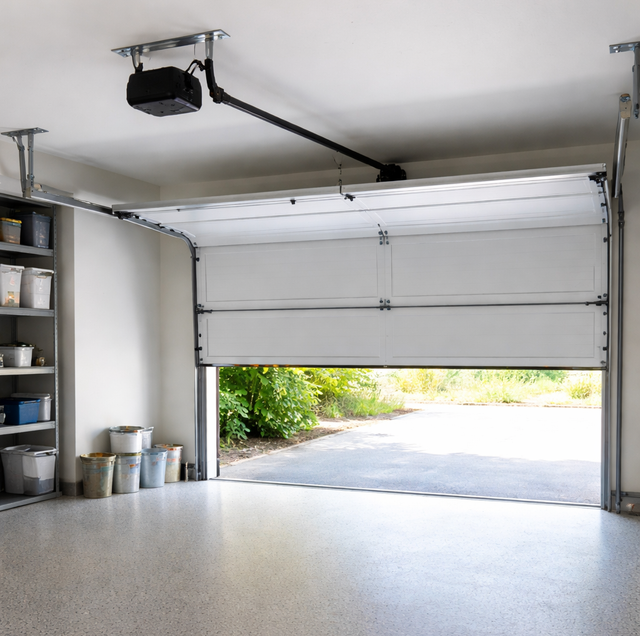
You leave the garage door up around waist height, just long enough to carry two loads of groceries in from the car, and by the time you're back it has sunk another foot on its own. So you grab whatever is nearby to prop it: a paint can, a scrap two-by-four, a kid's bike helmet wedged under the bottom panel. It works, until the day it doesn't drift down slowly and instead drops fast enough that the prop skids sideways instead of catching it. The prop becomes part of the routine: grab it on the way out, wedge it under the panel, move on. The door quietly gets written off as old or just finicky. Age has nothing to do with what is actually happening above it.
This Is Not a Convenience Problem
A garage door that opens and closes fine but will not hold a position partway through its travel is not being temperamental. It is telling you, plainly, that the counterbalance system responsible for offsetting its weight no longer matches the weight it is supposed to offset. On a torsion system, that means one or both springs mounted on the shaft above the door have lost tension relative to what the door weighs today. On an extension system, it means the springs stretched along the horizontal tracks have weakened past the point where they can hold the door's weight at rest.
Think of that spring the way you'd think of a counterweight on an old double-hung window. It is not there to hold the sash in place through friction; it is there to offset most of the sash's weight so a light push is all it takes to raise or lower it. A garage door opener is built on the same logic: it supplies the last bit of force to start and stop the door, not the force to carry a few hundred pounds of steel or wood on its own. When the spring side of that equation falls behind, the opener and the door both start compensating in ways they were never designed for, and a door that will not sit still halfway open is usually the first visible sign.
Why This Counts as a Real Safety Issue
A standard steel sectional garage door commonly weighs somewhere between 130 and 400 pounds depending on size, material, and insulation. When that door is stopped partway through a cycle, whether by the opener pausing or by you lifting it by hand, it is being held almost entirely by spring tension, not by the opener's brake or by friction in the track. If that tension has drifted out of match with the door's weight, gravity is the thing actually deciding what happens next, and gravity does not warn you first.
This is also why the safety features people trust most do not cover this failure. Photo-eye sensors and the sensing edge fitted to the bottom panel on the doors that have one are built to stop and reverse a door that is actively closing under power when something breaks the beam or gets caught underneath. They do nothing for a door that is sitting still, unpowered, and simply loses its counterbalance while a person, a pet, or a car is beneath it. A door that free-falls from a static half-open position is a failure the auto-reverse system was never built to catch.
What Actually Wears Down the Counterbalance
A few mechanisms account for most of the tension loss technicians see in the field, and none of them are unique to one time of year.
Heat and UV exposure: Sustained high temperatures and direct sun warp and fade exterior panels over years of exposure, and a panel that has bowed even slightly adds drag every time the door travels, so the spring works against more resistance than it was wound for. The spring's own daily heat-and-cool cycling adds to that, wearing coiled steel faster than in a shaded, temperature-stable garage. Cold snaps do the opposite damage: contracted steel becomes more brittle and more prone to sudden coil failure rather than gradual weakening, which is why a spring can seem fine for months and then let go all at once during the first hard freeze of the year. Either extreme stresses the same coil.
Humidity and rust: Moisture in the air promotes surface rust on unprotected torsion springs, lift cables, and hinge pins. Rust does not just look bad; it adds friction between coils and can eat into the cross-section of the wire itself, both of which change how much force the spring can actually deliver compared to its rated tension.
Cycle count: Every open-close is one cycle, and every spring is rated for a finite number of them before it is expected to weaken or break. A garage that doubles as the household's main entry point racks up cycles far faster than a side door used a handful of times a week, so a heavily used attached-garage door can reach the back half of a spring's service life years before a detached garage's would.
Shifting frames and tracks: Expansive clay soil, common in many areas, moves slabs and door frames by fractions of an inch over time, throwing a track slightly out of parallel. That adds drag at one specific point in the door's travel, which compounds with, but differs from, a weak spring.
A slipped cable: Occasionally the symptom looks like a bad spring but is actually a lift cable partly off its drum, changing how evenly the door's weight is carried on that side without the spring itself having failed.
Four Things to Observe, Not Fix, Before You Call
None of the steps below involve touching a spring, a cable, or a drum. Torsion springs are wound under enough stored tension to cause serious injury if they release unexpectedly or if someone attempts to adjust them without the correct winding bars, and a lift cable under load can whip hard enough to cut skin if it slips. The goal here is to watch and describe accurately, so a technician arrives already knowing roughly what failed.
1. Does it drift or does it drop? A slow sink over ten or fifteen seconds points to a spring that has gradually weakened. A sudden, fast fall points to something that has already failed outright, a broken coil or a cable that has come free, and that door should not be raised or lowered again by hand or opener until it is inspected.
2. Is the behavior worse at one height on the track? A torsion spring's resistance is not perfectly even across the door's full range of motion; the geometry of the wound coil delivers slightly different force depending on how far the shaft has rotated. Note whether the door holds fine near the top but drifts hard around the middle, or the reverse. That detail alone can help a technician narrow down whether the spring itself has weakened unevenly or a specific section of track is adding drag.
3. Was the opener engaged or disengaged when it happened? If the door drifts while the opener is still connected and doing the holding, the opener's gearing may be masking how weak the spring actually is, which means the real problem is worse than it looks day to day. If the manual release cord had already been pulled, or the door was being moved by hand, that confirms the drift is a counterbalance issue with nothing to do with the opener's motor or logic board.
4. Does it settle level or does one side sit lower? Most double-spring setups mount one spring near each end of a shared torsion tube, and two springs rarely wear at the same rate. A door that sags noticeably on one side as it drifts is pointing to one spring carrying more of the load than its partner, not to a symmetric loss of tension across the whole system.
What Not to Do While You Wait
Do not keep propping the door open as a routine habit; every cycle in a compromised state adds wear to an opener now working harder than it should. Do not use the opener to force the door past a point where it strains audibly, since that strain is the motor making up for a spring shortfall it was never sized to cover. Do not attempt to tighten, loosen, or wind anything near the springs yourself, even if a coil gap or a fraying cable is visible. If either is visible, stop entirely and leave the door where it is rather than cycling it again.
Frequently Asked Questions
Not necessarily. A full start-to-finish cycle only tests the very top and bottom of the door's travel, the two points where a spring's resistance curve matters least. That same mid-travel resistance curve is also why an outright spring failure tends to happen while the door is stopped or moving through the middle of a cycle rather than at full open or full closed, so a door that cycles cleanly end to end has not actually been tested at the point where trouble is most likely to show up first.
Standard-duty residential torsion springs are commonly rated around 10,000 cycles, which works out to roughly seven years for a door cycled about four times a day. Higher-cycle springs rated 20,000 to 30,000 cycles or more are available and often specified for garages used as a main entry, since heavier wire and a larger coil let them hold usable tension across far more cycles before the drift starts.
No, and it can make the situation harder to catch. The force and travel-limit settings control how hard the motor pushes and how far it travels, not how much tension the spring supplies. Raising the force setting can let the opener power through a weak spring for a while longer, which masks the underlying counterbalance problem instead of correcting it and can also push the motor to draw more current than it was designed for.
Single-spring torsion setups, more common on lighter or narrower doors, offer no backup if that one spring lets go: the door's full weight becomes unsupported all at once, producing a sudden drop rather than a gradual drift. Two-spring setups on wider or heavier doors give some partial support if only one spring weakens, which is part of why a two-spring door is more likely to drift unevenly first instead of failing all at once.
Yes. Extension springs stretch and contract along the horizontal tracks rather than twisting on a shaft above the door, and without a safety cable threaded through the coil to contain it, a failed extension spring can release with enough force to become a projectile inside the garage. Any extension-spring door missing a visible containment cable through the coil is worth flagging to a technician even before it starts drifting.
If the door is already showing this symptom, it's better to leave that test to a technician rather than doing it yourself. A door that's actively losing counterbalance can transfer more of its weight to your hands than expected the moment the opener is disconnected, and a technician can assess coil condition and cable tension visually first to judge whether a hand test is even appropriate before attempting one.
What This Comes Down To
A door that will not hold still halfway open is not a quirk to work around with a paint can and a hope that it improves on its own. It is the counterbalance system reporting, in the clearest way it has available, that the tension holding a few hundred pounds of door no longer matches the door's actual weight. Watching how it drifts, where it struggles, and whether the opener is carrying it gives a technician the information needed to identify the failed component before any tool touches the system, and that observation is the one part of this problem that is safe to do yourself.
Schedule a same-day spring and counterbalance inspection — a technician identifies which spring, cable, or track component has failed and explains what's actually happening before any repair starts. A door that refuses to hold at mid-travel is reporting that the counterbalance no longer carries its weight, which puts it in garage door spring replacement in Leander territory rather than anything an opener setting will cure, and on a door cycling four or five times a day it is worth asking what heavier-duty springs, rollers, and bearing plates would change while the shaft is already apart. Squared Away Garage Door Service is a Cedar Park outfit covering Central Texas; ask for a technician at (512) 456-3781.
