

How Long Do Garage Door Springs Last? The Real Answer
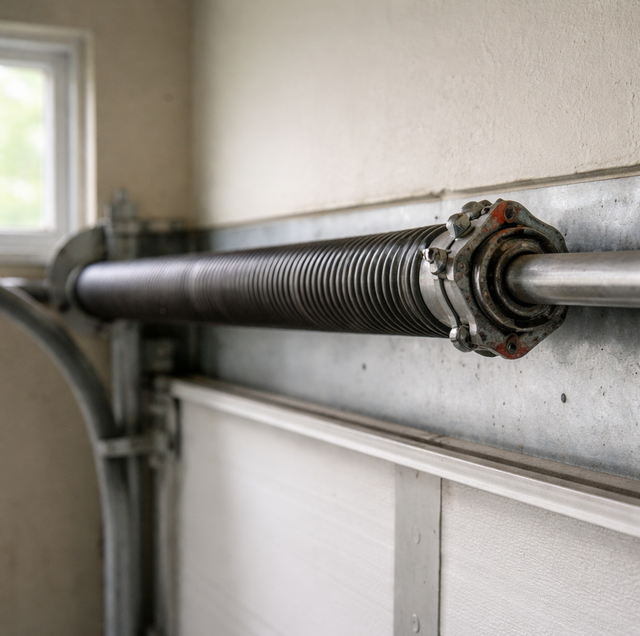
Quick Answer: Most standard garage door torsion springs are rated for about 10,000 cycles, which works out to roughly 7 to 14 years for an average household that opens the door a few times a day. High-cycle springs rated at 20,000 to 50,000 cycles or more can last two to five times as long. Because springs store extreme tension, they are strictly a job for a trained technician to adjust or replace.
If you have ever wondered when your garage door springs are due to fail, you have probably heard a number thrown around in years. That number is misleading. Springs do not age on a calendar the way a roof or a water heater does. They wear out based on how many times they have done their job, and that count has almost nothing to do with the date on the wall.
What Springs Actually Do Before We Talk About Lifespan
A garage door is heavy. A single-car steel door can weigh well over 100 pounds, and an insulated double door can run past 300. The opener motor on the ceiling is not what lifts that weight. Its job is small: nudge the door into motion and guide it along the tracks. The real lifting is done by the springs, which store energy when the door closes and release it to counterbalance the weight when the door opens.
Counterbalance is the key idea. When the springs are correctly sized and wound, a properly balanced door feels nearly weightless in your hands. You could lift it halfway, and it would hover there. That balance is what protects the opener, the cables, and the whole system from strain. When a spring weakens or breaks, that counterbalance disappears, and suddenly the full weight of the door lands on parts that were never meant to carry it.
Springs Are Rated in Cycles, Not Years
Here is the number that matters. A garage door spring is rated by cycles, and one cycle is a single open plus a single close. Manufacturers stamp springs with an expected cycle life based on the wire diameter, the coil count, and the drum size the spring is paired with.
A standard torsion spring on a typical residential door is often rated for around 10,000 cycles. Do the math, and the "years" figure falls out of your own habits:
A few cycles a day: A household that opens and closes the door three or four times daily uses roughly 1,200 to 1,500 cycles a year. At 10,000 cycles, a set of standard springs lands somewhere in the 7-to-14-year range.
Many cycles a day: A busy family that treats the garage as the main entrance, in and out for school, work, errands, and evening activities, can easily hit eight to twelve cycles a day. That is 3,000 to 4,000 cycles a year, and the same 10,000-cycle spring is used up in roughly three years.
Same spring, same quality, wildly different lifespan. The door in a home where two adults leave once and return once is coasting. The door that a family of five runs all day is working hard, and it will show its age far sooner even though both were installed the same week.
This is why a year figure from a neighbor or a forum never quite matches your own experience. Their usage is not your usage.
High-Cycle Springs and Why the Rating Varies
Not every spring is built to the same standard. High-cycle springs use thicker wire and a longer coil to spread the same load over more material, which lets them flex more times before fatigue sets in. Depending on the build, these run from 20,000 cycles up to 50,000 or more.
For a light-use door, a standard spring is fine, and the extra cost of a high-cycle upgrade is hard to justify. For that same busy family running eight-plus cycles a day, a 20,000-cycle spring roughly doubles the calendar life, and a higher rating stretches it further still. The upgrade is a usage decision, not a luxury one, and it is worth raising with a technician who can look at how your door actually gets used.
Torsion Versus Extension Springs
Two spring systems are common, and they do not age the same way.
Torsion springs mount on a metal shaft directly above the door opening. They wind and unwind to raise and lower the door, and they are the more modern, more durable choice. Because the load is controlled and the spring is anchored, torsion systems generally last longer, run more smoothly, and fail more predictably.
Extension springs stretch and contract along the horizontal tracks on either side of the door. They are older technology and common on lighter doors and in some builder installations. They tend to wear faster under the same use, and when one lets go, it can whip if it is not fitted with a safety containment cable through its center.
If your door still runs on extension springs and they whip when they break, that safety cable is not optional. A technician can confirm whether yours has one. Between the two systems, torsion is the sturdier and generally safer long-term setup.
What Actually Wears Springs Out
Cycle count is the clock, but several things speed that clock up, and some can cut a spring's life dramatically below its rating.
Rust and corrosion: Dry, unlubricated coils grind against themselves and against humid air. Rust pits the steel and creates weak points where a crack can start. A rusty spring can snap after thousands of cycles because the metal is compromised, not just tired. Humidity and moisture in the garage accelerate this.
An unbalanced door: If the door is out of balance, the springs fight extra weight on every single cycle. That constant overload burns through cycle life and drags the opener and cables down with it. Balance problems often trace back to shifting tracks, a bent rail, or springs that were never sized right to begin with.
Builder-grade, low-cycle springs: Many homes ship with the cheapest springs that meet spec on installation day. They pass inspection, and they are often on the low end of the cycle scale, which is why a spring can fail surprisingly early in a newer home.
Improper spring sizing: A spring matched to the wrong door weight or the wrong drum runs under constant strain. It may work at first, but it is overloaded on every cycle and will not reach its rated life. Correct sizing is a measurement job, which is one more reason spring work belongs with a professional.
None of these are seasonal. Cold can make steel more brittle in winter, and heat plus constant cycling stresses the same steel the rest of the year, so a spring under any of these conditions is being worn down no matter the month.
Warning Signs a Spring Is Failing or Already Broken
Springs rarely fail quietly. Watch and listen for these:
A loud bang: A breaking spring often goes off like a firecracker or a gunshot, sometimes from an idle garage in the middle of the night. If you hear it, assume a spring has snapped.
The door suddenly feels very heavy or will not lift: With the counterbalance gone, the door's full weight is back. If it feels like dead weight or the opener strains and stalls, stop.
A visible gap in the torsion spring coil: A healthy torsion spring is a tight, continuous coil. A break usually leaves an obvious two-to-three-inch gap where the two ends separated.
The opener struggling or reversing: An opener grinding, laboring, or backing off partway is often fighting a weak or broken spring, not failing on its own.
The door dropping fast or hanging crooked: A door that slams down quickly or sits at an angle in the tracks has lost even counterbalance on one side.
If you see or hear any sign of a broken spring, stop operating the door. Running an opener against a broken spring can damage the motor, snap a cable, or send the door dropping. Do not try to force it up or down by hand either.
Why Both Springs Get Replaced Together
Doors with two torsion springs almost always get both replaced at once, even when only one has broken. The reason is simple math. Both springs were installed at the same time and have taken nearly the same number of cycles, so the second spring is right behind the first. Replacing only the broken one usually means a second service call within months, and running a mismatched pair, one new and one worn, throws off the balance the whole system depends on. Replacing the set keeps the door balanced and saves you a repeat visit.
The Maintenance That Actually Extends Spring Life
You cannot add cycles to a spring's rating, but you can make sure it reaches the rating instead of failing early.
Lubricate on a schedule: A garage-door-specific lubricant on the springs, hinges, rollers, and bearings a couple of times a year cuts friction and holds off the rust that kills springs prematurely. Use a product made for garage doors, not a general degreaser that strips protection away.
Apply a garage-door-specific lubricant to the springs, hinges, rollers, and bearings a couple of times a year to cut friction and hold off the rust that kills springs early. Use a product made for garage doors, not a general degreaser that strips protection away.
Keep the door balanced: A balanced door means the springs carry only what they were sized for. If the door no longer hovers when raised halfway, or feels heavy on one side, have the balance checked before the extra load eats into the springs.
Book periodic tune-ups: A professional tune-up catches the small problems that shorten spring life: early rust, a track drifting out of alignment, cables starting to fray, hardware working loose. Fixing those keeps the whole system pulling together instead of overloading the springs.
A safety note that cannot be repeated too often: garage door springs are under extreme tension and can cause serious injury or death if they release unexpectedly. Lubrication is a safe do-it-yourself task. Winding, adjusting, or replacing a spring is not, and never should be. Before any hands-on check near the springs, disconnect the opener so the door cannot move on you, and leave the tensioned work to a trained technician with the right winding bars and hardware.
Frequently Asked Questions
On a single-spring torsion setup, a technician can sometimes convert the door to a dual-spring system, which splits the load across two springs and lowers the strain on each. It is not a universal fix and depends on the shaft length, the header space above the door, and the door's weight, so it takes a measurement and an on-site assessment to know if your door is a candidate.
The lift cables that run from the bottom of the door up to the drums take stress on every cycle too, and it is common for a technician to find frayed or rusted cables during a spring replacement. Many pros recommend inspecting or replacing the cables at the same time as the springs, since a fresh spring paired with a fraying cable moves the next failure a few feet down the system.
A technician can read it from the spring's wire diameter, inside diameter, and overall length, then match those measurements against a spring chart to identify the rating. Some installers also mark the install date and spec on the spring or the header, so it is worth asking what went in if you ever have the door serviced.
Indirectly, yes. A heavier door, such as a solid-wood or a well-insulated multilayer steel door, needs springs sized for that extra weight. If the springs were undersized for a heavier door, they wear faster. The material itself does not fatigue the spring; the weight the material adds is what the spring has to counterbalance every cycle.
The opener is built to move a counterbalanced door, not to lift the raw weight of the panel. Running it against a broken spring can burn out the motor, strip the drive gear, or snap the trolley, turning a spring repair into an opener replacement. That is why the door should be left alone until a technician restores the counterbalance.
Look at the metal shaft mounted on the wall directly above the door opening. If you see a single long coiled spring centered on the shaft, it is a one-spring system; if you see two springs, one on each side of the center bracket, it is a dual-spring setup. Sharing that detail when you call helps a technician bring the right parts on the first visit.
Get your springs inspected before one snaps — protect your door, your opener, and everyone who parks under it. Cycle counts run out quietly, so Squared Away Garage Door Service books proactive spring replacement in Brushy Creek long before the break, and the same trucks reach the Brushy Creek area, Cedar Park, and the rest of Central Texas. Call (512) 456-3781.
