
Garage Door Buckling in the Middle: What the Bow Means
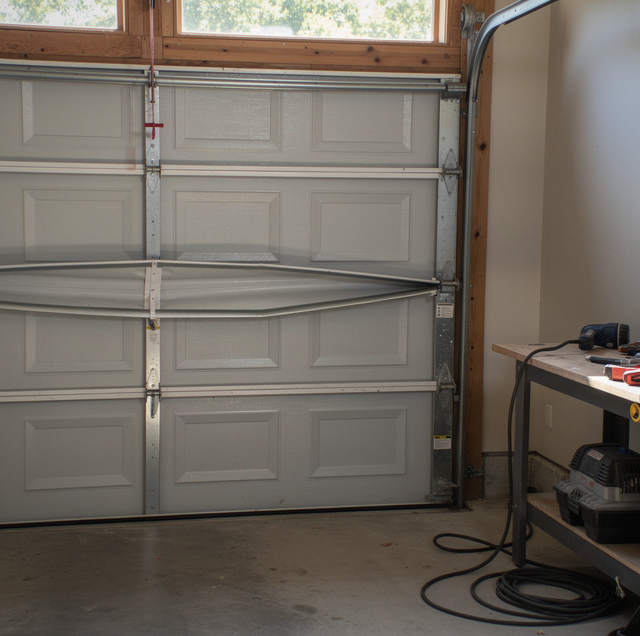
A garage door section starts as a flat sheet of galvanized steel. Roll-forming turns it into a series of raised panels, then folds the top and bottom edges into returns that interlock with the sections above and below it. That shape, not the steel's raw thickness, is what lets a section span sixteen feet without sagging under its own weight: the ribs and returns are what resist bending across the section's width. When a section starts to bow or buckle across that width, usually as the door climbs its first few inches of travel, it's that engineered profile losing a fight it wasn't built to carry alone.
The Shape That Keeps a Steel Panel From Sagging
The raised panel pattern most residential sectional doors use is structural as much as decorative. Each rib acts like a shallow beam running the width of the section, and the folded return along the top and bottom edges does double duty: it locks into the joint hardware on the section above or below it and stiffens that edge against bending. Together, the ribs and returns give a section enough rigidity to resist deflecting across a wide span while staying light enough for the springs and opener to lift.
That rigidity has a limit. Under normal load, a section flexes slightly and returns to flat, as any formed steel part does within its elastic range. Push past that range, and the steel takes what's called a permanent set: it stops springing back, and the bow becomes part of the panel's shape. Once a section has bowed and held that bow with no load on it, the profile itself has changed.
The End Stiles, the Center Stile, and What Ties Them Together
Every section has a vertical end stile riveted to the steel at each edge. The end stile carries the roller bracket and takes the shear load as the door travels around the curve where the vertical track becomes horizontal. On a full sixteen-foot door, a center stile runs down the middle of the section, too, splitting the unsupported span roughly in half and giving the panel a second vertical anchor point to bow against rather than a single continuous, unsupported width.
The roller bracket rides on the end stile and, on a wide door, on the center stile as well, so the section's weight is carried through the stiles to the throat of the track. The panel skin does a different job. It keeps the section rigid across its own width while the stiles and their roller brackets carry that rigid section's share of the door's overall weight.
Hinges connect one section to the next at every horizontal joint. They let the door articulate as it curves through the track and, just as importantly, they transfer load between sections so no single section carries its share of the door's weight in isolation.
What the Strut Is Actually Bracing
A strut is a horizontal brace, usually a formed steel channel, bolted across the back of a section from end stile to end stile, and through the center stile on a double-wide section. It ties the whole width of a section together into one stiffer unit, so no single point on that section has to carry a load by itself.
That matters most on the section carrying the operator's connection point. The opener's arm attaches to a bracket near the middle of that section, and every time the door cycles, the full pull of the opener lands at that one spot. The springs' lift, by contrast, is distributed along the section's whole width. A section sized to hold its shape under its own weight and the springs' counterbalance can still give under a second, concentrated force pulling from the middle, and the strut is what's supposed to carry that difference.
Why the Bow Appears at the Moment of Highest Load
Buckling is rarely visible throughout a full cycle. It shows up hardest in the first few inches, right as the door breaks away from the floor. That's the point of highest resistance: the weatherstrip along the bottom is still gripping the slab, the door hasn't built any upward momentum, and the opener is pulling against the full weight of a door still at rest. Whatever force reaches the section through the strut and its connection point is at its highest right there.
A section with a sound strut absorbs that instant without visibly changing shape. A section that's under-braced for it flexes hardest exactly there, then may straighten out, or look close to straight, for the rest of the door's travel.
Don't keep running a door that visibly bends as it lifts, and don't park or stand under it. A panel that has flexed for months can give way without the noise a breaking spring or cable makes first.
A Door Without a Strut on the Operator Section
The plainest version of this failure is a section that never had a strut installed where the opener attaches, usually a sixteen-foot double-wide door where the opener was added or replaced without reinforcing the section it's mounted to. Every cycle since then has left that section's own skin and stiles to resist the operator's pull on their own, and every cycle has flexed it a little further.
A bow is continuous across the panel's face. A section that has come apart at its joints shows a gap at a hinge line instead, which is a hardware failure with a different fix. A missing strut leaves the section's own material to do a job it was never designed to do alone, and steel, however well-formed, only absorbs so many cycles that way before it stops recovering.
The Quiet Version: A Strut Loose on One End
A strut that has come loose at one end is harder to catch than one that was never installed, because, at a glance, the reinforcement is still there. The bolt pattern is visible, the channel is still bolted to the panel, and nothing looks obviously wrong. What's actually happened is that one end of the brace, usually at an end stile, has backed out or sheared, so the strut now ties down only one side of the section instead of both.
Under load, that shows up as an asymmetric bow: the section flexes more on the unsecured side than the other; instead of bowing evenly across its whole width the way a section with no strut at all tends to. It is mistaken for a track or roller problem because the door binds or hesitates unevenly rather than lifting stiffly. The emergency release does not shorten that wait. The release cord is safe to use only with the door fully closed and the counterbalance intact, and it is never a way to hold a door open.
What Repeated Cycles Do to a Bowed Section
Curved steel bends more easily in the direction it's already curved. A section that has taken a set starts every cycle from an already-curved shape instead of a flat one, so the bow doesn't hold at the size it reached the first time. It tends to deepen.
The stiles, hinges, and rollers along that section are all built to work with a panel that holds a true, flat plane. Once the plane itself is gone, the load path through the rest of the door has changed too, even if nothing else has failed yet. The section standing in the opening is no longer the section that was installed.
Frequently Asked Questions
Look at the door fully open and at rest, with nothing loading that section. Sight along the panel's face from one end at a shallow angle instead of looking at it square on, because a gentle curve reads as flat from directly underneath and only shows itself along the line of sight.
It can. The hinges and roller brackets along a bowed section are set at fixed spacing, and a section that's no longer holding a true flat plane can throw its own roller slightly out of true in the track's throat at that joint, which shows up as a separate binding or rubbing problem right at that hinge line.
Not reliably. Once the steel has exceeded its elastic range, pushing it back toward flat usually shifts the strain to a slightly different point in the panel rather than removing it, and the ribbed profile rarely regains its original stiffness, even if the surface looks straighter afterward.
Yes. A sixteen-foot double has roughly double the unsupported span on either side of the opener's connection point compared with an eight- or nine-foot single, so a strut sized for a narrower door can be undersized once it's carrying the same point load across double the width.
It does. Residential door skins commonly run 24 or 25 gauge, with lighter skins down to 27 on economy doors, and a lighter-gauge section leans harder on its strut for stiffness at a given span than a heavier-gauge one does, which is one reason two doors that look identical from the driveway can behave differently under the same load.
By watching the section's face while the door runs through a full cycle, rather than inspecting it while standing still. A bracing problem produces flex that appears and disappears at the same point in the travel cycle, cycle after cycle, and the panel visibly moves against the line of the section beside it. A track or roller fault tends to announce itself at the same place in the track, regardless of the direction the door is moving, and it shifts the whole section rather than deforming one panel's face.
Schedule a spring and reinforcement inspection — a technician can check the strut, stiles, and hinges before a bow turns into a bigger repair. Squared Away Garage Door Service serves Cedar Park and Central Texas, and the same visit can cover a full garage door safety inspection or move on to panel replacement if the section has already taken a permanent set. Call (512) 456-3781.
