
Emergency Garage Door Board-Up: How Long It Should Last
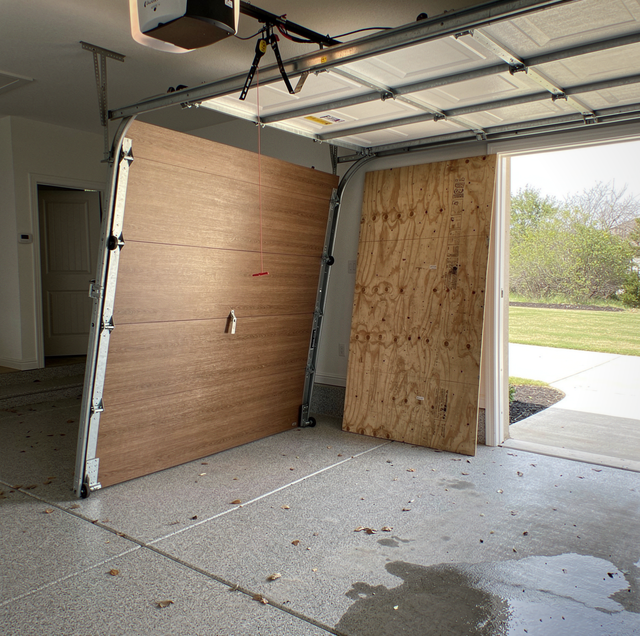
Quick Answer: A board-up closes a garage opening against weather and casual entry for a night or two. It doesn't repair the door, restore security-grade protection, or replace a technician's assessment of what actually failed.
By the time you see it, the opening is already covered. Whatever used to hang there (the door, the track, the header) is hidden behind a flat panel that wasn't there an hour ago, and the garage reads as closed from the driveway. That's the emergency board-up, already done. What it has actually bought you is narrower than it looks standing in front of it.
Securing the Opening vs Repairing the Door
A board-up and a repair solve two different problems, and mixing them up is the misunderstanding most homeowners bring to the follow-up call. Repairing the door means fixing the specific part that failed: a torsion spring, a cable, a section riding off its track, so the door itself opens and closes the way it did before. Securing the opening means putting something rigid between your garage and the outside, independent of whatever is wrong with the door.
A technician can finish the second in a fraction of the time it takes to finish the first, because it sidesteps the failure rather than correcting it. It works the same way a tarp over a torn section of roof does: it keeps the weather out without doing a single thing about what's broken underneath. Standing in the garage afterward, both can look like the door is handled. Only the repair gives you back a door that opens, and everything scheduled after tonight is scheduled around that.
Weather Exclusion vs. Security
A rigid panel across the opening keeps out the two things weather throws at an unprotected garage: wind-driven rain and anything the wind carries with it. That benefit is real and immediate, especially if the same storm that damaged your door is still moving through the area. Everything along the walls, the drywall, the water heater, and the opener's logic board overhead stays dry, and a garage that stays dry overnight has no second problem waiting in the morning.
Security is a different dimension. A door still hanging in its tracks, even a damaged one, carries locking hardware, mass, and a motor drive that holds it in place, and all three belong to the door itself. A temporary closure carries none of them, which is why the arrangement is written down as temporary and a repair visit is scheduled before the technician leaves.
What the Closure Changes for the Household
The change the closure makes is visible from the street. An opening stands wide, with a damaged door hanging over it, announcing that something in the house went wrong and that nobody has dealt with it yet. A covered opening takes that announcement away. From the sidewalk, the garage reads like every other garage on the block.
The layer worth your attention while the temporary closure is in place is the one inside, at the passage door between the garage and the house. In an ordinary week that door carries almost nothing, because the garage door in front of it is doing the work, so plenty of households never think to secure it, and some have a latch that stopped catching properly years ago. For the nights the panel is up, that interior door is the one worth walking over to, and checking it takes a moment.
The last thing the closure changes is the clock. A temporary arrangement does not get stronger by sitting there. It offers on night four exactly what it offered on night one, while the weather it is holding back keeps arriving. That is why the whole thing is counted in nights, and why the date of the repair visit is the number the household should be tracking.
A Door Immobilized in Place vs an Opening Closed Off on Its Own
Which approach a technician takes depends on the condition of the door in front of them. If the door can still be handled safely and is already resting closed, immobilizing it there, so it can't be walked open or pushed by wind, lets the door itself stay the barrier for the night.
If the door is stuck part-open, off its track, or under load from failed hardware, its position stops being something anyone can count on holding, and a technician will close off the opening on its own instead, independent of where the door happens to be sitting. The door then waits for the repair visit untouched. One thing rules out the manual release as part of either arrangement. The release cord is safe to use only with the door fully closed and the counterbalance intact, and it is never a way to hold a door open.
What Makes a Temporary Closure Harder or Impossible
Not every failure leaves a door that can simply be left alone under a covering. A section resting under uneven load, where one end still carries weight, the torsion spring is no longer balancing correctly, can shift once someone starts working around it, so a technician won't board around a door in that state without addressing the load first.
A track that has pulled away from the framing, rather than just bent, means the door's position is fixed to nothing predictable, and propping a panel against it solves little if what sits behind it can still move. Hardware left in a partial, damaged state (a cable that has gone slack and crowded out of its groove, a flag bracket no longer anchored to the framing) gets assessed before anyone spends time working around it. In any of these cases, the sequence changes: the opening still gets covered, but stabilizing what is inside it comes first, on the same visit.
A door resting under uneven spring load or off its track should not be forced, propped, or wedged into place by anyone other than a technician. Hardware still under tension can shift without warning, causing injury.
One Night vs Three Weeks
A board-up is sized for one night, or maybe two, while parts and scheduling catch up to the repair itself. What stretches it past that is a backordered part or a full schedule. The panel will sit there indefinitely without complaining, which is exactly the problem: a one-night measure becomes a three-week arrangement quietly, one postponed date at a time.
Humidity makes that stretch worse than it looks from the driveway. A sealed opening with no airflow behind it holds moisture against wood and hardware for as long as it stays sealed, and springs, cables, and the fasteners tying the track to the framing all age faster in that air. A garage that spends three weeks behind a panel comes out of it in worse condition than it went in.
That panel's job was never to fix anything. It was to buy your household one uninterrupted night, and it does that one thing reliably. Every night after the first is borrowed against a repair that hasn't happened yet.
Frequently Asked Questions
Yes, and the reason has to do with the covering itself. Once the panel material spans the opening, the exterior view of the damage no longer exists for anyone looking at it later, and the panel shouldn't be pulled back afterward to re-expose it. The inside face stays reachable through the passage door, so the view from the driveway is the one with a deadline on it.
No. Once a temporary panel spans the opening on its own, there's no way to open or close it as the door normally would, so the garage is inaccessible through that opening until the door or track is repaired. Any vehicle that was already inside stays inside until then.
The motor head is unplugged at the ceiling receptacle rather than left live above a door nobody should be operating. Unplugging is what actually takes the door out of service, because the wall console inside the garage and every remote already programmed to that opener can each send a command on its own, and removing one of them leaves the rest working. With the cord out of the receptacle, none of them reaches the motor.
A technician tags it out of service before leaving. The marking goes on the door itself and at the release cord handle, because those are the two things somebody reaches for without thinking, and one person trying the opener once is all it takes. A stuck or partially loaded door can sit completely still and look inert while still holding enough stored energy to move the moment something changes.
Yes. A share of after-hours calls turn out to be something a technician resolves on the same visit, without leaving anything covered overnight. A wall console, or the low-voltage wire running from it to the motor head, can fail, so the door takes no commands from inside the garage while the remotes still work perfectly. That reads like a dead opener and is a minor repair. A photo eye knocked out of its aim by something leaning against the bracket is the same kind of call. A board-up is held for the smaller share where the opening can't be closed by any other means that night.
Removing it is part of the repair visit itself. Once the door or track is fixed and the opening can close and lock normally again, the temporary panel comes down during the same appointment. Nothing about the removal requires anyone from the household to be there, since the work is done from outside, which matters if the repair falls on a weekday when the house is empty.
Call for emergency dispatch — a technician secures the opening tonight and schedules the repair. Squared Away Garage Door Service serves Cedar Park and Central Texas, and the follow-up visit runs out of the same crew that handles emergency garage door repair in Georgetown and after-hours dispatch in Round Rock. Call (512) 456-3781.
