

What Causes Garage Door Springs to Rust and Snap Years Early
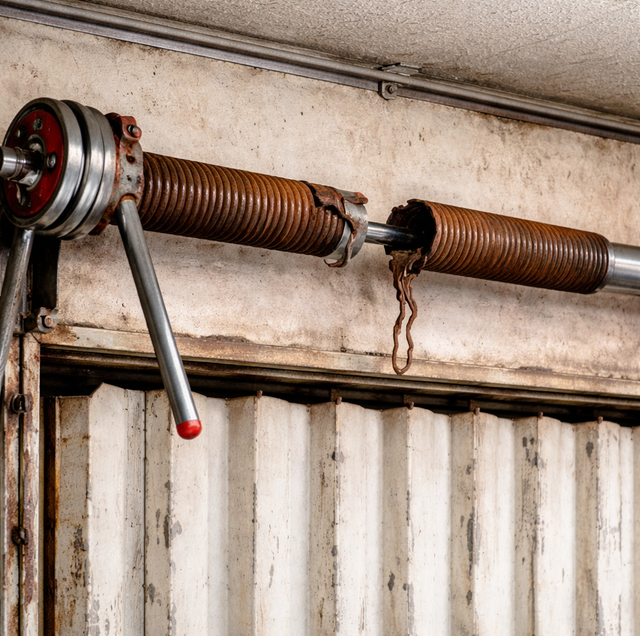
A snapped torsion spring tells you how it died if you look at the break. Hold the two ends together under a work light, and the fracture face usually isn't uniform: a flat, dull crescent near the wire's outer surface, stained brown, beside a bright, coarse, angled area. The brown crescent grew across months or years of ordinary cycles. The bright area tore in a fraction of a second.
Corrosion seeds the first part; the second part makes the bang. A spring aging cleanly gives up strength gradually, and the door gets heavier month by month, while a corroded spring feels normal until the end, because the damage is packed into one small volume of steel instead of spread along the coil.
What a Torsion Spring Is Actually Holding
On a sectional door, the counterbalance sits on a steel shaft above the opening. Each spring is anchored at the middle by a stationary cone bolted to the center bracket and gripped at the outer end by a winding cone with two set screws. A cable drum rides at each end, and a galvanized aircraft cable runs down to the bottom bracket.
The spring is wound by hand with winding bars, in counted turns read off the drum's own chart rather than judged by feel. A 7-foot door on standard lift drums commonly lands near 7.5 turns, or 30 quarter-turns of stored energy held over your head. Springs are rated in inch-pounds per turn, and that rating rides almost entirely on wire diameter: torque climbs with the fourth power of thickness, so a few thousandths of an inch of gauge is a large change.
Surface condition matters more on a spring than on any other steel in the garage, for a reason buried in the name. A torsion spring describes how the assembly is loaded, not how the wire is stressed. Winding the coil bends the wire around its own cross-section, so stress peaks at the outer skin and falls to nearly nothing at the core. Anything eating the surface eats the material carrying the load.
Reading the Coils: Four Stages of a Corroding Spring
| Stage | What you see or hear | What is happening in the steel | What it means for the door |
|---|---|---|---|
| 1. Film loss | Coils chalky gray or flat black instead of oiled or bright | The oil film or zinc layer has thinned from coil-on-coil rubbing | Lifts normally; still fixable with lubricant |
| 2. Staining in the gaps | Brown streaks between coils; orange dust on the slab below | Moisture sits in gaps that cannot dry or exchange air, corroding faster than the open face | Balance is fine, but coils drag instead of sliding |
| 3. Pitting and coil jacking | Pocked coils you can feel with a fingertip; a squeal at mid-travel | Rust occupies several times the volume of the steel it consumed, wedging coils apart and pitting the wire | Less torque than it was sized for, and the door can pull unevenly |
| 4. Cracking | Often nothing; sometimes one tick at a point in travel | A fatigue crack has started at the deepest pit and grows a little every cycle | The uncracked remainder carries everything; failure is a question of cycles, not years |
Nearly all the useful warning sits between stages 2 and 3. Stage 4 is quiet by nature, which is why a spring that looked passable in March is in two pieces in April.
Why Rust Starts Between the Coils Instead of on Top of Them
A wound spring holds its coils close together, and those narrow gaps act like any tight joint between two pieces of steel. Water wicks in and struggles to get out. The oxygen inside gets used up and is slow to replenish, so metal deep in the crevice turns anodic to metal on the open face and corrodes faster than the part you can see. Glance up, and it looks acceptable while the gaps run brown.
Humidity does the driving. Bare steel corrodes slowly in dry air, and the rate climbs sharply once relative humidity sits above roughly 60 percent, about where a thin film of water starts holding on the surface. Condensation then runs both directions across the year. On a humid morning, steel that cooled overnight sits below the dew point of incoming air and beads water while the concrete stays dry; in a cold snap, the reverse happens when warmer indoor air meets chilled hardware. Repeated wet-dry cycling wears a coating faster than constant wetness. Chlorides speed it up, and they often live in the same room: pool chlorine tablets, driveway de-icer, and some fertilizers shed compounds that break down protective films and drive pitting into bare steel.
Galvanized and Oil-Tempered Wire Protect the Steel Differently
Residential torsion springs are wound from high-carbon steel wire in one of two common finishes, and they do not defend themselves the same way.
Oil-tempered wire: the name describes a heat treatment, not a coating. The wire is quenched and tempered to set its strength, which is what the ASTM A229 material spec covers. The dark surface is oxide and residual oil, so these springs ship with a rust-preventive film over bare steel. That film is a barrier and nothing more; once rubbing or solvent takes it off, nothing is held in reserve.
Galvanized wire: zinc does not merely cover the steel; it defends it. Zinc is anodic to steel, so it corrodes preferentially and keeps protecting the wire across a scratch, a nick, or a set-screw mark rather than letting a pit start there. That sacrificial behavior is why a galvanized spring can look chalky for years and still be sound underneath. The catch is that zinc gets consumed as it works, fastest where coils rub and where the cones clamp, and a spot that has run out has no more protection than bare wire. Makers usually coat the wire before coiling rather than plating a finished spring, partly because electroplating high-carbon steel drives hydrogen into the metal and calls for a bake to drive it back out.
Neither finish is rust-proof: one gives a sacrificial layer, the other a film to be renewed. Suppliers also note that a galvanized spring's rating runs slightly under the same size in oil-tempered wire.
How One Pit Becomes a Snap
Spring wire is drawn and heat-treated to very high tensile strength, and high-strength steel pays for that with notch sensitivity: the stronger the wire, the more its fatigue life drops from a small surface defect. A corrosion pit is a defect with an unhelpful shape, narrow and sharp at the bottom, sitting where bending stress already peaks.
A second effect layers on top. Steel cycling in dry air has a load below which it runs essentially forever. Steel cycling in a corrosive environment loses that floor, because corrosion keeps re-sharpening the crack tip between cycles. Engineers call that corrosion fatigue, and it makes the two problems together worse than either alone.
From there the crack grows the way a tear grows in paper: starting one takes real effort, continuing one takes almost none. It creeps across the wire cycle by cycle, leaving the flat oxidized crescent visible on the break, until the shrinking sound section can no longer hold the wound torque. Breaks often land within a few coils of a cone, where the wire's transition into the fitting changes how load travels, though a deep pit can crack the wire anywhere.
What the Same Moisture Does to the Hardware Around It
Lift cables are typically 1/8-inch galvanized aircraft cable, and they corrode worst where they wrap the drum and where they sit in the bottom bracket, out of sight and slow to dry. Broken strands stand up from the lay of the cable and snag, and a parted cable throws a shock into the spring that a healthy system never sees. The center bearing and the end bearing plates rust the same way, and a dry, gritty bearing adds drag the spring pays for every cycle. That drag rarely reads as a bearing problem. It reads as a spring that wore out early.
Once a spring breaks, cable tension drops instantly on that side, slack cable can jump the drum grooves, and the door hangs low at one corner. Forcing the opener anyway is how a spring failure becomes a bent top section or a stripped nylon drive gear.
What Actually Slows Corrosion Down
Lubrication does the most work, and the method matters as much as the interval. A garage-door lubricant, lithium- or silicone-based, sprayed along each spring and wiped so it wicks into the gaps between coils, does two jobs: it keeps coils sliding instead of grinding, and it lays a water-shedding film exactly where crevice corrosion starts. Twice a year suits an average door; a garage used as the household's main entry can see three or four cycles a day and earns more. A clinging film beats a thin penetrant, which creeps and flashes off.
Skip the track itself, where grease only collects grit. The rest is housekeeping: keep the bottom seal and weatherstrip intact, and move pool chemicals and de-icer into sealed containers.
The Stage Where a Spring Is Still a Scheduled Repair
Mild dulling and gray discoloration is normal. The signals that deserve a call are specific: orange dust under the shaft, brown streaking in the gaps between coils, a squeal fresh lubricant will not quiet, and a door gone heavier by hand. A spring caught there comes off on a planned visit. A spring left to crack picks its own day.
Frequently Asked Questions
Not once pitting is visible, and a wire brush can make it worse by stripping whatever zinc is still working. What gets judged is depth, not color: a pit you can catch a fingernail on has already cut into the wire's outer skin, which is the part of the cross-section carrying nearly all the stress. Light bloom on an otherwise smooth coil is a different finding, and that does come back with cleaning and a fresh film. Coating over pitting does not help either, because paint or cold-galvanizing spray bridges a pit rather than filling it and seals moisture underneath.
Usually, though the reliable confirmation is visual: a break leaves a gap of an inch or two in the coil where the ends recoiled apart, easy to spot from the floor with a flashlight. A spring can also crack while the door sits closed at rest, with no noise worth noticing. On a two-spring door, the survivor keeps some counterbalance, so the door may still open, slowly enough that people blame the opener.
Same chemistry, different weak point. Extension springs stretch along the horizontal tracks under tension, which twists the wire rather than bending it, and their highest-stressed feature is the end loop formed into each end, where a tight bend radius crowds stress into a small area. Corrosion at those loops usually finishes them, so they deserve the closest look. Because a failed extension spring can travel rather than release in place, a safety cable through the middle of each one is standard practice.
Less than people expect. A cool surface in humid air is exactly what condenses water, so a conditioned garage can wet its hardware on a muggy day when an uninsulated one would not. The bigger factors are how often the door opens, whether the slab sits over a vapor retarder, and whether any exhaust path exists. A bare slab over damp soil pushes vapor upward toward the coldest steel in the space.
Only indirectly. A cycle rating describes wire diameter and coil geometry, not corrosion resistance. The side benefit is real: thicker wire loses a smaller percentage of its cross-section to the same depth of pit, so it tolerates corrosion better than thin wire. High-cycle springs are also commonly stocked in oil-tempered black rather than galvanized, so a damp garage is worth raising when a spring is ordered.
Turning up the opener's force adjustment. It feels like progress, since the door stops stalling and reversing, and it removes the protection between a heavy door and whatever is underneath it. That setting is how the opener senses an obstruction, so raising it to cover a failing spring means the unit can no longer tell a heavy door from a blocked one.
Rust does not wear a spring out the way years do. It takes a load the wire was built to carry for tens of thousands of cycles and funnels it into a pit the size of a pinhead, which is how a decade of quiet service ends in one bang. The coil gives notice first: dust on the concrete, brown in the gaps, and a door gone heavy in the hand.
Get the springs inspected while the pitting is still surface-deep, since spring replacement in Leander on a scheduled visit costs far less than a snapped wire on a Sunday morning, and a Squared Away Garage Door Service technician can check the bearings and flag garage door cable repair while the door is already open. Call (512) 456-3781.
