
What's Included in a Professional Garage Door Tune-Up, Really?
You call and book a "tune-up" because the door has been running long enough without one, and the person on the phone confirms a time window. That's the whole transaction. You hang up with no real sense of what's about to happen in your garage. Is a technician going to oil a few hinges and call it done in fifteen minutes? Is there actually a checklist, or is "tune-up" just a friendlier word for "we looked at it"?
The honest answer is that a real tune-up is closer to a multi-point inspection than a quick spray-and-go. Each item on the list exists because a specific part fails in a specific way, and catching it early is the difference between a five-minute adjustment and a Saturday morning spent stuck in the driveway. Here's what a technician is actually checking, and the mechanical reason each check earns its place on the list.
Is a Tune-Up Just an Oiling?
No, and this is the most common misunderstanding about what the visit covers. Lubrication is one item on the list, usually the last one, but it's applied after every moving part has already been inspected and adjusted. Oiling a hinge that's about to shear, or a roller stem that's already bent, doesn't fix anything; it just makes the failure quieter for a few more cycles. A tune-up done right moves through the spring system, the track and rollers, the cables, the hardware, the sensors, the opener's electronics, and the weather seals before a drop of lubricant goes anywhere.
Why Does the Spring Tension and Balance Test Come First?
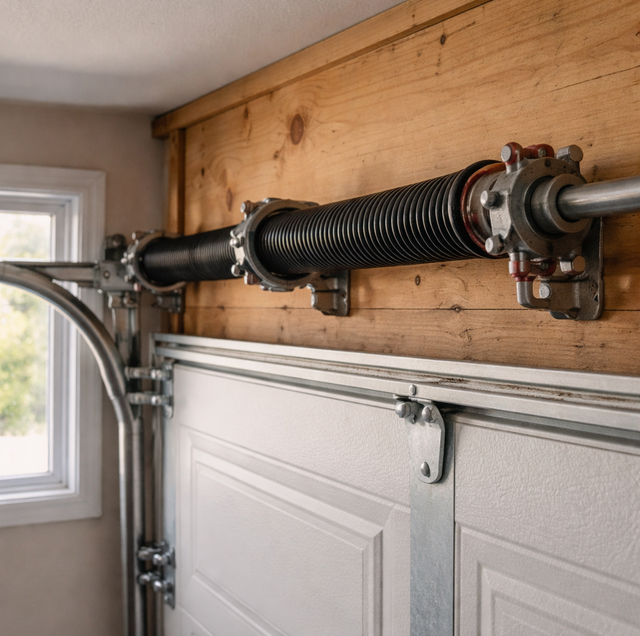
The springs, mounted above the door on a torsion shaft or alongside the tracks as extension springs, are doing almost all the physical work of lifting a door that commonly weighs 130 to 400 pounds. The opener motor was never sized to lift that weight on its own; it's built to handle maybe 10 to 15 pounds of net resistance once the springs are carrying their share. That's why balance gets tested first, by hand, with the opener disconnected: a technician lifts the door to roughly waist height and lets go. A properly balanced door stays where it's placed. One that sinks or lurches upward means the springs have lost tension relative to the door's weight, even though the opener is still, for now, compensating.
That compensation is the part homeowners miss. A door can still open and close on an out-of-balance spring, so it looks fine. What's actually happening is the motor working harder on every cycle to make up for what the springs aren't lifting anymore, which wears the drive gear, the belt or chain, and the motor windings faster than they were built to wear. An out-of-balance door doesn't announce itself as a spring problem; it shows up months later as an opener problem, and by then the repair is bigger than a spring adjustment.
What Does Track Alignment and Roller Condition Actually Check?
The two vertical tracks guide the door in a straight line, and they only need to be a few degrees out of plumb before that guidance starts working against the door instead of for it. A technician checks both tracks for level and for gaps between the rail and the wall it's bolted to, because expansive soil shifting a slab, or a stray impact from a car bumper or a stored ladder, can walk a track out of true without any single dramatic moment to point to.
Rollers get checked alongside the track for the same reason a tire gets checked alongside an alignment: a track that's slightly off puts uneven load on whichever rollers are riding the tight side of the channel. Steel rollers show that stress as flat spots and metal-on-metal wear; nylon rollers show it as cracking or chunks missing from the wheel. Either one turns a smooth, quiet door into one that shakes or grinds on the way up, and the sound often gets blamed on the opener when the actual cause is riding a few inches away in the track.
Why Does the Technician Inspect the Cables and the Drum Instead of Just Looking at the Door?
The lift cables run from the bottom brackets of the door up to drums mounted on the same shaft as the springs, and they're doing quiet, constant work every time the door moves. A technician looks closely at two things here: fraying along the cable itself, especially near where it wraps the drum, and how cleanly the cable is seated in the drum's grooves. A cable that's climbing out of its groove, even slightly, can jump the drum entirely on a future cycle, and when that happens the door drops unevenly on one side because the opposite cable is still holding its corner.
This is also where storm damage and simple age show up first, because cables under constant tension develop weak points at the same spots, near the drum and near the bottom bracket, long before they visibly snap. A cable with a handful of broken strands still holds, until it doesn't, and there's rarely a warning cycle before it lets go.
Why Does a Tune-Up Include Checking Every Bolt and Hinge?
A garage door isn't a static structure; every cycle flexes hinges, vibrates brackets, and puts a small load-and-release stress on every fastener holding the track to the wall and the hardware to the panels. One cycle doesn't loosen anything noticeably. A few thousand cycles, which a busy household's main-entry door can rack up in a year or two, is a different story. Hinges pivot at the same points thousands of times and gradually work their mounting screws loose, and a loose hinge lets a panel flex slightly out of plane on every open and close.
A technician goes over the hinges, the track brackets, and the header bracket with a wrench, tightening anything that's crept loose. This step catches a problem that's easy to misdiagnose: a rattle or a wobble that sounds like it's coming from the opener is very often a loose bracket a few feet away, and it's a five-minute fix if it's caught during a tune-up instead of after the vibration has worked something else loose too.
What Happens During the Sensor Alignment and Auto-Reverse Test?
Every residential opener built since the mid-1990s uses a pair of photo-eye sensors mounted low on each side of the track, roughly six inches off the floor, that shine an invisible beam across the doorway. Break that beam while the door is closing and the opener stops and sends the door back up. A technician checks two separate things here: whether the sensors are still aimed precisely at each other (a knock from a stored bike or a garden hose can nudge one sensor's angle just enough to throw off the alignment) and whether the reversal actually fires when it's tested. Those are two separate tests with two different props: passing an object through the beam while the door is closing checks the photo-eyes, while a two-by-four laid flat on the floor under the door checks contact reversal, since a board that low never touches a beam mounted six inches up. A door that passes one test and fails the other still has a live safety problem.
This test matters for a reason beyond convenience. A door that closes on an obstruction, a pet, a bag of groceries, a foot, without reversing isn't a minor inconvenience; it's the one safety function the whole system depends on. Some doors also use a sensing edge, a rubber strip along the bottom panel wired to reverse the door on contact, and where one is installed, that gets tested the same way.
Why Does the Opener Need Force and Travel-Limit Calibration?
Separate from the mechanical hardware, the opener's logic board (the circuit board controlling how far the door travels and how much force the motor applies before it assumes it's hit an obstruction) has its own settings, and those settings drift. As springs lose a little tension over time, or as hardware loosens slightly, the door's actual resistance during a cycle changes, and force and travel-limit settings that were dialed in correctly a year ago can end up mismatched to how the door behaves today.
A technician checks where the door actually stops on both the open and close cycle against where the opener thinks it stops, and adjusts the force setting so the motor isn't compensating for a spring or hardware issue by simply pushing harder. This is also where a power surge from a storm shows up: a surged logic board can lose its calibrated limits entirely, and the door starts reversing early, or refusing to fully seat on the floor, until the settings are reset.
Why Does the Weather Stripping Get Checked Alongside the Hardware?
The rubber seal running along the bottom of the door, and the vinyl strips along the sides and top where the panels meet the frame, aren't part of the lifting system, but a technician checks them anyway because they're doing a different job that fails the same way over time. UV exposure dries and cracks the bottom seal until it stops flexing against the slab, and the flange wears flattest at the same spots it presses into the floor on every close. A cracked or flattened bottom seal isn't a hardware problem, so it doesn't affect balance or make the door bind, but it does let water, dust, and pests under the door and gives outside air a continuous path into the bay, which is a common reason a garage stays noticeably hotter or colder than the rest of the house even after everything else checks out fine.
Side and top weather stripping wear the same way at the points where the door contacts them most, usually the bottom corners, and a gap there is often mistaken for a track or leveling issue when it's really just worn rubber.
Why Does the Type of Lubricant Matter More Than Whether It Gets Applied at All?
Lubrication is the last step, and it's also the one most homeowners get wrong when they try it themselves. The springs, hinges, roller bearings, and the opener's rail need a lubricant rated for those parts, usually a lithium-based or silicone spray, not household oil like WD-40 or a general-purpose 3-in-1 oil. The door tracks are the exception on that list: they get wiped clean rather than greased, because a lubricated channel collects grit and turns the roller into a grinding wheel. The wrong lubricant is often too thin to stay put through repeated cycles, and worse, it tends to attract dust and grit the way flypaper attracts flies, building up a gritty film on the spring coils and roller bearings instead of protecting them.
Applied correctly, on parts that have already been inspected, torqued, and calibrated, the lubricant's job is simple: cut friction between metal parts that are otherwise sound. Applied first, or applied everywhere, it works against the inspection it was supposed to follow.
What All of This Adds Up To
None of these eight checks exist in isolation. A spring that's lost tension puts extra strain on the opener, which drifts the force settings, which can mask a hardware problem that's been loosening the whole time. A tune-up catches each of those threads while they're still small and independent, before one problem starts causing the next one. That's the actual difference between a fifteen-minute oiling and a real multi-point tune-up: one treats the symptoms you can hear, the other checks every system that could be quietly working against the others.
Frequently Asked Questions
A tune-up is inspection and adjustment, not replacement. If a technician finds a cracked roller, a frayed cable, or a spring close to the end of its rated cycle life, that gets flagged as a separate repair with its own scope, rather than swapped out automatically as part of the visit. This keeps the tune-up itself focused on catching problems early rather than becoming an open-ended repair.
A thorough tune-up covering all eight checks above typically runs 30 to 45 minutes for a standard single door, longer for a double-wide door or one running on a side-mounted jackshaft operator instead of a center-mounted opener, since a jackshaft setup has its own cable and drum configuration to inspect on the wall rather than overhead.
Most tune-up checklists focus on the door's mechanical systems and the opener's motor and logic board, not the wall control panel or exterior keypad. If those accessories are acting up- a slow response, a keypad that intermittently doesn't register- that's usually a separate wiring or battery issue worth mentioning to the technician during the visit rather than something the standard tune-up automatically diagnoses.
The door starts telling on itself in small, specific ways. A close limit set slightly short leaves a strip of daylight along the bottom seal; set slightly long, the door presses into the slab and bounces back up a few inches as the opener reads the floor itself as an obstruction. On the up cycle, a drifted limit shows as the door stopping an inch or two shy of the top, or as the rollers thumping into the stop bolts at the end of the horizontal track. A worn bottom seal can trigger that same close-cycle bounce on its own by changing how much rubber there is left to compress, which is one reason the seal and the limits get looked at on one visit rather than separately.
A thorough tune-up tests the manual release separately from the powered functions, since the disconnect mechanism has its own set of moving parts, a spring-loaded lever and a trolley carriage on the opener rail, that can seize or fail to engage even when the powered opener works perfectly. That function only gets used during a power outage or an emergency, so a technician confirming it actually disengages the door from the opener is one of the few checks that could otherwise go untested for years.
A battery backup unit gets its own separate check, confirming the battery actually holds a charge and the unit switches over automatically during a simulated power interruption, since a backup that fails silently only gets discovered during an actual outage. A smart opener with app connectivity adds a check of whether the unit's Wi-Fi connection and remote-monitoring alerts are still functioning, since a firmware update or a router change can quietly disconnect the smart features while the door itself keeps working normally.
Knowing the eight checks changes what you can ask when the technician packs up. Not just whether the door passed, but which items looked fine, which ones are trending the wrong way, and which one is going to need a decision before the next visit comes around.
Request a multi-point tune-up and ask the technician to walk the findings item by item instead of handing you a pass or a fail, the way Squared Away Garage Door Service runs its garage door maintenance tune-ups at home and on rentals covered by Brushy Creek garage door service. Call (512) 456-3781.
