

Torsion vs. Extension Garage Door Springs: 4 Real Differences
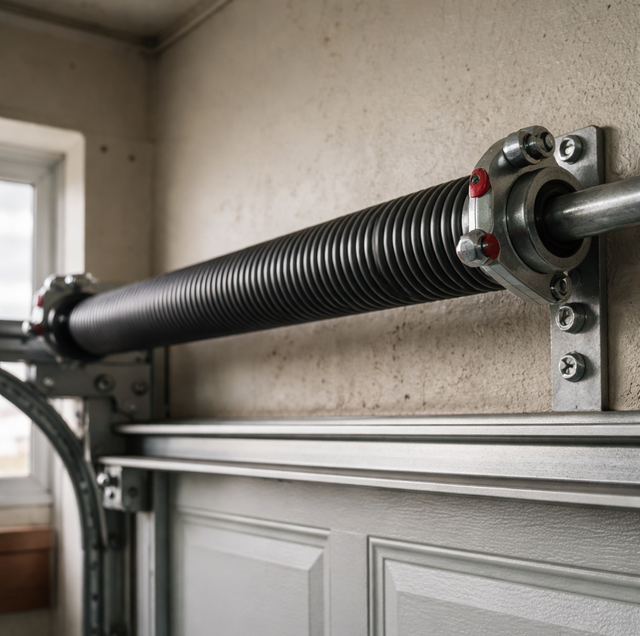
Quick Answer: Torsion springs mount on a metal shaft above the door and store energy by twisting; extension springs run along the horizontal tracks and store energy by stretching. Torsion gives smoother, more controlled travel and longer life on heavier doors, while extension is simpler and common on lighter or older doors. Both are under extreme tension and should only be adjusted or replaced by a professional.
A garage door panel and hardware can weigh well over a hundred pounds, yet you or the opener move it with almost no effort. That gap between the real weight and the effort you feel is the work of the springs. Understanding the two main spring types and how they differ helps you recognize what you already have and why one may be right for a heavier door.
What Garage Door Springs Actually Do
The springs on a garage door exist for one reason: to counterbalance the weight of the door. A sectional door is heavy, and lifting that full mass with a motor or by hand would be slow, hard on the machinery, and unsafe. Springs solve this by storing energy when the door is down and releasing it as the door rises, so the load stays close to balanced through the whole travel.
When a door is properly counterbalanced, it feels nearly weightless. Raise it halfway with the opener disconnected, and it should hold roughly in place rather than slamming down or shooting up. That balance is what protects the opener, the cables, and the tracks from carrying weight they were never meant to carry. The opener's real job is mostly to guide the door and hold it, not to haul the entire load. The springs do the heavy work.
Two designs handle that counterbalancing job in different ways, and the difference shows up in how the door moves, how long the hardware lasts, and how the system behaves when a spring finally gives out.
How Torsion Springs Work
A torsion spring is a tightly wound coil mounted horizontally on a steel shaft above the door opening. Cables wrap around drums at each end of that shaft. When the door closes, the door's weight winds the spring tighter, loading it with energy. When the door opens, the spring unwinds, turning the shaft and drums, which reel in the cables and lift the door.
One spring or two: Many single doors run on a single torsion spring, while wider or heavier doors often use two. The spring is sized to the specific door by wire gauge, inside diameter, and length, so the counterbalance matches the weight it has to lift. A spring that is mismatched to the door will never balance correctly, which is one reason sizing is not a guessing game.
Smoother travel and longer life: Because the torsion spring drives a shaft and drums, the pull on both sides of the door stays even and controlled. The door tends to move smoothly and track straight. Torsion systems are also rated for more open-close cycles than typical extension setups, so they tend to last longer before fatigue sets in, especially on doors used many times a day.
Safer when it fails: When a torsion spring breaks, it usually stays contained on the shaft rather than flying loose. The door will suddenly feel far too heavy and may refuse to open, but the broken spring is generally held in place by the bar it sits on. That contained failure is a meaningful safety advantage, though a torsion spring under tension is still extremely dangerous to handle.
How Extension Springs Work
An extension spring stretches rather than twists. These springs run along the horizontal tracks, one on each side, above and parallel to the track. As the door closes, the springs extend and store energy; as the door opens, they contract and pull the door up through a system of pulleys and cables.
An older, simpler design: Extension springs are the older of the two designs and are frequently found on lighter doors and on homes built decades ago. The individual spring costs less, which is part of why the design stayed common for so long on standard single doors. The system uses more moving parts, including pulleys and more cabling, so more components can wear or need attention over time.
Because an extension spring is not anchored to a central shaft, a spring that snaps under tension can whip loose with real force. A safety cable is a separate cable run through the center of each extension spring and secured at both ends, so that if the spring breaks, the cable contains the pieces instead of letting them become a projectile. An extension-spring door without safety cables is a serious hazard.
Torsion vs Extension: The Tradeoffs
The two designs are not simply better and worse; each fits a different situation, and the choice usually comes down to the door's weight, how often it runs, and the balance between upfront cost and long-term durability.
| Factor | Torsion springs | Extension springs |
|---|---|---|
| Mounting | On a shaft above the door | Along the horizontal tracks |
| How it stores energy | Twists | Stretches |
| Door travel | Smoother, more controlled | Jerkier, can bounce |
| Durability | Rated for more cycles | Fewer cycles on typical setups |
| Best for | Heavier and wider doors | Lighter and older doors |
| Parts count | Fewer moving parts | More parts, including pulleys |
| Failure behavior | Usually stays contained | Can whip loose without safety cables |
| Relative cost | Higher upfront | Lower upfront |
Torsion wins on smoothness, durability, and safe failure, and it handles heavy doors better, but it costs more upfront. Extension is cheaper and perfectly workable on lighter doors, though it moves less smoothly and depends entirely on intact safety cables to fail safely. Many homeowners upgrading a heavy insulated door move from extension to torsion for the quieter, longer-lasting travel.
Why Springs Eventually Break
Every spring has a finite life measured in cycles, where one cycle is a single open and a single close. A standard spring might be rated somewhere in the range of ten thousand cycles, and higher-cycle springs are available for doors that run constantly. The spring does not care about time so much as use: a door opened eight times a day burns through its rated cycles far faster than one opened twice.
Springs are steel under constant load, and steel fatigues. Each cycle flexes the metal a little, and eventually a microscopic crack grows until the coil parts. Rust accelerates this by pitting the surface and giving cracks a place to start, which is why humidity and moisture shorten spring life. Weather cuts both ways here: cold can make steel more brittle and prone to snapping in one season, while heat and constant cycling fatigue the same steel the rest of the year, so no single season deserves the blame.
How to Tell Which Type You Have
To identify your spring type from the ground with the door closed, look at the wall directly above the opening. A coiled spring wound around a horizontal shaft centered over the door is torsion; long springs stretched along the tracks on each side are extension.
A quick tell: torsion sits over the opening on one bar, while extension sits out over the tracks in pairs. Note what you find before calling for service, since it helps the technician arrive prepared. Do not pull, poke, or measure the spring itself while checking. Looking is safe; touching a loaded spring is not.
Why Spring Work Is Pro-Only
Garage door springs store an enormous amount of energy under high tension, whether they are wound tight or stretched taut. That stored energy is the whole point of the design, and it is also what makes the springs dangerous. A spring or a winding bar that slips or lets go can strike with enough force to cause serious injury or death. This is not a cautious exaggeration; it is the reason the trade treats spring work as specialized.
Replacing or adjusting a spring calls for the correct winding bars, proper sizing, and the technique to control the tension at every step. If you have a broken spring, do not try to force the door open or work on it yourself, and avoid running the opener against a dead spring, which can burn out the motor or bend the door. When you do a balance check to test counterbalance, do it only with the door fully down and the opener disconnected, and never with the door raised. The safe move with any spring repair or replacement is to call a trained technician.
Frequently Asked Questions
Often yes, if there is enough clearance above the opening, called headroom, to mount the shaft and springs. A conversion swaps in the shaft, drums, and torsion spring sized to your door, and it is a common upgrade on heavier insulated doors. A technician measures your headroom and door weight first, since very low ceilings sometimes rule it out or call for a low-headroom kit.
On a two-spring torsion setup, replacing both at once is the usual recommendation. Both springs have logged nearly the same number of cycles, so the second is likely close to failure even if it looks fine. Replacing the pair also keeps the counterbalance even and saves a second service call within a short window.
At a typical ten-thousand-cycle rating, a door opened around four times a day tends to last roughly seven years, while heavier daily use can shorten that to a few years. High-cycle springs rated for tens of thousands of cycles exist for busy households and can push service life well past a decade.
No. The opener guides and holds the door, but the springs carry the weight. If the springs fail, the opener alone cannot lift a full-weight door and will strain or stall trying. A properly balanced door should be liftable by hand with almost no effort, which is the springs doing their job, not the motor.
Generally yes. Because torsion drives a central shaft with even tension on both cables, the door moves with less bounce and rattle, so it tends to run quieter. Extension systems, with more pulleys and separate springs pulling each side, more often produce a jerkier motion and extra noise as parts wear.
Torsion springs often carry a paint stripe on the coil end and stamped markings that encode the wire gauge, wind direction, and sometimes the cycle rating. Left-wind and right-wind springs are color-coded so they are installed on the correct side. A technician reads these to match a replacement exactly, which is why a photo of the spring end speeds up getting the right part.
Get your spring type checked before it fails — a quick professional look confirms what you have and whether it is safe. Squared Away Garage Door Service serves Cedar Park and Central Texas. Call (512) 456-3781.
