
24-Hour Garage Door Repair: The Test Any Caller Can Run
Quick Answer: A real 24/7 operation can describe the door's problem, identify who is coming, and call from a number that also rings during the day. An answering service can only take your name and address.
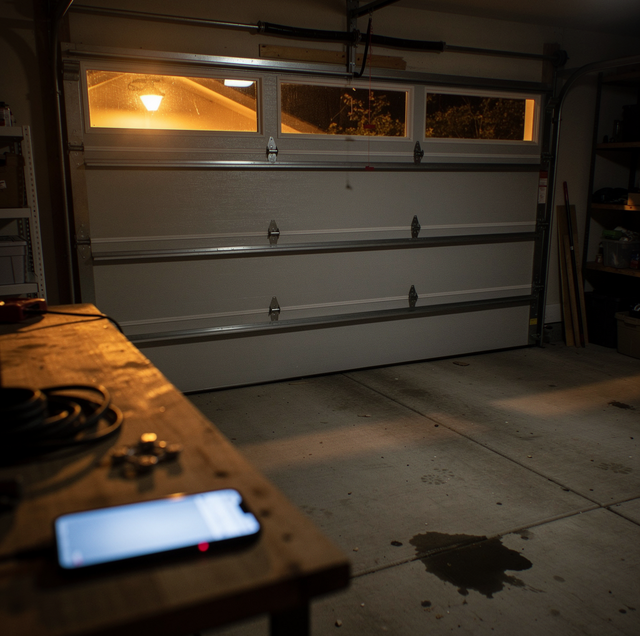
You hang up the phone. The garage door is still open, the driveway light is the only thing on, and for a few seconds nothing happens at all. That gap, the quiet right after the call ends, is where the difference between a real 24-hour repair operation and an answering service picking up an overflow line becomes clear. Anyone can put "24/7" on a website. What happens in the minutes after you hang up is harder to fake, and it comes down to a handful of things you can check on the very first call, before a truck is anywhere near your street.
Who Picks Up, and Whether They Know the Door's Parts
Say something specific: the spring let go with a bang, or a cable is hanging loose by the bottom bracket. A person actually connected to that night's dispatch usually reacts to the specific words, maybe repeating the part back to confirm what you mean, or asking whether the door is a single wide door or two smaller ones. A pure message-taking line often falls back on the same general script no matter what you named, treating a bent track exactly like a dead remote. That flatness, the same response regardless of what broke, is a bigger tell than how fast the phone got answered.
What Happens Next, Not Just a Promise That Someone Will Call
Ask directly: what happens after we hang up? An operation actually running dispatch can usually describe a real next step: the on-call technician gets paged and calls you back, or the person on the phone checks who is closest and passes your number along right then. An answering service, even a well-run one, can only describe its own process: someone will review the message and follow up, because it has no visibility past that point. The difference shows up in whether there's a described handoff to an actual person, not in how fast anyone claims to respond, and not in a message that simply drops into a queue that empties onto someone else's schedule.
Diagnostic Questions Versus a Name and an Address
A person actually coordinating a truck tends to ask questions that shape what gets loaded before anyone leaves: is the opener still running, is a spring visibly broken, has anyone tried forcing the door tonight. Those answers change which parts ride out with the technician. An intake-only line skips straight to contact information, because it has nothing to prepare for. If your own answer involves the manual release, a competent dispatcher will usually add the one caution that matters before you touch it: the release cord is safe to use only with the door fully closed and the counterbalance intact, and it is never a way to hold a door open. A script-only line rarely volunteers that kind of specific, situational warning unprompted.
Whether the Company Can Name the Technician Who Is Coming
Ask who is coming, by name. A real dispatch can usually give at least a first name, sometimes a description of the truck, because that information already exists somewhere: on a schedule, in a radio call, on an app the dispatcher is looking at right now. A resold-lead setup often cannot answer this at all because the job has not been assigned to anyone yet; it is still being offered to the first subcontractor to take it. The innocent version of the same silence is a one-truck shop where the owner is also the dispatcher and has never had a schedule to read a name off. Refusing the question twice, or answering both times vaguely, is what's worth noticing.
A Local Number Versus One That Only Rings After Dark
Check whether the number on your caller ID is the same one the company lists for daytime calls. One number that works around the clock usually means a single dispatch system handling both regular business and emergencies. A separate, unlisted-feeling number that only seems to work at night and does not appear anywhere else on the company's own site resembles how a national lead-generation network operates: local-sounding storefronts on the front end, one shared call center on the back end. A dedicated after-hours line is no warning sign by itself; some regional operations run one deliberately and list it on the same page that explains their overnight coverage. What is worth checking is whether that number appears on the company's own pages or only surfaces when you search for the exact phrase "24 hour garage door repair" at 2 a.m.
What the Website Says About After-Hours Work Versus What the Phone Says
The call you just made can be checked against something the company already published. An operation running a real overnight dispatch usually describes it in some detail somewhere on its own site: what it treats as an emergency, roughly what to expect once a call comes in, sometimes even stating plainly that a live answering service handles the overnight phones. When a site lists daytime hours only, or never mentions emergency work at all, and the phone nonetheless answers at 3 a.m. with a full pitch, the two accounts of the same company do not agree. The mismatch itself carries the information: one of those two accounts describes an operation that does not exist as described, and which one it is determines whether you are talking to the company you looked up.
What the Call Itself Already Told You
None of this requires interrogating anyone. A single call, five minutes at most, usually surfaces two or three of these signals without much effort on your part: how specific the questions are, whether the person can describe what happens next, whether the number matches the one on the website. You don't need certainty before deciding whether to stay on the line with that company or hang up and try the next one. A door that won't close can usually wait the extra few minutes it takes to make one more call, and an operation that is actually running a real dispatch will not be thrown off by a caller asking a direct question or two before deciding.
Frequently Asked Questions
Three things, and the handoff runs on them. An on-call rotation naming who is up that night and how to reach them directly. An intake script that captures the door's state instead of only the caller's details: what the door is doing, whether it is open or closed, whether a vehicle or a person is shut in. And a stated threshold for which calls wake the on-call technician and which wait until the morning schedule. Plenty of well-run local shops outsource the phone line itself. What separates them is whether the service was handed those three things or just a message pad.
A quick reverse search on the number itself sometimes turns up the same digits listed across several differently named "local" company websites in different cities, a pattern consistent with one shared call center answering for multiple lead-generation storefronts rather than one shop with one truck.
No. A newer scheduler at a small, honest shop might not know a stationary cone from a cable drum yet either. The telling behavior is what happens in the next thirty seconds: whether that person can put you on a short hold and come back with an answer, or name the technician they will check with and say when that call will come. A line with no route into the company has no one to put you on hold for, so the conversation ends with the message.
In a real dispatch, you'll usually get a second call explaining the change, a closer job ran long, or a truck had a mechanical problem, along with an updated name. In a resold-lead setup, there is often no second call at all, because the job was already sold on to a different subcontractor the moment you hung up.
Not on its own, and there is a more useful question than working out a corporate structure at 2 a.m. Ask whose name goes on the paperwork you sign, who stands behind the repair if the same part fails next week, and what number you call to raise it. An affiliated shop sharing one after-hours desk can answer all three in one breath, and gives the same company name for all three. A resold lead tends to produce a different answer to each, or no answer at all until a technician is already standing in the driveway.
Often, and it can be more revealing. A reply that asks a specific follow-up, whether the door is stopped partway or sitting all the way open, or whether the bottom section is resting on anything, shows an actual person read the message. A generic "thanks, someone will reach out soon" text is the same holding pattern as an unanswered call, just in writing.
Talk to an actual dispatcher, any hour — describe what the door is doing and get a real next step, not just a callback promise. Squared Away Garage Door Service answers its own phone, so a 2 a.m. call for overnight emergency repairs in Pflugerville reaches the same dispatcher as a Tuesday tune-up anywhere else in our Pflugerville service area, Cedar Park, and Central Texas. Call (512) 456-3781.
