
Can a Garage Door Fall? 4 Failures That Cause a Drop
A garage door rarely falls because the opener let go. In nearly every case where a door comes down fast, the counterbalance system that was carrying the weight had already failed, and the opener was left holding a load it was never built to hold. That distinction tells you where to look. A sudden drop is rare on a door that gets normal use and periodic service; the risk concentrates in a short list of hardware failures, and most of them give warning days or weeks ahead.
How a Garage Door Is Held Up
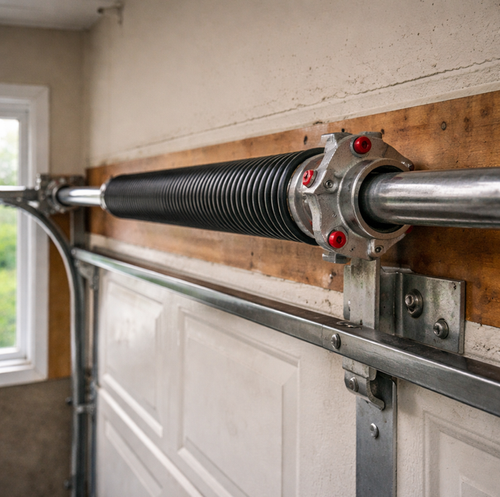
A sectional door is a balancing act, not a lifting contest. On a torsion system, springs sit on a steel shaft above the opening. As the door travels down, cables unwind off drums at each end of the shaft and wind the springs tighter, and that stored torque pays back out to carry the door on the way up. Extension springs do the same job stretched along the horizontal tracks.
The closest household comparison is an old sash window with hidden counterweights: the sash feels light because a matched weight is doing the work inside the frame, and cutting that cord turns a window that glided into one that slams.
The load path is a short chain: spring, shaft, drum, cable, bottom bracket, door section. Every part in it carries real weight, and the opener is not in that chain. An opener is sized to move a door whose weight is already offset, not to restrain a full panel that has lost its counterbalance. Commercial rolling steel doors work on the same principle with the spring assembly inside the barrel, so what follows applies to a warehouse door as much as a two-car residential one.
A Broken Counterbalance Spring
A torsion spring fails recognizably. The steel fatigues over thousands of open-and-close cycles until a coil separates, leaving a visible gap in what should be a continuous wind, often within a few coils of the winding cone. Most people hear it: one loud bang from the garage, sometimes hours before anyone touches the door.
The instant it separates, the torque offsetting the door's weight is gone. The door did not get heavier; the thing canceling out its weight stopped existing. If the door was closed, it stays closed and feels immovable. If it was open, its full weight now rests on the opener's trolley, rail, and drive gear. Openers hold that for a while, and then they cannot. The failure shows up as a stripped nylon drive gear, a bent operator arm, or a trolley pulling off the rail, and the door comes down with it.
A second spring is not a spare: Many doors carry a matched pair of torsion springs. When one breaks, the other is still wound and pulling, so the door is half-supported rather than unsupported. It may still move under power, which is exactly why people keep using it. A technician replaces both, because they have taken the same number of cycles and the survivor is on the same schedule as the one that just went.
Do not pull the emergency release cord on an open door with a broken spring. That cord's only function is to disconnect the door from the opener, and the opener is the only thing still holding the weight.
Frayed and Snapped Lift Cables
Lift cables are galvanized aircraft cable, one per side, running from a fitting on the bottom bracket up to a grooved drum. They carry the door's weight every time it moves. A cable rarely fails all at once. It frays: strands break and stand up off the lay, the cable flattens or birdcages where it bends, and the survivors take a larger share of a load that has not changed.
Two places do most of the failing. The first is where the cable enters the first groove of the drum, which sees the highest tension in the whole run. The second is the bottom fitting, closest to the floor: standing water from sprinkler overspray or a wet vehicle corrodes it from the outside, and in dry conditions grit packs into the strands and abrades them from the inside.
Cables also come off the drum. If the door binds on a worn roller or closes onto an obstruction, the cable goes slack, unspools, and re-tensions where it does not belong, often crossing over itself in the grooves.
When a cable snaps, the door racks. One corner keeps its support, and the other loses it; the rollers bind against the track, and the door jams at an angle or pulls a section out of the track. A frayed cable is a countdown, not a maybe.
Cable Drums That Slip on the Shaft
Drums are cast aluminum, cut with a helical groove the cable wraps into, and they clamp to the torsion shaft with set screws. That clamp is the only thing tying the spring's torque to the cable, and the set screws have a tightening spec for a reason.
Slippage starts small. A screw left under-tightened at installation, a shaft scored by a previous drum, or a hub cracked from over-torquing all let the drum creep a fraction of a turn at a time. What you notice first is a door slightly out of level, then more so a week later, with slack in one cable at the closed position and sometimes a clunk at the same point in every cycle. If the drum breaks loose while the door is up, that side's cable pays out with nothing restraining it and the corner drops.
Drums are also matched to a door's height and lift type, so a standard-lift drum left on a door rehung for high-lift geometry runs the cable off the end of its groove before travel finishes.
Bottom Brackets That Pull Loose
The bottom bracket at each lower corner is where the lift cable terminates, so whenever the door is closed it sits under the full pull of the counterbalance. The bracket itself seldom breaks; the material behind it does, usually an end stile corroded from the inside by condensation or softened by wicked-up moisture, and once the fasteners let go the cable end releases while the spring is still pulling on it. The corner drops and the cable whips. Rust streaking below a bracket, a gap between the bracket and the door skin, or fastener heads backing out are reasons to stop using the door that day, and the bracket itself is a separate, professional-only repair with its own failure pattern worth knowing in detail.
Signs a Door Should Be Taken Out of Service
Any one of these is enough to stop operating the door until someone qualified has looked at it:
- A loud bang with no obvious cause: A spring separating is loud, and on a two-spring system the door may still open afterward.
- A door that suddenly feels heavy: A motor that labors, stalls, or lifts a few inches and reverses is reporting a counterbalance problem, not an opener problem.
- A door that slams or speeds up near the floor: Lost spring tension shows up as acceleration in the last stretch of travel.
- A crooked door or uneven gap at the floor: One low corner points at a cable, drum, or bracket on that side.
- Broken strands, kinks, rust, or slack in a cable: The cable is no longer at full strength.
- Grinding, popping, or a clunk mid-travel: Hardware is moving that should not be.
What to Do Before a Technician Arrives
Take the door out of service and mean it. Nobody cycles it "just once more" to get a car out, and nobody walks under it. If the door is closed, leave it closed. If it is open and you suspect a spring or cable failure, leave it open rather than trying to bring it down; a door that comes down without its counterbalance does not come down slowly.
Unplug the opener and take the remotes and any phone app access out of circulation, so nobody starts a cycle without knowing what is wrong. On a commercial opening, tag the wall station so a shift worker does not press it.
Then leave the repair itself alone. A wound torsion spring holds a large amount of stored energy and releases it through whatever is closest when it lets go. A technician brings winding bars sized to the cone, clamps to hold the shaft and the door, and a way to control the tension before anything is unbolted. The tension is the dangerous part, and it does not care how handy you are.
A door that falls is rare. A door that shows one of the signs above and gets used anyway is how the rare thing happens.
Frequently Asked Questions
Springs are rated in cycles rather than years, where one cycle is a full open plus a full close. Manufacturers commonly rate a standard torsion spring at roughly 10,000 cycles, with high-cycle versions available that use thicker wire and a longer body. Calendar life depends on traffic: a household using the garage as its main entry runs several cycles a day, while a door that only moves on weekends may last decades on the same springs.
No. The photo eyes mounted low on each track only interrupt a powered closing cycle when something breaks the beam near the floor, and the opener's force sensing reads resistance while the motor drives the door. A door in free fall is not being driven, so neither system has anything to act on. A related trap: raising the force setting so the opener pushes through resistance is the shortcut people reach for when a door feels heavy. That setting exists so the opener stops when something is wrong; turning it up deletes the warning without fixing the cause.
They fail differently. An extension spring stores its energy stretched along the horizontal track, so a break can throw spring sections across the garage. The safeguard is a containment cable, sometimes called a safety cable, threaded through each spring and anchored at both ends so a broken spring stays on the cable instead of becoming a projectile. Older installations were often built without them, or had them left off during a past repair. If your springs run parallel to the ceiling tracks, have a technician confirm the containment cables are present and anchored.
Say so when you book the call, because it changes how the visit gets scheduled. Do not force the door up with an extra pair of hands and a piece of lumber wedged underneath; a prop that slips puts the whole door on whoever is beneath it. A technician can raise and secure the door safely, usually by clamping locking pliers to the track below a roller so it is held mechanically while the counterbalance is rebuilt.
Yes, on some. Sectional and rolling steel doors can be fitted with a spring-failure device, sometimes called a safety brake, which mounts on the counterbalance shaft and grabs when it senses the shaft spinning faster than normal travel. Rolling doors may use a governor working on a similar principle. A widely adopted workplace safety standard treats these as inspected equipment, function-tested on a schedule by a qualified person rather than fitted once and forgotten. If you manage a building with high-cycle doors, ask whether yours has one and when it was last tested.
It depends on what absorbed the impact, and the assessment goes past the part that failed. A technician checks the bottom section for a bowed or crushed end stile, the track for a flare or twist where the rollers hit, the shaft for a bend or a chewed keyway, the hinges and top fixtures for elongated fastener holes, and the opener rail for deflection. A single damaged bottom section can often be swapped on a door still in production. An older door with a discontinued panel profile, or damage across several sections, is where replacement makes more sense than a patchwork rebuild.
Schedule a garage door safety inspection so a technician can measure what is actually holding the door up instead of guessing at it, and if the coils turn out to be the weak point, Squared Away Garage Door Service handles spring replacement in Brushy Creek on the same visit. Call (512) 456-3781.
