
The Overlay Trick Behind Real-Looking Carriage House Doors
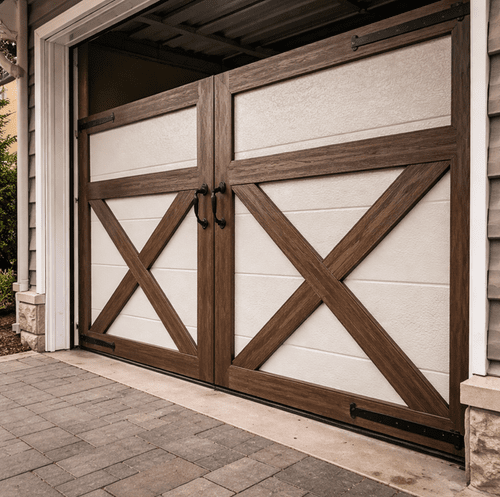
A carriage house garage door is supposed to look hand-built: layered panels, exposed hinge straps, the texture of a barn door that's been repainted a dozen times over a hundred years. A growing share of the doors that pull off that look have never had a plank of wood in them.
That's the overlay approach. Decorative panel pieces, shaped and grooved to mimic board-and-batten or raised-panel wood construction, are fastened to the face of a standard steel or composite garage door. The door underneath still operates like any other sectional door, rolling up on tracks, but the visible face reads as a built-up wood carriage door from the driveway or the street.
What Overlay Construction Means
Strip the overlay pieces off and what's left is an ordinary insulated steel sectional door: two steel skins with a foam core between them, the same basic sandwich used on plain flush-panel and raised-panel doors. The overlay is a separate layer of decorative material, typically a wood-composite or engineered material shaped into individual boards, battens, or panel frames, that gets attached to the outside face after the base door is built.
Manufacturers including C.H.I. sell these as a distinct product line rather than an add-on kit, because the overlay pieces, the door's panel layout, and the decorative hardware are engineered together at the factory. The batten spacing lines up with the door's section joints, the simulated grain runs the direction a real board would run, and the hardware positions are planned around where the overlay seams fall. That coordination is part of what makes the finished door read as intentional rather than assembled.
Decorative hardware: Hinge straps, handles, and sometimes a speakeasy-style grille insert are bolted to the face for visual effect. None of it is structural. The door still opens and closes on its steel hinges and rollers; the carriage-style hardware is there because a real carriage door would have had working hardware in those spots, and the overlay style borrows the visual cue.
Why Steel or Composite Instead of Solid Wood
The reason to build the look this way instead of ordering an actual wood door comes down to what happens to wood outdoors. A solid wood garage door sits exposed to direct sun, driving rain, and temperature swings on one of the largest painted surfaces on a house. Wood moves with moisture: it swells when it absorbs humidity and shrinks as it dries out, and that repeated cycling is what eventually opens joints, cracks panels, and lets water behind the paint film.
Heat speeds up the paint breakdown and can dry and check exposed wood grain over time; cold and damp conditions do the opposite kind of damage, swelling joints and holding moisture against the wood long enough for rot to start at end grain and fastener holes. Neither extreme is the real problem on its own — it's the door sitting through both patterns, season after season, that eventually shows up as peeling paint, warped stiles, or a panel that no longer sits flush.
A steel or composite door with an applied overlay doesn't eliminate weather exposure, but it removes the load-bearing wood from the equation. The structural skins are steel, which doesn't swell or shrink with moisture the way wood does, and the overlay material is generally formulated to resist water absorption rather than to look identical to painted lumber under a microscope. The visual wood grain is molded or textured in; the physical behavior underneath it isn't wood's behavior anymore.
Who the Overlay Style Suits
This style tends to make the most sense for a specific kind of buyer: someone who wants the carriage-house look on a house that doesn't otherwise use real exposed wood trim, siding, or shutters. On a home like that, the garage door is a style statement rather than a match to existing wood elements, so there's no material-matching reason to insist on solid wood: a steel or composite overlay door can hit the same visual target as the rest of the house's exterior finishes, which are probably vinyl, fiber cement, or painted composite trim already.
It also suits anyone who's priced out what a solid-wood custom carriage door involves in ongoing upkeep and decided the wood is the part they don't want, not the look. If the goal is the appearance of a hand-built wood door on the street and in photos, overlay construction delivers that from a normal viewing distance. Up close, on a door where every joint and reveal has been hand-fitted and finished by a woodworker, a trained eye can usually tell the difference between an applied overlay and true carpentry. Most people looking at a driveway from the sidewalk cannot.
Homeowners restoring a whole house in genuine wood, or on a historic property where an inspector or design review board expects real wood construction, are the group this style doesn't suit. Overlay is a look-alike product; if the requirement calls for genuine solid-wood construction, check the property's own governing standards or an inspector's requirements before assuming an overlay door will satisfy them.
The Maintenance Tradeoff Against Solid Wood
The upkeep difference is the entire reason this product category exists, so it's worth being specific about what changes.
Repainting cycle: Solid wood needs a maintained paint or stain film to keep moisture out of the grain, and that film fails faster on wood than on steel because wood keeps moving underneath it. A steel-skin overlay door still has a factory finish that can eventually fade or chip, especially at edges and hardware points, but there's no bare wood grain underneath waiting to absorb water the moment the coating opens up.
Warping and squaring: A wood panel that swells unevenly can bow, and a door with bowed panels stops sealing evenly against the weather seal and can bind against the tracks. Steel skins don't warp the way solid wood panels do, so the door is far less likely to develop that kind of fit problem over its service life.
Rot at vulnerable points: End grain, fastener holes, and the bottom few inches of a wood door nearest the driveway are where rot typically starts, because that's where water sits longest. An overlay door's structural skin isn't organic material, so there's no rot risk in the steel itself. However, the composite overlay pieces and any exposed wood trim elsewhere on the garage still need normal weather-sealing attention.
What doesn't go away: Hardware still needs occasional lubrication, the weather seal at the bottom and sides still wears and needs replacing periodically, and the finish still benefits from an occasional rinse to clear off road grime and pollen buildup that can dull a factory coating over time. Overlay construction removes wood's specific failure modes; it doesn't turn the door into something that needs zero attention ever.
Choosing Panel Style and Hardware Details
Overlay doors are typically offered in a handful of standard panel layouts, ranging from a simple board-and-batten pattern with vertical strips over a flat face, to a more elaborate raised-panel arrangement meant to echo a traditional carriage-house swing door. Manufacturers also generally offer optional window inserts, arched or rectangular, positioned in the upper section to match the carriage aesthetic, and a range of decorative hinge and handle finishes meant to coordinate with a home's existing exterior hardware.
Board-and-batten: Vertical overlay strips run the height of the door face, spaced to suggest individual boards. This is usually the lighter-weight overlay option since it covers less of the door's total surface area with applied material.
Full raised-panel overlay: More of the door face is covered in shaped panel sections, giving more visual depth and shadow lines but adding more applied material and more attachment points to the base door.
Neither choice changes how the door operates; they're aesthetic decisions about how much of the carriage-door illusion a household wants, balanced against the added weight of more extensive overlay coverage.
Setting Expectations on Manufacturer Claims
Manufacturer marketing for overlay lines tends to emphasize how close the finished product looks to a genuine custom wood carriage door, and from typical viewing distances that claim generally holds up. Treat specific durability or lifespan claims from any manufacturer's marketing material as advertised performance rather than independently verified fact, and ask an installer for the manufacturer's own published warranty terms if long-term performance is a deciding factor.
Getting the Look Installed Correctly
Because the overlay panels, hardware layout, and base door are engineered as one product, a qualified installer measures the opening, confirms the model and overlay style are compatible with the existing track and opener setup, and accounts for the added weight when the door is balanced and hung. Getting this look onto a home that doesn't currently have it is a new-door installation, not a hardware upgrade to the door already in the opening.
Frequently Asked Questions
The overlay pieces do add weight compared to a plain flush-panel door of the same size, sometimes enough to move the door into a different spring class. The manufacturer publishes the door's total weight for a given model and overlay style, and the installer uses that published weight to size the counterbalance for your specific opening rather than assuming a standard spring will do. A homeowner shouldn't add or adjust any counterbalance components themselves; that sizing and the balance check afterward are professional work.
Most overlay-style doors ship with a factory-applied finish matched to the molded wood-grain texture. That finish can generally be repainted later using a paint suited to the door's skin material. What's harder to match after a repaint is the factory's original color-and-texture combination across the overlay pieces and the base panel at the same time, since a hand-applied repaint won't necessarily replicate the factory's exact process. Solid wood, by contrast, sands and refinishes easily in a new color because the whole surface is the same material to begin with.
Composite overlay material is generally formulated to resist UV degradation better than bare wood. However, manufacturers typically still note that color can fade gradually over years of direct sun exposure, similar to how any exterior finish weathers over time. Attachment points for the overlay pieces are set at the factory and don't loosen the way a field-applied wood trim piece might work loose from repeated expansion and contraction, since the composite material doesn't move with humidity the way solid wood does.
Some manufacturers offer a modular option: overlay strips on the upper panels only, with the lower panels left plain, rather than covering the entire door face. That's a different choice from picking board-and-batten over raised-panel, since it changes how much of the door carries applied material rather than which pattern the material forms, and it can suit a smaller opening or a homeowner who wants a hint of the style rather than the complete effect.
An overlay door still operates as a standard sectional door, rolling up along tracks into the ceiling of the garage, even though its face is styled to resemble a traditional hinged carriage door. A true swing-style carriage door pivots outward on real hinges and needs clearance in the driveway to open, along with a person to manually swing each side unless it's been fitted with special hardware. The overlay version keeps the automatic, tracked operation of a normal garage door while only borrowing the visual style of the swing version.
Usually not, since replacement sections for an overlay door are ordered against the specific model and panel style, matching the batten spacing and grain direction to the sections still in place. What can complicate it is an aged finish or a color that's since been discontinued, since a brand-new section next to years of factory-weathered finish is more visible on an overlay door's textured face than it would be on a plain flush panel. Ask the installer to check current availability for your exact model before assuming a single-section swap will match seamlessly.
Book a door installation in Leander and see the overlay construction up close before you settle on a batten layout, or work through the custom designer garage doors with Squared Away Garage Door Service if you want the profile drawn to your own elevation. Call (512) 456-3781.
