
Garage Door Won’t Open: When It Traps a Wheelchair Inside
Quick Answer: A stuck garage door becomes a higher-stakes failure when it blocks a wheelchair, scooter, or the step-free entrance a household relies on. Do not push equipment through a partial opening, and call emergency services if anyone is at risk.
For most households, a garage door that will not open is a scheduling problem: move the second car, carry the trash out the front, wait for the truck. In a household where the garage is also how a wheelchair, mobility scooter, or power chair gets in and out, the same failure lands somewhere else entirely. The equipment someone uses every day ends up on the wrong side of a door that will not move, and the step-free entrance the house depends on stops working.
The Moment a Garage Door Traps a Wheelchair or Scooter
A trapped car and trapped mobility equipment are not the same event. If a car cannot get out of the garage, the household usually has options: walk out the front door, borrow a ride, take the second vehicle. Every one of those options quietly assumes a body that can manage a step and a front entrance that was never built to be level.
For someone whose daily route in and out of the house runs through the garage, over a ramp or a level threshold, a jammed door closes the only path that works. A power chair or scooter cannot be turned sideways through a narrow interior doorway, nor can it be bumped up an exterior step. The passage door from an attached garage into the house commonly sits a riser above the slab, and the front entrance of most houses has at least one more. When the garage is the accessible route, its failure does not take away a second option. It takes away the only one.
There is a second effect that is easy to miss in the first hour. The garage is often where the equipment lives between trips, on its charger, and a door that will not open can separate a person from that charger as effectively as it separates them from the driveway. A powered chair sitting behind a stuck door loses range every hour it is not on charge.
The First Few Minutes After It Happens
What happens in the first few minutes matters more here than with an ordinary stuck door. Confirm first that nobody is in a position where they have to move right now. A garage without conditioned air swings hot in the summer months and cold in the winter ones, so a person waiting in one is not simply waiting. If anyone is hurt, exposed, or cannot get themselves to a safer spot, call emergency services before touching the door at all.
Once that is settled, stop trying to make the door work. No prying at the bottom seal, no repeated remote presses hoping the motor catches, no attempt to walk the door up by hand without knowing what is actually wrong with it. Each of those can turn a door that is merely stuck into one that has come off its track, or drop a cable, and both take longer to fix and close the opening completely rather than partially.
Then call for service and say plainly that this door is the accessible entrance to the house. Mention whether someone is separated from their equipment or from a way out of the house. That detail changes how the call is prioritized. Describe it as a stuck garage door, and it is heard as one.
Why the Manual Release Cord Is Not the Way Out
Pulling the manual release on a door whose springs have failed puts the entire door in the hands of whoever is standing under it. That is the outcome to picture before anyone reaches for the cord, because the cord looks like the obvious answer and, in this situation, is the wrong one.
The release does have a real purpose. It disconnects the door from the carriage that rides the opener rail, allowing the door to move by hand when the motor, drive gear, or the opener's electronics have failed. It does nothing about the part of the system that actually carries the door's weight.
A residential sectional door commonly weighs somewhere between 150 and 250 pounds depending on its size, its material, and whether it is insulated. Almost none of that is carried by the opener. The springs above the opening, wound against the door's own weight, do that work, and the opener contributes little more than the push that starts and stops the travel. That is why a properly balanced door can be moved with one hand, and why an unbalanced one cannot be moved safely at all. When a spring has broken, or a cable has come off its drum, the counterbalance is gone, and the release cord hands the full weight of the door to a person with nothing behind it.
Holding a disconnected door open by hand while anyone passes underneath is not something to attempt at any staffing level. Nothing is holding the door but grip, and a door that slips has a person under it. The release cord is safe to use only with the door fully closed and the counterbalance intact, and it is never a way to hold a door open.
There is a reach problem on top of the weight problem. The release handle hangs from the carriage on the opener rail, near the ceiling and usually toward the middle of the bay. From a seated position, it is out of reach without help. The one component sold as the manual backup is the component a person using mobility equipment is least able to operate.
A door with the opener disconnected is unsupported dead weight. Never hold one open by hand so a person or equipment can pass underneath, and never treat a partial lift as a safe gap to move through.
A Door Stopped Partway Takes Away Headroom, Not Width
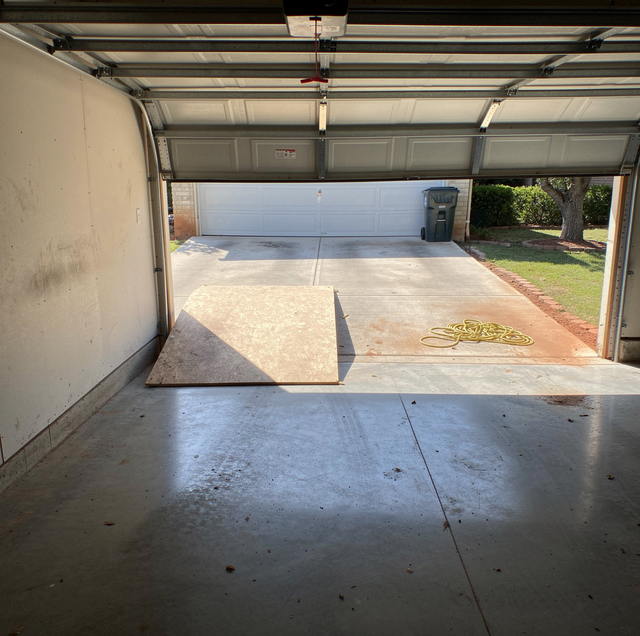
A garage door does not have to be fully closed to block the opening. A door that stops a foot or two off the floor, which happens when a track binds, a cable slips off its drum, or the opener's travel limits lose their setting, can look passable from across the garage.
What a partly open door removes is headroom. The opening itself does not narrow at all: a single-car door is normally 8 or 9 feet wide, and a double is around 16, so the jambs are never what stops anyone. The constraint is vertical, measured from the floor to the lowest edge of the door, and it must be measured against a person's seated overall height rather than the width of their equipment. Someone sitting in a power chair or on a scooter carries their head and shoulders well over four feet off the floor. A door stopped two feet up is not a low gap to duck under. It is a closed door with a view of the driveway beneath it.
A seated rider also cannot fold at the waist the way a standing person can to clear a low edge, and tipping a chair back to gain a few inches puts the rider and the equipment at risk in the same movement. Treat a partly open door as closed, whatever the gap looks like, and leave it where it stopped until someone has established why it stopped there.
Building a Second Way in Before You Need One
The failures above are hard to prevent outright. Springs age, tracks bind, sensors drift out of alignment. What a household can control is whether a failed garage door can cut off every route into and out of the house, and that is worth arranging in advance rather than during the failure.
A second accessible route matters most. A ramp or a level threshold at a side or back entrance, independent of the garage, gives the household a path that does not depend on that one door. Where that is not physically possible, an exterior keypad or a smart opener that a neighbor, family member, or caregiver can operate remotely means somebody does not have to be already standing at the house to open it.
It also helps to keep the opener's brand and model number written somewhere a caller can read it out, and to know which parts of the door have been serviced and when. Rollers, cables, and springs wear by cycle count, and a door used as a household's main entrance racks up cycles two or three times faster than one that only lets a second car out on weekends.
The households that come through this well are the ones that stopped thinking of the garage door as part of the car's routine and started thinking of it as part of the house's accessibility. That changes what maintenance means. A balance and hardware check on a door that is somebody's front entrance carries different stakes than the same check on a door that shelters a spare vehicle, and it earns a place on the calendar with everything else the household depends on.
Frequently Asked Questions
No. The photo-eye beam runs across the opening low on both tracks, a few inches off the floor, and a sensing edge sits on the bottom rail. Both act only while the door is traveling downward, reversing it before contact. Neither does anything for a door that has already stopped, and neither one is a way to hold a door open or keep a gap clear.
Many current openers support a temporary or scheduled code that expires on its own, or app-based guest access that can be revoked without changing the primary code. Older units with a single fixed keypad code cannot. Worth knowing either way: keypad codes live in the opener's logic board, so a board replacement after a surge wipes them and every code has to be reprogrammed.
Often not, and it is worth measuring before counting on it. A standard exterior service door leaf is 32 inches, and the stop plus the thickness of the open leaf takes a couple of inches off that before anyone gets through. Most also sit on a raised sill with a step outside and no landing wide enough to turn on.
If nobody is hurt, use the non-emergency line rather than 911. Say that a person and their mobility equipment are on opposite sides of a garage door that is mechanically stuck and cannot simply be lifted, whether another exterior door can be opened from outside, and how to reach the property, including a gate code and which side of the house to approach. Responders otherwise arrive expecting a door they can raise by hand.
Not quite. With a sectional door fully open, the top section and the curve of the horizontal track sit in the head of the opening, so the usable clear height is typically a few inches less than the door's nominal height. Measure to the lowest hardware hanging in the opening rather than to the header. That margin matters for a tall seated rider or a scooter with a raised seat.
Yes, and the difference is larger than it looks. A folding manual chair weighs a few tens of pounds. A powered chair or scooter with its battery pack commonly weighs several times that, and many cannot be pushed at all until a freewheel lever on the drive is disengaged. Plan around the powered case, since any plan that works for it also works for the lighter one.
Tell dispatch the garage is the accessible entrance when you call — Squared Away Garage Door Service runs Austin emergency garage door repair and the garage door spring replacement that a failed counterbalance usually needs, throughout Cedar Park and Central Texas. Call (512) 456-3781.
