

Car Trapped in the Garage by a Broken Spring: The Cord Risk
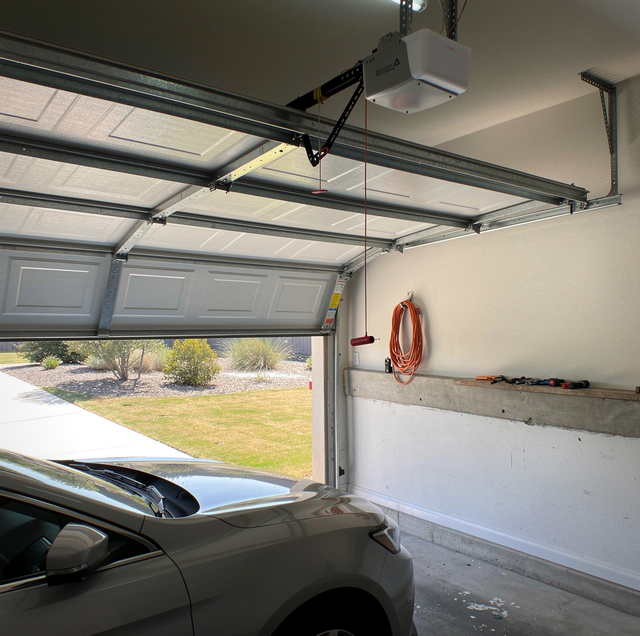
Quick Answer: A broken torsion spring removes the counterbalance that carries the door's weight. Pulling the release cord with the door part way up leaves nothing holding it up. The cord is safe only when the door is fully closed.
The red handle hangs off the carriage on a short length of rope, at about shoulder height, and until this morning it was scenery. Now the car is shut in behind a door that will not lift, and that handle is the one part of the system that looks made for exactly this.
It was put there for a situation. Just not this one. Everything the cord accomplishes rests on the door's counterbalance still working, which is the one thing a broken spring has taken away.
What the Red Handle Is Actually Connected To
Follow the rail back toward the motor, and you find two pieces most people read as one. The outer carriage rides the rail fixed to the chain or belt, and is what the motor drags back and forth. The inner carriage sits inside it and carries the J-arm, the bent steel arm bolted to the top section of the door. A spring-loaded release pin joins the two, and the rope on the red handle pulls that pin.
That is the whole mechanism. The cord withdraws one pin, separating the door from the opener. Nothing else.
Which matters here, because on a door with a broken spring the opener is often the only thing still holding it where it sits. Pulling the pin hands you a door that nothing is controlling. That pin was designed for a power outage on a healthy door, where the springs are still wound and carrying the weight.
Why a Broken Spring Leaves the Door Unheld
Above the opening, a steel shaft runs the width of the door carrying the torsion springs and a cable drum at each end. Lift cables run from those drums down to the bottom brackets at the two bottom corners. Wound springs store torque; the drums convert it into an upward pull on the cables, and that pull is very nearly equal to what the door weighs.
That is what balanced means, and it is what a technician confirms by hand on a door already known to be sound: released from the opener, a healthy sectional door left at knee height stays there, neither creeping down nor drifting up.
So the opener was never lifting the door. It supplied the small push needed to start the door moving, keep it going against the friction of the rollers and hinge, and stop it. That is why an opener is rated in horsepower fractions. Hoisting a few hundred pounds of steel was never its job. When a spring breaks, the door's mass remains unchanged, and the system carrying it has stopped. It is not heavy. It is unheld.
An opener does read resistance and reverses when it meets abnormal force, but a setting tuned for a balanced door absorbs a good deal of new resistance before it trips, which is why a snapped-spring door sometimes lifts a few inches and stops crooked.
On a two-spring door, one spring breaking does not release the other. The intact spring still holds its full torque on the shaft, and nothing about a quiet garage means the system has gone inert.
The First Second After the Pin Lets Go
If the door is part way up when the cord is pulled, the inner carriage has been holding it at that height. Withdraw the pin and the holding stops in the same instant. There is no delay to react in.
What is left resisting the door is the roller friction in the track throat and the drag of the cable on the drums. Neither is a brake. The door starts moving, follows the curve where the horizontal track turns down, and gathers speed along the vertical run.
The rope in your hand does nothing about that. It is tied to a release lever on a carriage now free to slide along the rail, with no anchor and no connection to the door's weight. Holding it only puts your arm and shoulder into the load path, along with everything else in the opening, including the front of the car.
What the Door Does to Itself in the Minutes After
The bottom section lands first and takes the impact through the two bottom brackets, stamped fittings bolted into the end stiles and sized for the steady pull of a cable. A hard landing bends one or tears its fasteners out of the stile.
The cables go slack the moment the door's weight is on the floor, and slack cable crowds out of its groove on the drum. Once out, it wraps at the wrong diameter or piles on itself, and the two sides fall out of sync, so the door travels crooked, one end stile leading the other, rollers skewing in the throat and finding the gap at the radius.
The sections are thin steel formed into a profile, and nearly all their stiffness comes from that shape rather than the metal's thickness. A crease across one takes away more than its size suggests, because the profile is what held the door flat across its width. Hinges built for straight-line load get shear instead, showing up later as elongated barrels.
What arrived as a spring replacement leaves as springs, cables, drums, a bottom bracket, a section, and track work.
Why a Fully Closed Door Is the Only Safe Starting Point
A door resting on the floor has nowhere to go. There is no height beneath it, so nothing stored there wants to move.
The closed position is the assumption the instruction is built on. The release cord is safe to use only with the door fully closed and the counterbalance intact, and it is never a way to hold a door open.
The second half of that condition is what a broken spring removes: even from the closed position, a door with no counterbalance will not go up by hand in any controlled way.
The door does not have to be near the top for this to matter. One sitting a foot off the concrete still has its full mass and a hard floor under it, and the fingers most likely to be under the bottom rail belong to whoever is helping.
What Your Real Options Are With the Car Inside
Start from the least comfortable fact: the car is a possession, and a night behind a broken door costs nothing but inconvenience.
Stop pressing the wall button. Each press asks the opener to move an unbalanced door, loading a chain, a carriage, and a J-arm against weight the springs no longer carry.
Keep people and pets out of the bay, and tell the household the door is out of service. The family member who walks in an hour from now and sees a car that needs to get out is the one most likely to reach for that cord.
When you call, say the spring is broken, and a vehicle is shut inside. That is a different call from one where a door will not close, and it is triaged differently. If a service door gets you out, use it.
A technician arriving on this secures the door in the down position before touching anything, replaces the spring set with the door held there, then checks the cables, drums, and bottom brackets, because a door that has cycled since the break has usually moved something.
The last part is worth waiting for. After new springs go on, the door is balanced by hand at several heights before the opener is reconnected, because a set that is close but not right hands that difference back to the opener for years.
Frequently Asked Questions
A broken torsion spring leaves the door sitting square and dead, with a visible gap of roughly two to three inches in the coil above the opening where the ends separated. A failed cable does the opposite: the door tips, one bottom corner sitting higher than the other, and the loose cable hangs slack down the track.
Torsion spring torque is highest with the door down and lowest with it up, so the closed position is the peak-stress point of every cycle. Add humid air, which puts fine rust pitting into the coil surface and gives a crack somewhere to start, and that is where a tired spring lets go.
Manufacturers commonly rate a standard residential spring at around 10,000 cycles, with higher-cycle springs available as an upgrade. One cycle is a trip up plus a trip back down. A household using the garage as its main entry runs four to six cycles a day, reaching that rating in well under a decade.
Normally yes, and not for the reason people assume. Both were installed the same day and have run the identical cycle count. They are also matched by wire diameter, inside diameter, and wound length, so pairing a new spring with a tired one puts an uneven twist into the shaft and pulls the two drums out of step.
The geometry differs, and the consequence is identical. Extension springs run horizontally along the tracks on each side and stretch as the door closes, rather than winding on a shaft. They should have a containment cable threaded through the center of each so a break cannot send pieces across the garage.
That is usually a roller bound in the throat of the track, or a door racked far enough that one end stile presses against the track flange. It is the one presentation where the door feels reassuringly stuck. What holds it there is friction, and friction lets go without warning. Mention the height when you call.
Call before anyone touches the release cord — a broken counterbalance with a vehicle shut inside is treated as an emergency call, and the spring set is replaced with the door secured in the down position. Squared Away Garage Door Service serves Cedar Park and Central Texas. Call (512) 456-3781.
