

Dented Garage Door Panel: Repair It or Replace It?
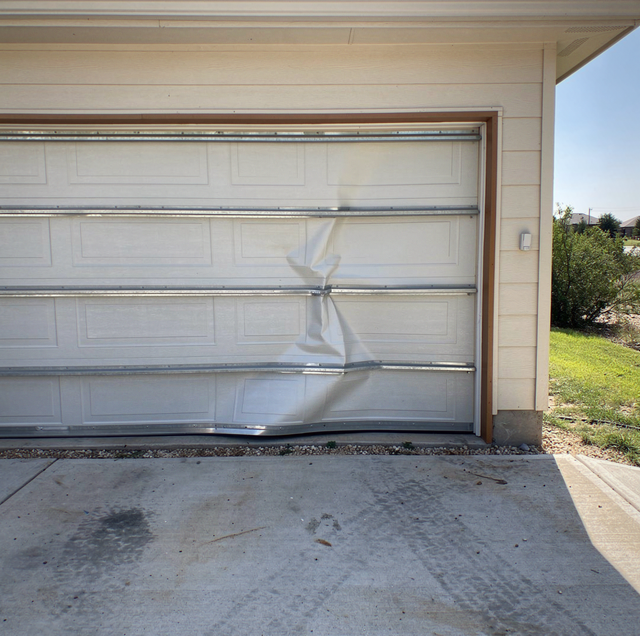
A trash can gets away from someone in a windstorm, a mirror clips the corner while backing out, or a hailstorm rolls through and leaves a pattern of shallow dimples across the top two sections. Whatever the cause, the question that follows is almost always the same: does this need a whole new door, or can the damaged section just be swapped out? The honest answer depends on more than how bad the dent looks.
How a Garage Door Panel Is Actually Built
Most residential doors, whether steel, aluminum, or a steel-and-composite combination, are built in horizontal sections stacked on top of one another, typically four sections in a standard 7-foot door. Each section is a "sandwich": an outer steel or aluminum skin, a layer of rigid foam insulation (polyurethane or polystyrene) bonded to the inside, and often a thinner steel backer skin on insulated doors. The panels are hemmed at the edges, meaning the metal is folded over itself rather than welded, and hinges bolt through pre-punched holes at set intervals to connect each section to the next and to the rollers that ride in the tracks.
That construction matters for the repair-versus-replace decision because a dent isn't just cosmetic. A shallow dent that only deforms the outer skin is very different from an impact that cracks the foam core, separates the bonded layers, or bends the section enough to throw off the hinge holes, which changes how that panel tracks against its neighbors.
What a Technician Is Actually Checking
When someone comes out to look at a dented panel, they're evaluating a handful of specific things, not just eyeballing the dent:
Depth and location of the dent: A shallow dent in the flat field of a panel is cosmetic. A dent near a hinge point, near the panel seam, or one that's creased sharply enough to show a crack line in the paint is structural, because it can affect how the section flexes as the door cycles.
Whether the foam core is exposed or compromised: If the impact broke through the outer skin, the insulation layer is exposed to moisture and temperature fluctuations, which can cause the foam to degrade or the bonded layers to separate over time, even if the dent itself doesn't get worse.
Whether the frame or hinge holes are distorted: A hard enough impact can bend the panel just enough that the hinge no longer sits flush, causing the door to shift slightly out of alignment every time it cycles, not just at the damaged spot.
How old the door is and whether the panel style is still made: Manufacturers periodically retire specific panel profiles and colors. A five-year-old door from a common line might have an exact-match replacement section available; a fifteen-year-old door might not, which means a color or texture mismatch is likely even with a successful panel swap.
Whether it's a single-panel or multi-panel door: A double-wide door often has two side-by-side sections per row rather than one continuous panel, so a dent confined to one half can sometimes be replaced without touching the matching section on the other side.
Repair (Single-Panel Replacement) vs. Full Door Replacement
| Factor | Single-Panel Replacement | Full Door Replacement |
|---|---|---|
| Best fit for | One or two sections with cosmetic to moderate dents; rest of door in good shape | Multiple panels damaged, door is older, or structural distortion is present |
| Color/texture match | Close on newer doors; can vary on older or discontinued lines | Guaranteed uniform, since the entire door is new |
| Downtime | Usually a single visit; section is unbolted and swapped | Typically a scheduled install, more involved than a panel swap |
| Impact on insulation value | Neutral if core wasn't compromised in the damaged section | Opportunity to upgrade R-value across the whole door |
| Wind-load/hardware rating | Must match the original door's rating exactly, or the assembly's rating is void | New door can be specified to current wind-load rating |
| Good long-term fit when | Door is under 8-10 years old with otherwise sound hardware | Door has multiple aging components (opener, springs, seals) nearing end of service life |
Why Panel Matching Isn't Always Simple
Replacing a single section is often a clean fix, but the hardware has to match, not just the color. A panel is only as strong as the assembly it bolts into: on a wind-load-rated door, every section, hinge, and track component is engineered together to meet a specific rating. Swapping in a generic or mismatched panel on a rated door can quietly void that rating even if it looks like a clean fix, because the replacement section wasn't tested as part of that specific assembly.
There's also a practical matching issue: paint finishes fade with UV exposure over years, so even an exact factory-match replacement panel can look slightly brighter or a shade off from its neighbors for a while. On a door with multiple panels already showing sun fade, this is worth discussing before committing to a partial repair, since the mismatch may bother some homeowners more than others.
What the Repair Visit Actually Looks Like
A single-panel swap starts by disconnecting the opener arm, allowing the door to be moved by hand without the motor fighting the technician. The hinges connecting the damaged section to the panels above and below are unbolted, as are the roller brackets that sit in the vertical tracks on each side. If the door uses torsion springs, the section is supported so it doesn't shift the balance of the rest of the door while it's detached; extension-spring doors, which run along the horizontal track instead of a shaft-mounted spring, are handled a little differently since the pulley system stays under tension the whole time.
Once the new section is bolted in with matching hinge hardware, the technician checks that the seams between it and its neighbors sit flush, that the weatherstripping between sections compresses evenly, and that the door doesn't bind or rub against the track as it cycles. A section that's even slightly out of square at the hinge line will telegraph into a rubbing sound or a slow drag within the first few weeks, so that alignment check at install time matters as much as the swap itself.
Track and roller condition: because the impact that dented the panel can also nudge a roller or slightly bend a track section, a thorough repair includes checking the rollers and track near the damaged panel, not just the panel bolts themselves. A dent that seems purely cosmetic can still leave a roller riding slightly off-center, which shows up as noise long after the visible damage is fixed.
When Hail Damage Changes the Calculation
Hail dents are often shallow and widespread rather than one deep impact, sometimes across two or three panels at once and sometimes across the whole door face. That pattern changes the math: replacing three or four individual sections is a bigger job than one panel swap, and it still leaves the door with a patchwork repair history rather than a uniform surface. This is also where working with a homeowner's insurance carrier on a storm claim often comes into play, since a widespread hail event is frequently treated as a single covered incident rather than isolated cosmetic damage.
A detail that's easy to miss: hail impacts don't always leave visible paint damage even when they've stressed the panel. A shallow, evenly spaced dimple pattern across a whole section can look purely cosmetic from the driveway but still be enough to affect how light reflects off the surface at certain angles, which is often how a widespread hail event gets spotted days or weeks after the storm rather than immediately.
Insulation and Efficiency Considerations
If the damaged section is on an older, non-insulated door, a full replacement is also an opportunity to upgrade to an insulated door, which uses a foam core between the steel skins to reduce heat transfer through the garage door itself. This matters more than people expect in a garage that shares a wall with living space, or one that gets intense summer heat, since an uninsulated steel door skin can radiate a significant amount of heat into the garage during peak afternoon sun. A single-panel repair on an otherwise non-insulated door won't change that much; it only matters when the whole door is being replaced anyway.
Frequently Asked Questions
No, and a top-section swap is usually one of the simpler panel repairs, precisely because it's closest to the header and hinges to only one neighboring panel on one side, rather than two like a middle section does. The main difference from a mid-door repair is that the technician is working closer to the torsion shaft and center bracket, so expect a quick visual check of that hardware as part of the visit even though the repair itself doesn't touch it.
On some shallow dents in solid steel without an insulation core, careful reshaping is sometimes possible, but on insulated panels the bonded foam core resists being pushed back into shape and can crack or separate from the metal skin during the attempt, which often makes the repair worse than leaving the dent alone until a proper replacement.
It can. If the dent bends the panel enough to change how it sits against its neighboring sections, the door can develop a slight bind as it travels, which the opener compensates for by working harder. Over time, that added strain shows up as premature wear on the drive gear or belt rather than as an obvious symptom at the panel itself.
A technician can typically identify the door's brand and model from a data plate, sticker, or embossed marking on the inside of one of the panels, then check current parts availability. Popular lines from manufacturers like Clopay or Amarr often stay in production or have close equivalents for many years, while smaller or discontinued lines are harder to source exact matches for.
Yes. Once the outer skin is broken through, the exposed foam core and steel backer are open to moisture, which can lead to rust forming on the backer skin over months, especially in humid conditions. What starts as a cosmetic issue can turn into a corrosion issue if it sits unaddressed through a few humid seasons.
That's a question only your door's manufacturer warranty terms can answer, since coverage language differs between brands and sometimes between product lines from the same brand. What we can control is sourcing and installing the replacement section through the appropriate channel for your door's specific model. If you want a definitive answer on how a repair affects your particular warranty, the manufacturer or your original installation paperwork is the place to check.
A dent is rarely just about looks. The real question is whether the impact stayed skin-deep or reached the structure underneath, and that's usually easier to see up close than from across the driveway.
Get a free panel damage assessment — same-day estimates, and we work directly with your insurer on storm and hail claims. Squared Away Garage Door Service serves Cedar Park and Central Texas. Call (512) 456-3781.
