

Burning Smell From a Garage Door Opener: What It Already Did
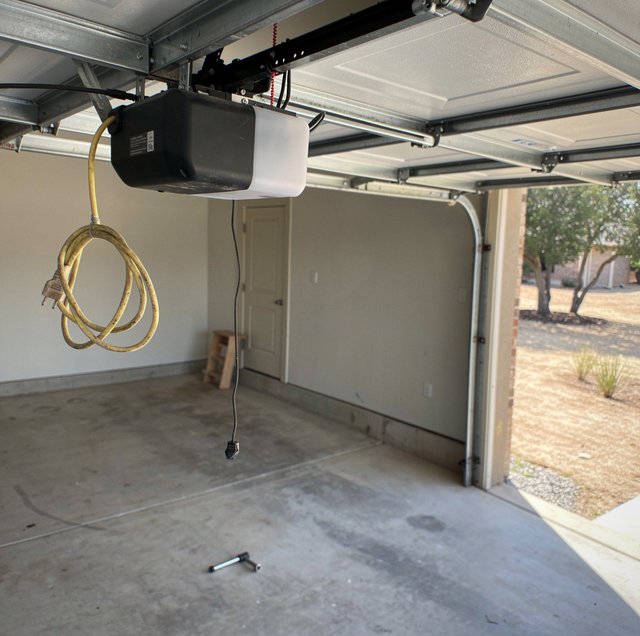
Quick Answer: Odor is the slowest signal an opener produces: the part reached its limit, changed state, and released vapor before your nose registered any of it. That is why the answer is a diagnostic visit rather than another press.
Hot plastic gives off a sweet, sharp edge. Scorched varnish is drier and more acrid, and it hangs in a closed garage long after the door is raised. Arcing has a thin metallic tang that registers at the back of the throat. Whichever is drifting down from the motor head above your garage door, the smell is information.
What You Are Actually Smelling
Odor from a motor head is material leaving a solid and entering the air. Enamel insulation on copper windings breaks down into an acrid chemical dryness. Thermoplastic softens and then chars, which reads as sweet and slightly sickly. Grease cooked past its service temperature smells scorched and faintly oily.
None of those changes reverse when the part cools.
The Heat Came First and the Smell Came After
A component has to reach its degradation temperature before it releases anything. The vapor then leaves the housing through vent slots, crosses several feet of still air in the garage, and reaches a concentration your nose can register.
Every step takes time. By the moment the smell reaches you, the overheating has been running a while and may already be finished. The odor is a poor thermometer and a good alarm: it says little about how hot something got, and it says with confidence that something got hot enough to change state.
Five Common Sources, Five Different Smells
Five things on a residential opener commonly produce a burning smell, and they smell different.
Motor winding insulation: The copper in the motor is coated in a thin enamel film that keeps adjacent turns of wire from touching. Overheat the winding, and that film scorches. The smell is dry, acrid, and persistent, lingering for days because it soaked into the windings.
The drive gear against the worm: Chain and belt openers turn a steel worm on the motor shaft against a greased nylon gear. Under high load or with spent grease, that contact runs hot; the nylon glazes, and the smell is sweet plastic.
A relay or a connector on the board: Relay contacts that switch motor current pit and roughen over thousands of cycles, and a loosened connector does the same at its terminal. Both give a sharp, metallic, faintly ozone-like smell.
The capacitor: The capacitor that helps the motor start is usually a sealed can holding an electrolyte. Age, heat, and repeated hard starts degrade it, and a failed one can vent. That smell is oily and chemically sharp, and it usually arrives with a motor that hums and struggles to start cleanly.
An over-wattage lamp in the light socket: This is the one benign candidate on the list. Opener light enclosures are rated for a modest bulb, and they trap heat, so a bulb above that rating, or a lens packed with dust, bakes the socket and the plastic around it, with no connection to the drive.
The Root Cause Is More Often Mechanical Than Electrical
The smell is thermal or electrical. The reason behind it usually is not.
A residential opener is sized to move a door; its springs are already holding up. The counterbalance carries the weight; the opener supplies direction and a modest push. When torsion springs fatigue or surface-rust in humid air, they stop returning the lift they once did. That weight lands on the opener, and every cycle after is a hard pull instead of a nudge.
Repeated hard starts are what cook a motor. A motor spinning freely draws less current than a loaded one, and a start draws more than steady running. An opener starting against a door its springs no longer counterbalance does that many times a day.
Here is the part that catches people out. Openers do sense force: an opener reads abnormal resistance during travel and reverses. So why does a heavy door not trip that protection? Because the force settings were tuned when the door was healthy, with headroom so ordinary variation does not cause nuisance reversals. A door that grows heavier slowly, over months, can consume a good deal of that headroom and still complete every cycle. The opener keeps finishing the job, and the cost of finishing it goes into the motor as heat.
What Is Happening While the Unit Cools
Most opener motors carry a thermal protector, a bimetal switch buried against the winding. When the winding passes its limit, the switch opens, and the motor stops. As it cools, the switch closes again, and the opener answers a button press as though nothing happened.
A thermal protector guards the winding and nothing else. It has no reading on the drive gear, the board, or the capacitor, so a unit that resets and runs again tells you nothing about the condition of those three.
A door that works this morning tells you the switch cooled. It says nothing about the winding. A nylon tooth that softened under load keeps whatever shape it took while hot, and a pitted relay contact carries more resistance than a clean one, so it runs hotter the next time.
What the Next Press Would Do
The next press starts from that worse baseline against the same unchanged load.
Carbonized insulation separates wire turns less reliably than the enamel it used to be, so a turn can short to its neighbor and heat faster than the winding around it. A vented capacitor makes starting harder, and harder starting drives more current back into the winding that just overheated.
There is a second cost with nothing electrical about it. A press puts a door of unknown mechanical condition into motion above a floor where people and vehicles are present, and if a fatigued counterbalance drives the sequence, that door is heavier than the system was built to support.
The unit does not get another press: not to confirm the smell, not to see whether it still runs, not to move the door first.
Where the Stop-Use Line Sits
The line sits at the smell itself. One burning odor traced to the motor head takes the opener out of service until someone qualified looks at it. No second cycle produces useful information, and no "it only smelled a little" moves the line.
A remote in a vehicle, an exterior keypad, a wall console, and a phone app are four ways to send a command. Everyone who can operate the door needs to know it is down.
If the door has to sit closed in the meantime, one limitation of the manual release holds regardless: The release cord is safe to use only with the door fully closed and the counterbalance intact, and it is never a way to hold a door open.
What a Technician Will Want to Know
The observations you already have beat anything gathered later. What the smell was like, in your words. Whether the door was moving or sitting still. Whether the opener has stopped mid-travel in recent weeks and worked again later, which is what a thermal protector cycling looks like from the floor. Whether the smell first appeared after a storm, since a surge on the incoming power can damage board components without much outward sign.
One thing to know before the visit: a technician who finds an overheated motor checks the door's balance first. Putting a new opener on a door whose counterbalance has quietly gone out of adjustment installs a healthy motor into the conditions that killed the last one.
Frequently Asked Questions
Somewhat. A chain drive runs metal-on-metal with oil, so overheating smells of hot oil and warm steel. A belt drive adds a scorched-rubber note if its belt drags against a sprocket that will not turn. A screw drive rides a lubricated threaded steel shaft, where spent grease gives a cooked-grease character.
Yes, and the door itself is the most common alternative. A roller bearing running dry, or a hinge whose barrel has worn oval, makes real heat at a small contact point and gives a hot metallic smell with nothing electrical involved. A garage holds other candidates: a freezer compressor, a dust-caked shop light.
Yes. A timer-to-close setting runs on a countdown the unit keeps to itself, so it can send a valid command hours after everyone has stopped thinking about the opener. An app carries the same risk from any distance, including from a phone whose owner never smelled the garage.
In both directions. An uninsulated garage that sits hot leaves the motor less temperature margin, so a winding under load reaches its limit sooner than it would in cooler air. Cold works against the mechanism instead: gearbox grease and rail lubricant thicken as they chill, drag rises, and the first cycles after a long idle draw harder.
Heat and combustion products rise, so an overheating motor head deposits soot on the ceiling directly above itself. That soot is the one piece of evidence visible from the floor once the smell has cleared, and it tends to move the conversation toward replacement.
Age matters less than duty. Residential openers are built for intermittent duty, short runs with time to shed heat in between, so several trips in a row on a busy evening load the motor harder than the same cycles spread across a day. A main-entry door accumulates several times the cycles of a spare bay's door, and a door whose counterbalance has been fading for a year ages its opener faster than the calendar suggests.
Stop using the opener and schedule a diagnostic visit — a technician can identify the heat source and check the counterbalance behind it before anything about the unit is decided. Squared Away Garage Door Service serves Cedar Park and Central Texas. Call (512) 456-3781.
