

Bent Garage Door Torsion Shaft: Why the Door Binds at One Spot
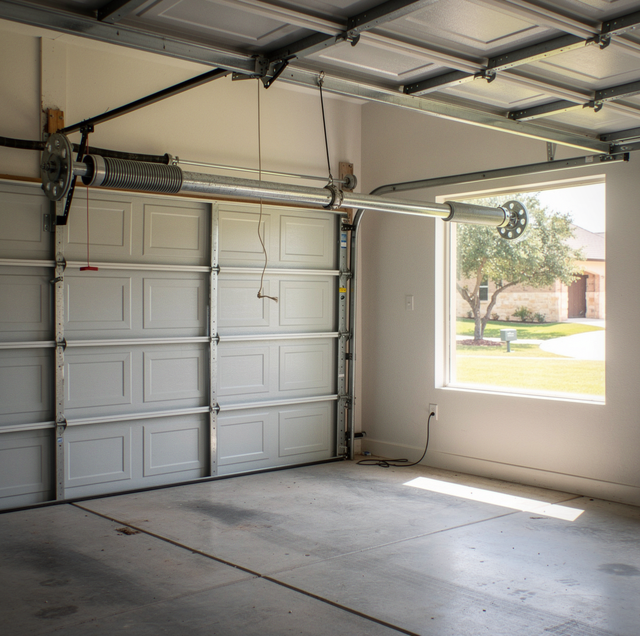
Quick Answer: A bent torsion shaft puts the cable drums out of true, so the two sides of the door take up cable unevenly and bind at a repeatable height. The tube is replaced, and the door should remain still until it is.
Somewhere around waist height, the door hesitates. It leaves the floor cleanly, finishes the last two feet without complaint, and in between there is a hitch: a scrape, a knock, a half second where the door seems to hang. The next morning it happens again at the same height, going up and coming down. A fault that lives at one position and nowhere else is a narrow clue, and on a torsion door one common explanation is the steel tube above the opening.
The Tube Above the Opening and What It Carries
Look above a sectional door, and you find a horizontal steel tube spanning the opening, carried at each end by a bearing plate and in the middle by a center bracket. The torsion springs sit on that tube, clamped at their inner ends by stationary cones and at their outer ends by winding cones. At each end of the bearing, a cable drum with a spiral groove sits, and a lift cable runs from it down to the bottom bracket on the matching side of the door.
Lifting happens at the cables. The tube's whole contribution is torque: the springs unwind against it and deliver that turning effort to both drums in the same instant. Two drums locked to one shaft cannot take up cable at different rates, which is what holds the two sides of the door within a fraction of an inch of each other. Manufacturers commonly supply a galvanized tube an inch or an inch and a quarter across for standard residential doors, and a heavier tube or solid shaft for wide or heavy doors, often in two lengths joined by a coupler.
Three Geometries That Have to Hold
For that arrangement to work, the tube has to satisfy three conditions at once. It has to be straight along its length. It has to be round in section where a drum hub, a spring cone or a coupler clamps onto it. And it has to run true in its bearings, turning about its own axis. Lose one and the other two stop mattering.
Straight: What Puts a Bow in a Steel Tube
Thin-wall tube bends long before it breaks, so a bowed shaft is far more common than a snapped one. The usual causes share a shape: a sideways load applied to a part built only to twist.
- A door driven against something that will not yield: a slide lock left thrown, a bar across the track, a frame shifted enough for the door to bind on the jamb.
- A section coming down onto an obstruction: a bin, a bicycle, a raised tailgate. The door stops on one side while the springs keep turning the tube and the free side keeps winding.
- An impact at the bottom of the door traveling up a cable: a strike on a bottom corner puts a hard pull into the lift cable, whose only anchor at the top is the drum on the end of the tube.
- A coupler letting go on a two-piece shaft: once one half can rotate independently, the two halves work against each other across the joint, and the joint is where the tube gives.
Round: Where the Section Stops Being a Circle
Every hub that grips the shaft does it with set screws biting into the tube wall, leaving dimples. That much is intended. The wall flattening around one of those seats is not, and it happens where a drum has been shock-loaded or a hub re-tightened onto old dimples at a different clock position.
A shaft that is dead straight but oval at a drum seat behaves downstream much like a bent one. The drum rocks a few thousandths on its seat as it turns, and the groove presents the cable at a radius other than the one it was cut for. A worn coupler seat does the same.
True: Running Straight in the Bearings
Cable loads react at the ends of the shaft, so the two end bearing plates take the pull of the door's weight while the center bracket handles the springs' anchor load. One out of true sweeps a small circle, and the wobble shows up as a rhythmic tick that rises and falls with the door.
Bearings make this worse both ways. Humid air rusts a bearing that has gone dry, and one that has stopped turning becomes a fixed rubbing point on a moving tube, a bow in the making. A tube already bowed chews a good bearing out of round in turn.
The shaft carries the springs' stored energy at every door position, including fully closed. Nothing clamped to it comes apart safely until that tension is managed, which is why a bent tube is not a wait-and-see repair.
What the Drums Do With a Shaft That Wanders
A cable drum takes up a fixed length of cable per revolution because the groove is a helix of fixed radius. Change that radius, or the angle at which the cable leaves the groove, and the arithmetic changes. A bend puts one drum out of position while the other sits closer to where it belongs.
The door starts to rack. One end stile climbs slightly ahead of the other, and the difference accumulates through the travel. Rollers stop entering the throat of the track square and begin loading their stems sideways. On the low side, the cable can go slack enough to crowd out of its groove. The flag brackets and the track's curve then absorb loads that should have gone down a cable, which is how a shaft problem becomes a track problem.
Why It Happens at the Same Height Every Time
Shaft rotation and door height are geared to each other through the drums, so a given angle of the tube always corresponds to a given position of the door, every cycle, both directions. A defect fixed in the tube's geometry arrives at the same place in the travel every time.
Two places concentrate that error. One is the curve where the vertical track turns into the horizontal, where a roller arriving out of square has nowhere to go, and the hitch is usually loud enough to hear. The other is low in the travel, where torsion torque is at its maximum with the door down, so a tube that flexes will flex most there. A hitch that stays put at one height while the door gets slower around it is the pattern worth acting on.
What the Bend Is a Record Of
A shaft does not bow on its own. Whatever loaded it sideways usually left other marks: a creased bottom section, a bottom bracket drawn out of the end stile, a flag bracket working loose, a drum sitting on set screw dimples that no longer line up. A new tube dropped into an unexamined system inherits the geometry that ruined the old one.
A door with a bent shaft still has fully wound springs behind it and a counterbalance no longer sharing the load evenly across the opening. The release cord is safe to use only with the door fully closed and the counterbalance intact, and it is never a way to hold a door open.
Frequently Asked Questions
Replacement is the normal answer. Tube stock comes in standard lengths and is cut to the width of the opening, so a new shaft is sized to your door and not matched to the damaged one. Straightening leaves residual stress in the wall, and the old set screw dimples stop lining up with anything.
Not automatically, though they come off the tube either way, since the cones clamp to it. Manufacturers commonly rate a standard residential torsion spring at around 10,000 cycles, so one well into that range is often addressed while everything is apart. A spring that absorbed the same impact can show uneven coil spacing.
With the door down, the floor and the bottom seal act as a reference, hiding small differences between the sides. Racking shows only once both bottom corners are free of the slab. Expansive clay soil complicates it: a slab that has moved can leave the opening out of level, so the door can be square while the frame is not.
A coupler joint is standard on wide openings and says nothing on its own about the shaft's condition. The joint normally sits at the center bracket, where the tube is supported and the springs anchor, rather than out toward a drum where cable load reacts. What matters is that the two halves stay clocked to each other, so both drums present the same angle at the same moment. Coupler set screws get checked at a tune-up for that reason.
Standing still, a bow of a fraction of an inch across a sixteen-foot span is invisible. It shows when the tube rotates, because the drum faces and spring cones sweep visibly off center against whatever sits fixed behind them, the header or the center bracket. A phone video played back slowly shows a wobble the eye smooths out at full speed.
Not by putting a bow in the tube. A galvanized shaft is normally cut to length on site, leaving bare steel at the cut ends where corrosion can start. A film on the open span between brackets is cosmetic; corrosion under a drum hub or a cone changes the dimension a clamped fit depends on. End bearings are replaceable parts rather than items serviced in place, so they go out with the tube instead of being cleaned up and reused.
Have the shaft, drums, springs, and end bearings inspected before the door runs again — a bent tube changes how the whole counterbalance loads, and it does not improve with use. Squared Away Garage Door Service serves Cedar Park and Central Texas. Call (512) 456-3781.
