

Electric Car Trapped in the Garage: What the Charger Changes
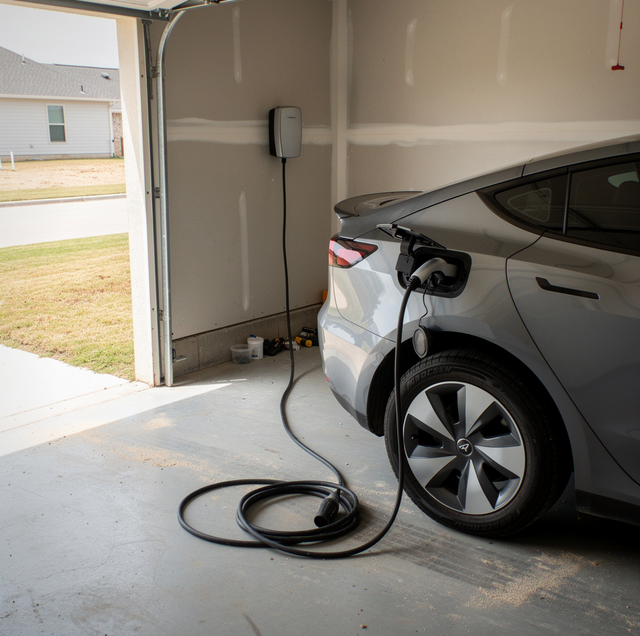
Quick Answer: An EV behind a stuck garage door adds one step before anything else: disconnect the charging cable the normal way and coil it back to the wall unit, so the floor is clear before a technician arrives.
The morning starts the way it always does. You get in, wake the car, and check the range on the dash out of habit before you reach for the opener button. The door has moved for you hundreds of mornings without a thought. This time it stops six inches up, or doesn't move at all, and you're sitting in a vehicle that is still wired to the wall behind you.
The Cable Is Still Connected to the Car
A stuck door is inconvenient for any driver. An EV owner has one more thing to handle first: the charging cable running from the wall unit to the car's charge port. That connection comes out the normal way, the same disconnect you would do at the end of any charge, before anyone tries to move the car.
Don't try to inch the car forward with the cable still attached: The connector latches into the charge port, and pulling against that latch puts the whole load on the port housing and on the cord's strain relief. Free the connector properly first.
Where the Cord Run Sits on the Floor
Once it is out of the car, the cable stops being an electrical question and becomes a physical one. A home charging cord is heavy, stiff, and long enough to loop, and where it lands on the slab depends on which side of the car the charge port is on. A port on the corner facing the door puts the run across the strip of floor between the front of the vehicle and the opening. A port at the rear or on the far side keeps it behind the car, but across the path anyone walks to a side entrance.
That strip of floor just inside the opening is the one piece of the garage a garage door technician actually has to have. It holds the feet of a ladder, a length of track laid down while it is swapped, spring hardware, a parts bag, and the technician's own footing. A loop of charging cable on the concrete is a trip hazard in exactly that spot, in a space darker than usual because the door isn't open. Coiling the cord back onto the holster on the wall unit takes a few seconds and settles it.
A Vehicle No One Can Push Clear
With a lighter car on a flat slab, two people can sometimes shift it in neutral far enough to matter. An EV takes that option off the table. The high-voltage battery pack sits under the car's floor and runs most of the length of the wheelbase, and it commonly puts an electric model several hundred pounds above the gas version of the same size. The weight is the whole story here. A vehicle that heavy, on a slab with any slope at all, gets away from two people the moment it starts rolling.
Do not try to push, roll, or winch the vehicle toward a door that has stopped partway. A door in that state has an unknown counterbalance behind it, and nobody should move anything beneath it.
There is a shortcut people reach for at about this point: pulling the door's emergency release and lifting the panel by hand. The release cord is safe to use only with the door fully closed and the counterbalance intact, and it is never a way to hold a door open.
The Wall Unit, the Conduit, and the Ladder
A wall-mounted charging station goes where the car parks, which in most garages means a side wall a few feet in from the opening, mounted at roughly waist to chest height, with conduit running from it toward a panel. The door's own hardware lives somewhere else: the spring anchor bracket is centered on the header directly above the opening, and the flag brackets and vertical tracks run up the jambs on either side of it. What the charger crowds is the floor and the wall space a technician has to stand and work in.
That is worth saying on the phone. What matters for a ladder set beside a charging installation is whether the conduit is strapped to the wall surface, where a rail can dent it or pull a strap loose, or buried behind the drywall, and whether the cable holster hangs at head height on the same wall. Point the run out on arrival if a cover plate hides it.
Any electrical work on the charging unit itself, from a tripped breaker to a loose connection, sits outside a garage door repair; that call goes to a licensed electrician, not the technician working on the door. What a door repair can plan around is the physical work near it: ladder placement, hardware removal, and panel handling that avoids a fixed obstacle.
One Vehicle and One Charger, Both Shut In
A household running on a single EV has one vehicle and one charging point, and on a morning like this, both are behind the same door. There is no second car in the driveway to take instead. The car cannot be pushed out, and it cannot be towed out either, because a tow truck needs the same opening the door is currently occupying.
Two things are worth establishing before that morning arrives. The first is whether the garage has a walk-in side entrance, because a person can leave through it long after a car can no longer. The second is that the vehicle is usually in better shape than it feels: a car shut in overnight has been charging the whole time it was stuck, so range is rarely what has gone wrong. It is the door standing between the car and the street.
How the Visit Goes When the Car Cannot Move
Most of a garage door repair happens above and around a parked car. Spring and cable work happens at the header and along the shaft above the opening, roller and track work runs up the jambs, and panel work happens at the opening itself. A car in its usual spot, a few feet back from the door, is normally clear of all of it, and a technician told in advance that an EV and a wall unit are in there can plan the approach before a ladder comes off the truck.
What changes in the vehicle is the order. The door has to move before the car can, so the visit runs that way: make the door safe and get it moving, let the car out, then leave anything that needs the wall the charger is on for last, with the bay empty.
One thing is worth settling while you wait: where the car goes once it is out. The apron directly in front of the door is where a ladder, a section of track, and a spread of hardware end up for the rest of the work, so the far end of the driveway or the street keeps the vehicle clear of the job that just freed it.
Frequently Asked Questions
No. The connector's locking pin secures the cable to the charge port and has nothing to do with the vehicle's door locks, parking brake, or transmission park setting. Unplugging frees the cable and leaves every other system on the car exactly where it was.
Yes, in park with the parking brake set and no one seated inside while anyone is on a ladder or handling overhead hardware. If a charge session was still running when the door stopped, end that session as you normally would before pulling the connector, so the wall unit doesn't attempt to restart while people step around the vehicle.
Yes, provided nobody tries to move the car. A home charging station is built to run unattended for hours, and a mechanical door fault has no electrical path to it. The session also ends automatically once the car reaches its set limit, so a long wait does not mean a long charge.
Stop using that cord and leave it unplugged. Crush damage to a charging cable happens inside the jacket, where a visual check will not find it, and a cord that looks intact can still have a damaged conductor or a compromised ground path. Inspection and replacement belong to a licensed electrician or the equipment's manufacturer, and neither is part of a garage door repair.
It depends on which circuits are wired to it. A backup covering only part of the house, kitchen outlets or lighting, may not include the garage door opener's circuit. A whole-home system that does cover it will run the opener through an outage. The piece aimed squarely at this problem is a battery backup built into the opener itself, which keeps the door working when the house has no power, and it is worth asking about separately. None of it helps a door stopped by a broken spring or a bound track.
Almost never. A charging station on a side wall sits clear of the jamb tracks, the header, and the torsion shaft, where door hardware actually lives. The exception is a wall-mount opener that sits beside the door on the torsion shaft instead of hanging from the ceiling, bringing a motor and its mounting onto a wall a charger may already share. Relocating a charging unit is an electrician's job, scheduled separately.
Schedule emergency garage door service — get the door open safely without disturbing the charging setup or the vehicle parked behind it. Squared Away Garage Door Service serves Cedar Park and Central Texas. Call (512) 456-3781.
