
Garage Door Won’t Open? What to Do When Locked Out
A garage door that ignores both the remote and the wall button doesn't necessarily mean a major repair is needed. Before assuming the worst, and before reaching for a tool that could turn a minor issue into a bigger one, there's a short list of things worth checking yourself, and an equally short list you should leave alone entirely.
Start With What's Actually Powering the Door
The first thing to rule out is the simplest: does the opener have power at all? Check the outlet the opener plugs into, and check the breaker panel for a tripped circuit, which sometimes happens after a storm or a brief power surge. If the opener's motor unit has no lights on and makes no sound when you press the button, a dead outlet or a tripped breaker is worth ruling out before assuming a mechanical failure.
If the opener has power but the remote isn't working, try the wall-mounted control button directly. A remote with a dead battery, or one that's lost its pairing with the opener's receiver after a power blip, is a common and easy-to-miss cause, and it's worth testing the wall button before assuming something bigger is wrong.
Check for a Blinking Light or Error Code
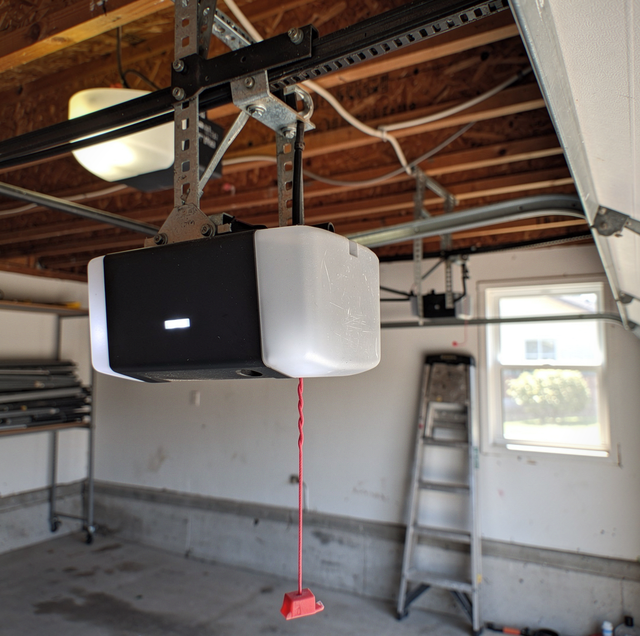
Most modern openers have a small LED on the motor unit that blinks a specific pattern when it detects a fault, whether that's a sensor misalignment, an obstruction, or a travel-limit problem. The number of blinks usually corresponds to a specific issue listed in the opener's manual or on a label inside the unit's housing. This is worth checking before calling anyone, since it can immediately point to whether the problem is the safety sensors near the floor, an obstruction the door is sensing, or something with the motor itself.
Check the Safety Sensors
If the door reverses immediately after starting to close, or refuses to close at all, the photo-eye safety sensors mounted a few inches above the floor on each side of the track are a likely cause. These sensors have to be aimed at each other precisely; if one has been bumped, if a spider web or dust has built up on the lens, or if direct sunlight is hitting one of them at a certain time of day, the door can refuse to close as a safety measure even though nothing is mechanically wrong. Wiping the lenses with a soft cloth and confirming that both sensor lights are steady, not blinking, is a quick check anyone can do.
What the Manual Release Cord Actually Does
Every opener-equipped garage door has a manual release, usually a red handle hanging from a cord near the trolley that rides along the ceiling-mounted rail. Pulling it disconnects the door from the opener's carriage, letting the door move by hand independent of the motor. This is the intended way to open a door manually during a power outage or opener malfunction, but it comes with an important caveat: it only works safely if the spring system is intact.
If a spring has already broken, which often makes itself known with a loud bang, the door has zero counterbalance assistance once disconnected from the opener, meaning it can be extremely heavy or, on some setups, could drop suddenly rather than staying in place. If you've heard a bang, seen a visibly broken spring, or the door feels unusually heavy the moment you try to lift it manually, stop and don't force it further. That's a call for professional help rather than a manual-release situation.
Locked Out From the Outside
If the issue is being unable to get into the garage from outside rather than the door not moving at all, most openers with an exterior keypad have a reset or programming issue as the likely culprit rather than a mechanical fault, particularly if the keypad's backlight or display looks dim, which often signals a battery that needs replacing. Some doors also have an exterior emergency release, a lock cylinder with a cable that pulls the same internal release the interior cord does, meant specifically for situations like a power outage combined with no other way into the house.
What Not to Try on Your Own
A few things are worth explicitly avoiding rather than attempting as quick fixes:
Don't force a door that's stuck partway: If the door stops halfway and won't continue in either direction, forcing it with the opener or by hand risks bending a track, snapping a cable already under strain, or dislodging a roller further.
Don't disconnect or adjust the springs: Torsion springs store enough energy to cause serious injury if released incorrectly, and this isn't a job most homeowners can do with the tools they have on hand.
Don't ignore a grinding or scraping sound and keep cycling the door: If the door is making an unusual sound as it moves, whether from a bent track, a broken roller, or something rubbing that shouldn't be, repeatedly cycling it to "see if it works" often turns a repairable problem into a bigger one.
Don't assume the sensors are the problem and bypass or disconnect them: Some manuals describe a way to run the opener without the safety sensors connected; this removes an important safety feature meant to prevent the door from closing on a person, pet, or object, and isn't a recommended workaround even temporarily.
When It's a True Emergency vs. a Wait-and-Schedule Situation
A door that's fully closed and simply won't open, with the car needed immediately, or a door stuck halfway open leaving the home insecure, both qualify as urgent enough for same-day or emergency service rather than waiting. A door that opens and closes fine but makes a new noise, or one that's slightly slower than usual, can typically wait for a scheduled appointment rather than an emergency call. The distinguishing factor is usually whether the door, in its current state, leaves the home insecure, traps a vehicle, or shows a sign (a bang, a snapped cable, a door that won't stay in one position) of an active structural failure rather than a nuisance issue.
Frequently Asked Questions
Generally yes, as a first check to see whether the door moves freely, but treat it as a test rather than a way to force the door the rest of the way if it resists. Lift evenly from the center rather than pulling up on one side, since tugging at an angle on a door that's already fighting back is a common way to bend a track or pop a roller loose. If it rises smoothly to about waist height and stays there on its own, that's actually a decent sign the springs are fine; if it slides back down or feels heavy at any point, stop and treat it as a spring or cable issue rather than an opener issue.
This often points to a stripped drive gear inside the opener's motor housing, a plastic or nylon component that wears down over years of use and eventually spins without engaging the belt or chain. It's a distinct problem from a track or spring issue, since the door itself is mechanically fine; the opener simply can't transfer motion to it anymore.
This is usually a battery issue rather than a range or interference issue, since a weakening remote battery often has just enough charge to work at close range but not enough to transmit reliably from farther away. It's worth swapping the battery before assuming a receiver or antenna problem.
Yes. Some openers have thermal overload protection in the motor that temporarily shuts the unit down if it overheats, which can happen during repeated cycling on an especially hot day in an unventilated garage. The opener typically resumes working on its own after cooling for a period, unlike a hardware failure.
Not necessarily. An exterior keypad usually operates on its own battery and communicates wirelessly with the opener's receiver, separate from the household power that runs the motor. A dead keypad battery or a lost programming code is a common, isolated cause that doesn't affect the wall control or handheld remote at all.
A door that's stuck usually still sits properly within the tracks but has hit an obstruction, a sensor fault, or a jammed component. A door that's actually off track has one or more rollers that have popped out of the track channel entirely, which usually shows as a visible gap or an angled section of the door rather than the door simply refusing to move.
Most lockouts trace back to something small and easy to overlook: a dead remote battery, a dusty sensor lens, a tripped breaker. The rare ones that don't, the kind tied to a spring or a cable, are worth handing off to someone who deals with them every day instead of troubleshooting under time pressure.
Call for emergency, same-day garage door service — available 24/7. Squared Away Garage Door Service serves Cedar Park and Central Texas. Call (512) 456-3781.
