

Frayed Garage Door Cable: How Dangerous Is It Really?
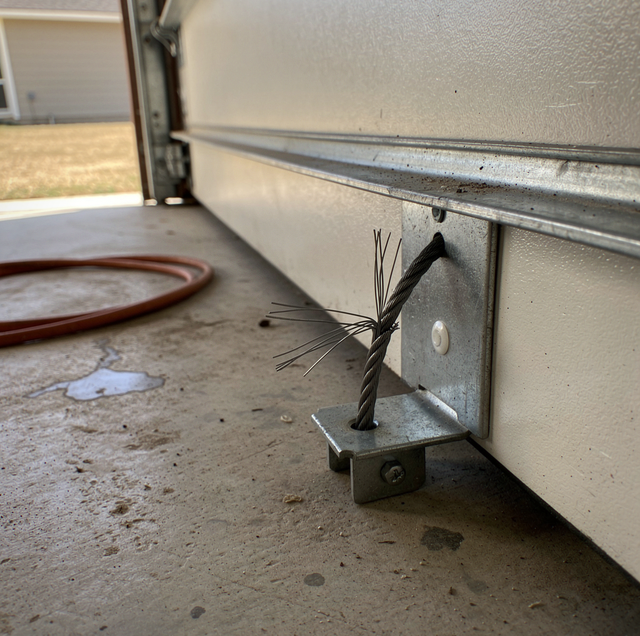
A garage door that hangs crooked on one side, paired with a faint metallic ticking as it travels, isn't always a hinge or a roller problem. Just as often, it's the lift cable starting to fail, and unlike most garage door wear, a fraying cable is one of the few issues that calls for a stop-using-it-today response instead of a get-to-it-this-weekend one.
What the Lift Cable Actually Does
A standard sectional garage door doesn't lift itself. The torsion spring (or springs) mounted above the door stores the energy needed to counterbalance the door's weight, and that energy transfers to the door through two braided steel cables, one on each side. Each cable is wound around a grooved cable drum attached to the spring shaft. As the shaft turns, the drum reels the cable in or lets it out, raising or lowering that side of the door in sync with the other.
The cable itself is thin, usually a 7x19 or 7x7 strand galvanized aircraft cable about 1/8 inch in diameter, but it's carrying a real load. On a typical double-car steel door, each cable can be under 150 to 200 pounds of tension when the door is at rest, more when the door is in motion. It isn't a decorative attachment. It's a structural component that does the same job as a suspension cable on a bridge, just at a much smaller scale.
Why Cables Fray in the First Place
Cable failure is almost never random. A few mechanisms drive it:
Rust and corrosion: Humidity and condensation inside the garage attack the zinc coating on the cable strands over time. Once rust reaches the steel core, individual strands weaken and start to snap, even though the cable still looks intact from a few feet away.
Drum wear or misalignment: The cable drum has a machined groove that the cable is supposed to sit in cleanly. If the drum shifts on the shaft, loosens, or wears unevenly, the cable rides against a rough edge on every cycle and shears strand by strand.
Bottom bracket wear: The cable terminates at the bottom bracket, a stamped steel fitting bolted to the bottom corner of the door. This bracket holds tremendous spring tension and is not something to loosen or remove yourself. Rust or a bent bracket here creates a sharp edge that saws into the cable with every open and close.
High cycle count: A garage that doubles as the main entry to the house might see the door cycle eight, ten, or more times a day. More cycles simply means more friction events over the cable's life, so wear that would take a decade in a side-entry garage can show up in half that time.
The Warning Signs Worth Acting On
A cable rarely fails without giving some notice first, even if the notice is subtle:
- The door hangs crooked, noticeably higher on one side than the other, especially when it's partway open.
- A popping, snapping, or grinding sound near the bottom corners as the door travels.
- Visible strand separation, sometimes called "birdcaging," where individual wire strands splay outward from the main cable body instead of lying flat and twisted together.
- Slack in the cable when the door is closed, instead of the cable staying taut against the drum.
- The door drops suddenly partway through a cycle, even a few inches, before continuing or stopping.
Any one of these on its own is worth a service call. More than one at once means the cable's remaining margin is thin.
Why a Frayed Cable Is a Safety Issue, Not Just a Wear Issue
When a lift cable lets go completely, it doesn't fail gently. The side of the door still attached to its cable stays supported; the side that lost its cable drops on its own weight, which can twist the door sideways in the tracks, bend a panel, or pop a hinge loose. A door that's several hundred pounds coming down unevenly can crack a windshield, damage a parked car's roof, or injure anyone standing underneath or reaching for the door at that moment. The cable itself can also whip when it releases from the drum under tension, posing a real laceration risk to the hands and face.
There's a second, quieter risk: a fraying cable changes how the door balances. As one cable weakens, the opener motor compensates by working harder on that side, which puts extra strain on the trolley, the drive gear, and eventually the logic board that controls the motor. What looks like "just a cable problem" can turn into an opener replacement if it's left running for weeks.
What Not to Do
Don't keep opening and closing the door "carefully" once you've spotted fraying, and don't try to replace the cable yourself. The spring above the cable is still under full tension, and releasing or re-tensioning it requires specific winding bars and a working knowledge of how many quarter-turns the spring needs, not a wrench and a guess. This is one of the most common sources of serious hand and eye injuries in home DIY repair, and it's also why professional technicians replace cables as a matched pair rather than patching one side.
If the door is currently stuck in an open or partially open position and the cable is visibly frayed or broken, leave it alone rather than forcing it down. Block the opening if kids or pets have access to the garage, and call for service instead of working around it.
What a Professional Repair Actually Involves
A technician responding to a cable call will typically clamp the door in place first, using locking pliers on the track above a roller so the door can't shift while the spring is released. From there, winding bars are used to unwind the torsion spring in controlled quarter-turn increments until all stored tension is gone. Only then is it safe to remove the drums, inspect them for wear or a shifted groove, and replace both cables, not just the frayed one, since the other cable has typically absorbed a similar cycle count and similar wear even if it hasn't shown symptoms yet.
After the new cables are installed and seated correctly in the drum grooves, the spring gets re-tensioned to the door's correct lift weight, and the technician checks balance by disconnecting the opener and manually lifting the door to roughly waist height. A properly balanced door should stay put rather than slide open or fall shut on its own. That balance check matters because a cable replacement done without re-verifying balance can leave the opener over-stressed even with brand-new cables.
Frequently Asked Questions
No. Leave the door exactly where it is and don't attempt to secure or prop it yourself. A frayed cable sits under a torsion spring that's still fully loaded, and the remaining good strands can shift or break without warning, even while the door looks perfectly still, so there's no clamp or brace a homeowner can safely add near the tracks or springs. Call for professional service instead. A technician carries the winding bars and stabilizing tools to secure the door and release spring tension safely before touching the cable, which a pair of pliers or a makeshift brace can't substitute for.
Most residential lift cables are rated for roughly the same cycle life as the torsion spring they're paired with, commonly around 10,000 cycles, which works out to somewhere between seven and twelve years for an average household. Homes where the garage is the primary entry point often see that shortened by several years because of the added daily cycles.
A broken spring usually makes a loud bang, often mistaken for a gunshot, and the door becomes too heavy to lift by hand at all, even with the opener disconnected. A fraying cable is quieter, tends to show up as a crooked or uneven door rather than a dead-weight door, and often gives visible warning (birdcaging strands, slack cable) before it fully lets go.
That depends entirely on the specific policy, and it isn't something we're in a position to interpret on a homeowner's behalf. Policies differ in how they classify sudden mechanical damage versus gradual wear, so if a cable failure damaged a vehicle or other property, your carrier is the right source for whether that particular event is covered.
Wear timing is the main reason, not convenience. A cable that hasn't started fraying yet but has seen the same cycle count as its failed twin is close enough to the same failure point that leaving it in place often just delays a second service call, sometimes by months rather than years. There's also a balance factor: pairing a brand-new cable with one that's already slightly stretched from years of tension can leave the door settling a touch unevenly when it's fully closed, which is one of the things a technician checks during the post-repair balance test.
Sometimes. If a cable is fraying at the same spot repeatedly rather than showing general wear, that often points to a bent bottom bracket, a shifted drum, or a track that's slightly out of alignment and rubbing the cable against an edge it shouldn't touch. A technician checking the cable will usually check those points as well, since replacing the cable alone won't fix a fraying pattern that keeps recurring.
A healthy cable doesn't ask for attention; it just stays taut, quiet, and out of sight cycle after cycle. The moment it starts making noise or letting one side of the door hang low, that's the signal to stop using the door and get it looked at, not to wait and see how many more cycles it has left.
Schedule a cable inspection — same-day appointments available for cable and spring repairs. Squared Away Garage Door Service serves Cedar Park and Central Texas. Call (512) 456-3781.
