
Emergency Key Release Won’t Work? Locked Out of a Detached Garage
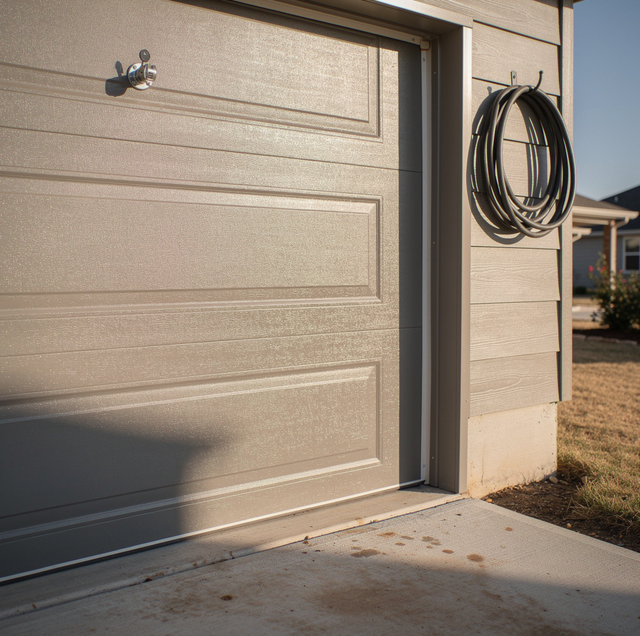
The keyed cylinder on the outside of a garage door is a release for the opener. It carries no bolt, holds nothing shut, and moves no part of the door itself. Its single job is to disconnect the opener's carriage from the drive chain or belt from outside the building, on a garage where nobody can walk in and pull the interior release cord by hand. That distinction stays academic until the hardware fails. When the cylinder seizes, the cable behind it stretches loose, or the key turns, and nothing happens at the other end, the person standing in the driveway isn't locked out of a lock — they're locked out of a building with no second entrance.
Quick Answer: This lock only disconnects the opener's trolley from outside; it isn't a house-style lock and doesn't open the door itself. A stuck, snapped, or unlinked release needs a technician, not force.
What the Key Release Actually Moves
The hardware itself is small: a keyed lock cylinder mounted through the face of the top section, near the middle of the door where it lines up with the opener rail behind it. A short cable runs from the back of that cylinder to the carriage riding that rail, the same one the interior release cord disconnects. Turning the key pulls the cable, which pulls a release lever, and the inner carriage that holds the door arm separates from the outer carriage that rides the chain or belt. That is the entire function. Once the carriage is released, the door is only as easy to move as its springs and rollers allow, the same as it would be for anyone reaching the interior cord by hand.
It sits in a keyway and takes a key, so it gets handled like a lock: turn it, and the door should open. Turning it opens nothing, working or seized. A jammed cylinder and a slack cable produce the same result from the driveway, whether the real fault sits in the lock or in the cable. Each needs a different fix, and neither is something the key can force through.
Why the Cylinder Is an Accessory and Not Standard Equipment
An attached garage almost never carries this cylinder. If the opener quits there, the interior door to the house is still the way in: walk through, reach the emergency cord, and release the carriage by hand. The exterior key release is built for the structure where that interior path does not exist, and it runs out through the face of the sectional door itself. The manufacturer's answer is to extend that same release cable to a cylinder mounted through the door, so a disconnect otherwise reachable only from inside can be reached from the driveway.
That is also why it is sold as an accessory rather than included by default. A chain- or belt-drive opener ships ready to accept one, but the cylinder, cable, and mounting hardware are added at installation for garages that are actually detached. A door never fitted with one has no partial version waiting to be found, so whether it is there is worth settling in daylight.
The Different Ways the Release Fails
- A seized cylinder: The key goes in but won't turn, or turns a few degrees and stops solid. A house lock gets worked and lubricated by daily use; this one can sit untouched for years between install and the night it is needed.
- A stretched or detached cable: The key turns freely, with no resistance and no click, because the cable to the carriage has stretched, slipped off its mounting clip, or parted at the crimped end. Nothing happens at the opener because nothing is pulling on it.
- A snapped key: What's left in the keyway is a broken stub, with the rest of the key in your hand and the cylinder jammed by the broken piece.
- A corroded lock body: The key resists at the point of insertion or won't seat fully, and there's visible rust or pitting around the face of the cylinder. Humidity and years of exposure do this to an exterior lock even when the rest of the door is sound.
- A release that pulls but doesn't disengage: The key turns, and the cable moves, but the inner carriage stays coupled to the outer one anyway. That points to a linkage problem at the carriage end, and it is the one failure mode that looks, from outside, exactly like success.
Why Forcing It Turns One Problem Into Two
All five failure modes produce the same result: the key does nothing and the door won't move. Prying at the door edge, forcing the cylinder, or leaning on the panel to spring it loose all read as the fastest option from that side. Each one adds a second repair on top of the first: a pried section face bends the steel skin, a forced cylinder tears out the mounting hole it sits in, and either one leaves a technician working around fresh damage instead of simply replacing the release hardware. Sectional steel doors do not flex back to flat once a corner has been bent; that panel gets swapped.
The steadier move, however unsatisfying it feels outside a building you can't get into, is to leave the hardware alone. Whatever failed at the cylinder or the cable has a mechanical fix, on site.
What Changes When the Power Also Goes Out
A related situation covers a garage that is structurally fine but has lost power: a feed gone dead, or a breaker at the house tripped and taken the garage's circuit with it. The opener has nothing to run on. For a garage with a key release in good order, this is the scenario the hardware was added for. Turning the key disengages the trolley the same way it would during an opener failure. What the door does after that depends entirely on the state of its springs, which nobody can establish from the driveway. The release cord is safe to use only with the door fully closed and the counterbalance intact, and it is never a way to hold a door open.
That option disappears the moment the release itself is also broken. A seized cylinder or a parted cable doesn't care whether the opener has power; either way, the carriage stays coupled, and the door stays where it is. That overlap is why a household relying on a single detached structure with no second entrance has more riding on this one piece of hardware than an attached garage ever does. An interior door does not disappear during a power outage, and here the mechanical release is the only thing standing in for it.
What to Have in Place Before It Fails
A few things are worth settling before any of this happens, rather than during it:
- Know whether the opener has a battery backup unit installed. That covers a power outage, but it is a separate system from the mechanical key release and won't help if the release itself has seized or the cable has failed.
- Keep more than one cut key, and keep at least one somewhere other than inside the garage it opens, with a household member rather than on the ring carrying the only house key.
- Have the cylinder and cable checked at a routine service visit. Sitting unused for long stretches makes wear and early seizing easy to miss, and the driveway at night is where that gets discovered.
- Treat a smart opener accessory as an addition to the mechanical release, not a replacement. A phone-based option depends on the same power and network conditions that the mechanical release is designed to work around.
Frequently Asked Questions
No. It ships with its own key blank from the opener manufacturer, and that blank is not one a locksmith can cut to match the house's other locks. The household ends up carrying a key that opens nothing else, so it tends to live apart from the ring everyone actually keeps on them.
Yes. It's sold as an add-on kit compatible with most chain- and belt-drive residential openers, and it goes onto an existing door without replacing either. What shapes the job is the top section itself: a strut running across it, a row of window inserts, or an insulated section built from two steel skins around a foam core all affect where the housing can land and how long a cylinder body the install calls for.
Then the fault is usually at the carriage end. The release pin joining the inner carriage to the outer one can gall or bend enough that it won't clear its seat even when the cable pulls all the way, and a rail knocked out of line does the same. The tell is that the cable goes visibly slack at the lock while the door arm never drops.
No. A technician can normally replace the cylinder working from the outside of the section, without pulling the panel. The panel only has to come off when the housing has bent the surrounding steel, which happens with corroded or forced failures, not with an ordinary seized lock. The replacement usually arrives as a matched cylinder and cable set, so the old key retires with it and every copy in the household is replaced at the same visit.
Only if it actually opens and can be reached without a ladder, and most cannot. Glazing set into a garage door section is not an opening at all: it is fixed into the panel at the factory, with no sash, no hinge, and nothing to unlatch. A window in the side wall of the structure is worth a look, though it is often painted shut or blocked by shelving.
Manufacturers commonly recommend exercising it a couple of times a year, separate from any opener maintenance, specifically because it is a mechanism that can sit untouched for long stretches and seize without any other symptoms appearing first.
Schedule an inspection of the key release and trolley connection — a technician can free a seized cylinder, replace a stretched cable, or reset a release that isn't disengaging, without damaging the door. Detached-garage owners shut out overnight can start with urgent garage door help in Austin, with the same call-out reaching after-hours door service in Round Rock. Squared Away Garage Door Service serves Cedar Park and Central Texas. Call (512) 456-3781.
